
Why Abandoned Carts Stay Abandoned Without AI Voice Calling (2026)
Why ecommerce stores struggle to recover abandoned carts with email and SMS alone, and how AI voice calling answers the objections that stop the purchase.
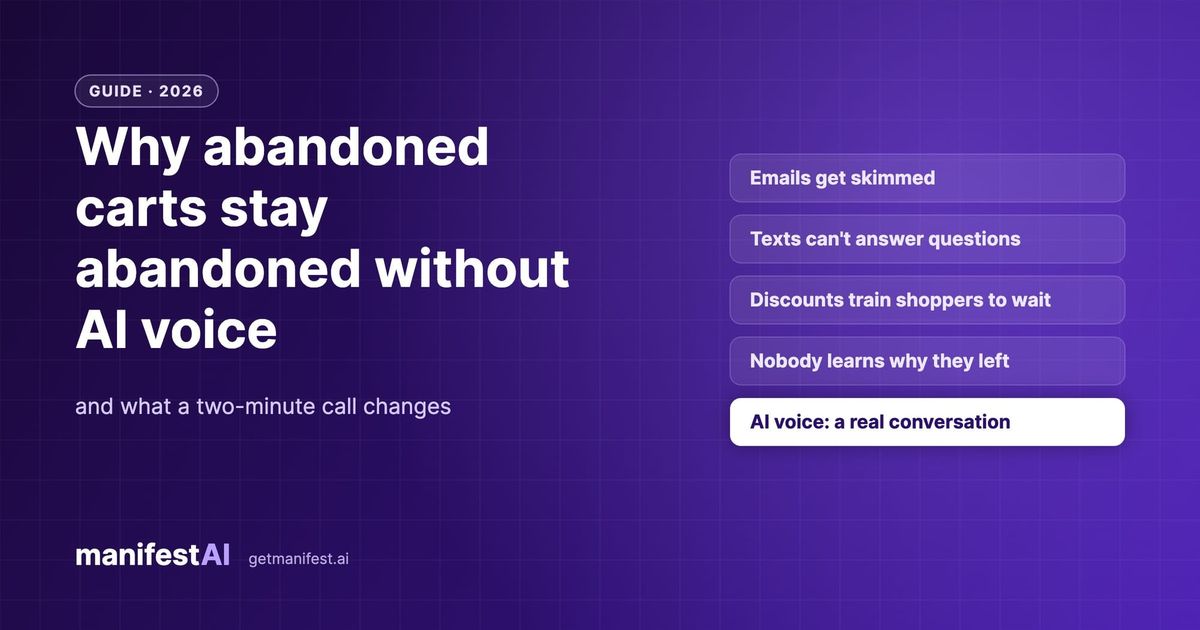
Ecommerce stores struggle with abandoned carts without AI voice calling because their recovery tools are one-way. Emails and texts can remind a shopper about the cart, but they cannot answer the question that stopped the purchase: what delivery will cost, whether it arrives in time, whether the size is right, or how returns work. Most abandonment comes from exactly these doubts, so reminders get ignored and discounts become the only lever. An AI voice agent calls the shopper within minutes, talks through the objection, and sends a payment link while they are still on the line.

How big is the abandoned cart problem?
Baymard Institute's benchmark puts the average documented online cart abandonment rate at 70.22%, across 50 studies. Many of those shoppers were only browsing, but Baymard's checkout research shows a large share leave for reasons that can be fixed:
| Reason for abandoning at checkout | Share of shoppers | Can a conversation fix it? |
|---|---|---|
| Extra costs too high (shipping, tax, fees) | 40% | Often: explain costs, point to free-shipping thresholds or an allowed offer |
| Delivery was too slow | 20% | Often: confirm real delivery dates and faster options |
| Didn't trust the site with card details | 19% | Often: a human-sounding call builds trust; offer COD or another payment method |
| Site wanted an account | 18% | Yes: send a direct payment link |
| Returns policy wasn't satisfactory | 13% | Yes: explain the actual policy clearly |
| Couldn't see total cost up front | 12% | Yes: state the total on the call |
Source: Baymard Institute, cart abandonment rate statistics (shoppers could select multiple reasons).
Losing carts that one call could save? Manifest AI Voice calls open carts within minutes, answers objections and sends a payment link during the call.
Why email and SMS recovery hit a ceiling
- They can't answer questions. A reminder email says "you left something behind". It doesn't tell the shopper whether the jacket runs small or if it arrives before Saturday.
- They compete in a crowded inbox. Recovery emails land next to dozens of other promotions, and many are skimmed or never opened.
- They lean on discounts. When the only tool is a message, the default fix is a coupon. Over time, shoppers learn to abandon carts and wait for the code, which erodes margin.
- They don't tell you why. A non-click is silent. You never learn whether price, delivery or trust lost the sale, so you can't fix the root cause on your site.
- High-value carts get the same treatment as low-value ones. A £15 cart and a £900 cart receive the same three emails, even though the larger one deserves a conversation.
What AI voice calling changes
Stores have always known that a phone call recovers more high-intent carts than an email, but calling every abandoned checkout with a human team doesn't scale. AI voice agents remove that constraint. Here is how it works in Manifest AI:
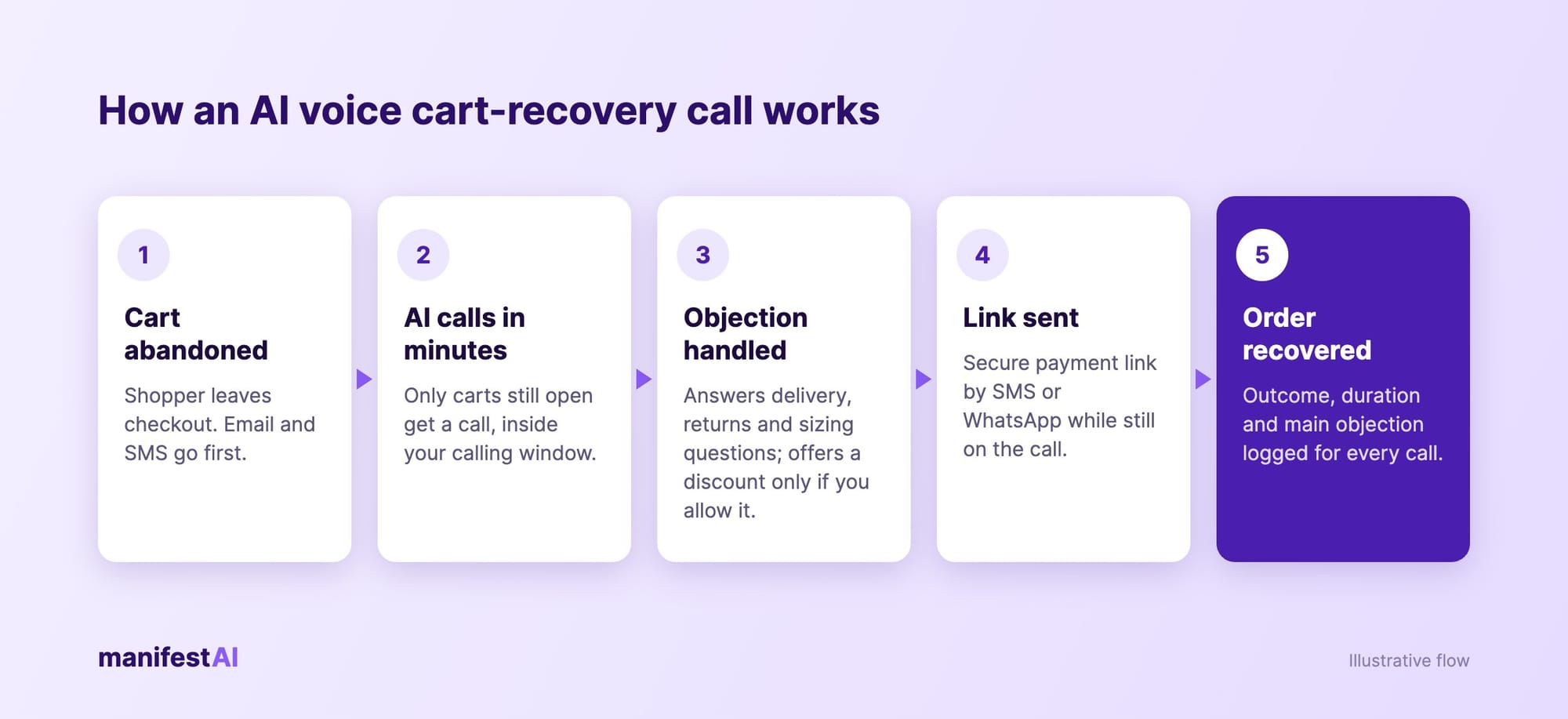
- Fast, but not first. Email and SMS go out first. The AI calls only carts that are still open, a few minutes after abandonment, inside the calling window you set.
- A real conversation. The agent introduces itself by name in your brand's tone and answers questions about delivery, shipping costs, returns and products using your policies.
- Controlled offers. It offers a discount only if you enable it, and never above your maximum, so discounts become a last resort, not a reflex.
- Closes on the call. It can update the delivery address and send a secure payment link by SMS or WhatsApp while the shopper is still on the line. Where you offer cash on delivery, it can place COD orders.
- Learns why shoppers leave. Every call is recorded and logged with its outcome and the main objection, so you can fix pricing, delivery or policy pages too.
- Polite retries. Missed calls retry twice, five minutes apart, then reschedule once.
Setup takes about 10 to 15 minutes once Manifest AI is connected: choose a voice, name and personality, pick your pitch strategy and decide which shoppers to call. Pricing is pay-per-use on call seconds, with no fixed fee for voice. For a detailed comparison with email and SMS tools, read Manifest AI Voice vs Klaviyo vs Attentive for cart recovery.
When AI voice calling makes sense
- Considered purchases: furniture, mattresses, electronics, jewellery and other higher-ticket items where shoppers have questions.
- Fit and sizing categories: apparel, lingerie and footwear, where doubt about size is a common blocker.
- COD-heavy markets: where a quick call confirms intent and moves shoppers to prepaid.
- Brands that already run email, SMS and WhatsApp flows and want to recover the carts those channels miss.
It is less useful for very low-value impulse carts, where the economics of any outreach are thin. Start with a cart-value threshold and widen it once you see results. WhatsApp remains a strong first channel, too; see our guide to WhatsApp abandoned cart recovery.
See what your brand could automate. Our team builds the agents for you, and most brands are live in about 2 weeks.
Consent and compliance
Voice calls are regulated. In the US, AI-generated voice calls fall under the Telephone Consumer Protection Act, and in 2024 the FCC confirmed that they require the consumer's prior consent. Other countries have their own rules on marketing calls and data protection. Before switching on AI calling:
- Collect clear consent at checkout for calls about the order.
- Honour opt-outs immediately and keep a record.
- Limit calls to sensible hours with a defined calling window.
- Check your setup with legal counsel for every market you call.
How to measure whether AI voice works for your store
- Answer rate: share of calls that connect.
- Recovered orders and revenue: orders placed during or shortly after a call, compared with a holdout group that gets only email and SMS.
- Discount rate on recovered orders: to make sure you are recovering carts without simply buying them back.
- Top objections: the reasons logged on calls, fed back into your product pages and policies.
80%+ of tickets automated, or your money back. That's the Manifest AI guarantee, written into your contract.
FAQ
Why do ecommerce stores struggle with abandoned carts?
Most abandonment comes from unanswered doubts such as extra costs, delivery speed, trust and returns. Email and SMS reminders cannot answer those questions, so they recover only a small share of carts and often rely on discounts.
Does AI voice calling work better than abandoned cart emails?
It does a different job. Emails remind; an AI voice agent holds a conversation, handles objections and sends a payment link in real time. The best results come from using voice after email and SMS, for carts that are still open.
Is it legal to call shoppers who abandon their carts?
It can be, with the right consent. In the US, AI voice calls require prior consent under the TCPA. Collect consent at checkout, honour opt-outs and confirm your setup with legal counsel for each market.
Will an AI voice agent give away discounts?
Only if you allow it. In Manifest AI you choose whether a discount can be offered and set the maximum, and you can lead with your USP, product value or returns policy instead.
How quickly does the AI call after a cart is abandoned?
You set the delay. Most stores call within minutes, while purchase intent is still high, and after email or SMS has had a chance to work.
See an AI voice agent recover a cart on your store. Book a demo of Manifest AI.