
Anveshan Wanted Customers to Talk Back. BIK Made It Happen.
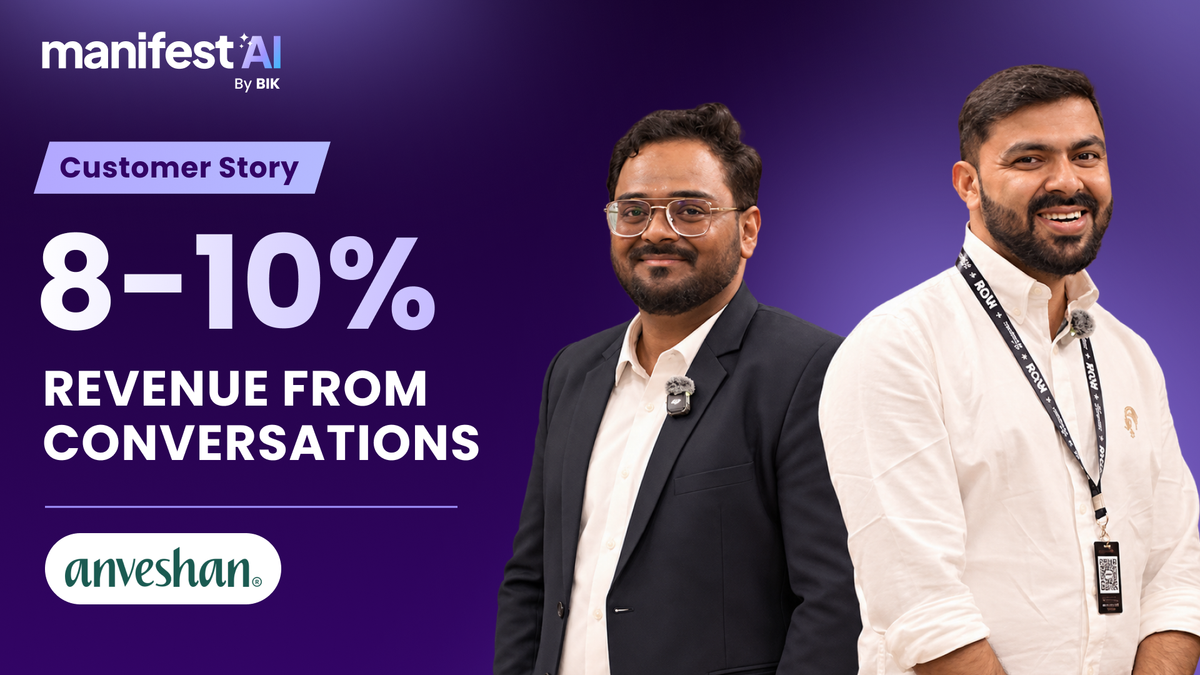
Anveshan checked five retention platforms and found none with real two-way messaging. Now 8 to 10% of its revenue comes from conversations on BIK.
Most retention tools are built to talk at people. You send a broadcast, a journey message goes out, and that's the end of it. Whatever the customer thinks about it never makes it back to the brand.
Jitendra from Anveshan got tired of that. He wanted a tool that could listen.
The problem with one-way messaging
Anveshan had been using the usual CRM and retention tools. They did the sending part fine. The gap was on the other side. Customers had opinions, questions and sometimes a clear wish to buy, and the tools had no good place for any of it to land.
So Anveshan went looking for a partner. Jitendra says they checked the top five players in the industry, and none of them offered real two-way communication. What they wanted was simple to describe: send a message to a customer, and let the customer answer. Maybe with feedback. Maybe with a question for the team about the product or how it's made. Maybe with "yes, I'll take it."
Most of these retention tools are one-way. You send a broadcast or a journey message, and the voice of the customer never reaches the brand.
BIK was the one that offered that.
What two-way conversations changed
Roughly 8 to 10% of Anveshan's revenue now comes from these conversations. The team sends a message, the customer replies with the intent to purchase, and the sale happens right there in the thread.
Almost 8 to 10% of our revenue comes from these conversations.
That number is the headline, but Jitendra pointed to a second benefit just as quickly. The same channel has become one of Anveshan's best sources of feedback. Customers tell them how delivery went, how the online purchase felt, whether they liked the product or didn't. It arrives unprompted, in the customer's own words.
His summary: two-way communication is the key thing BIK delivers.
Working with the BIK team
The second thing Jitendra wanted to get across was the people. And he was clear that he wasn't saying it because a camera was on.
We literally love the BIK team.
Anveshan has worked with a lot of partners, so he has plenty to compare against. What stands out is that the BIK team treats a brand's problem as its own. If a custom development is needed, they build it. No ifs and buts.
The same goes for the less glamorous moments. When Anveshan's own team changes and new people need to get up to speed, BIK steps in and walks them through the product feature by feature, including what's worth using first for their situation.
Jitendra described the relationship as a loop. As Anveshan grows, BIK grows, and as BIK builds new things, Anveshan gets more to work with. He called it a two-way process, which is a fitting echo of the product itself.
From our side, feedback like this is what shapes what we build next. We're glad to be part of Anveshan's growth, and we plan to keep earning the spot.


