
.png)
LIVE AMA- How Halo Collar Built a $100M Brand?
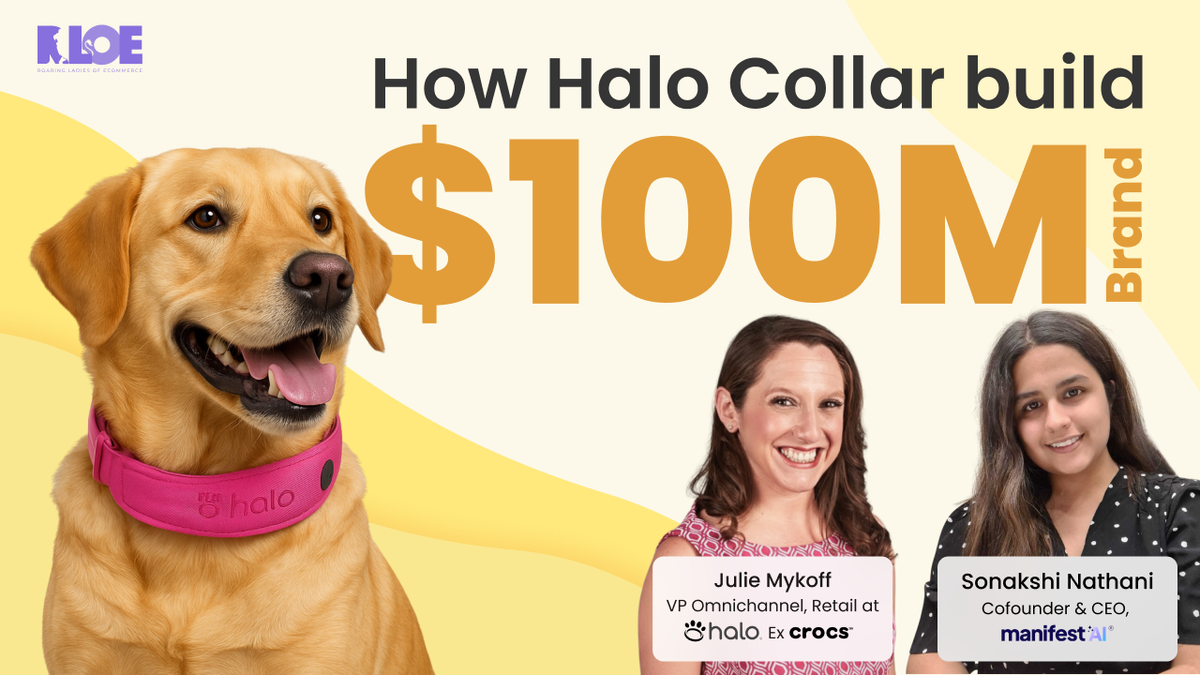
Welcome to our 9th AMA session featuring Julie Mykoff, VP of Omnichannel at Halo Collar, as we dive into “How Halo Collar Built a $100M Brand? ”
A Roaring Ladies of E-commerce Ask Me Anything Session.
Hosted by Sonakshi Nathani, Founder & CEO of Manifest AI & Creator of RLOE.
Quick context
RLOE hosts monthly AMAs for women in e-commerce. In this session, Sonakshi speaks with Julie about her career journey, building an omnichannel strategy for an innovative hardware+subscription product, marketplace strategy (Amazon, Chewy, more), audience targeting, and BFCM strategies & advice for women leaders.
About Manifest AI & RLOE
This AMA was sponsored by Manifest AI, an AI shopping-assistant platform helping e-commerce brands boost conversion and reduce support tickets. Also launched the World's first AI Commerce Agents Marketplace, a marketplace of 100+ AI agents, also a platform to build your own.
Every month, we host AMA sessions for our Roaring Ladies of eCommerce (RLOE) community, a global women’s eCommerce network of 700+ members from top brands and agencies like Glossier, Glamnetic, Liquid Death, Steve Madden, VaynerMedia, H&M, Sol de Janeiro, Sephora, and Skims.
It is one of the most active and valuable communities in the eCommerce space.
The Conversation (Q&A) between Julie & Sonakshi
Q1. Sonakshi: Julie, welcome! Before we dive into omnichannel, tell us about your journey. What shaped your career and got you to where you are today?
Julie: Like many people here, I come from very humble beginnings. I didn’t go to a fancy college, I had no connections in the industry—I simply knew I wanted to work in retail and merchandising.
A fun story: my grandparents owned a little shoe shop, and I used to help them pick kids’ shoes for the store. That experience gave me an early buyer mindset, and it stuck.
I started my career on the retail floor. Anyone who has worked in stores knows how humbling that is, but it gives invaluable perspective. You see customer behavior firsthand—it’s not just numbers on a dashboard.
Over the years, I worked across stores, merchandising, ecommerce, and digital marketplaces. And now, in omnichannel, those worlds all come together. Consumers move fluidly between platforms, devices, and physical spaces. Our job is to show up where they are—not force them into a funnel that only fits us.
I’ve always approached my career with one mindset: never say never. Don’t dismiss opportunities because they don’t look perfect. The best roles in my life were the ones I didn’t expect.
Q2. Sonakshi: How do you think about omnichannel when the product requires customer education?
Julie: It starts with empathy: Where is the customer, and how do they like to shop?
Omnichannel for a “new tech” product looks very different from omnichannel for a utility product everyone already understands.
For example, Halo Collar replaces the need for a physical fence. It tracks your dog's location, provides containment boundaries, and even delivers health metrics—almost like a Fitbit or Oura Ring for dogs.
So the way we show up on Amazon is different from TikTok, which is different from our DTC site, which is different again from an outdoor retailer.
The brand message must stay consistent, but the education format changes.
Someone on TikTok might need a fast, visual “what is Halo?”
Someone on Amazon might be searching for GPS or containment products already.
Someone in a home improvement store might be looking for alternatives to building a fence.
Omnichannel is personalization across platforms without losing brand identity.
Q3. Sonakshi: Which omnichannel channels matter most for Halo today?
Julie: Since we don’t have Halo stores, our channels focus on where our customer naturally shops:
- Home improvement — for customers replacing traditional fencing.
- Outdoor retailers — hikers, campers, and suburban families who want tracking + safety.
- Pet specialty — the obvious one.
- Digital marketplaces — especially Amazon, which remains a discovery powerhouse.
We see huge value in showing up in all relevant customer environments, even if they convert somewhere else later.
Q4. Sonakshi: When customers find Halo on Amazon, how do they typically discover the product? Through keywords or recommendations?
Julie: Right now, more through search-based discovery, especially around terms like GPS, containment, and smart pet tech.
But we’re shifting toward a full-funnel approach, because Amazon’s traffic is far larger than ours. Many customers don’t even know this kind of product exists, so our job is to reach those people—not just the ones already searching for us.
Q5. Sonakshi: Who is your target audience - just dog owners or more specific segments?
Julie: A bit of both.
We focus on people actively searching for:
- GPS tracking
- Containment systems
- Smart/AI-integrated pet tech
But we’re expanding into lifestyle segments like:
- New movers (setting up a new home)
- New dog owners (signals: crates, puppy pads, training items)
- Outdoor and hiking enthusiasts
The goal is to reach people at the moment of need.
Q6. Sonakshi: If a brand wants to double its omnichannel revenue on a small budget, what top strategies would you recommend?
Julie:
- Choose the right industries, not just the biggest ones.
Your price point and product type should guide which retailers you approach. - Analyze retailer footprints & marketing capabilities.
Where will your product actually get visibility? - Look for consumer behavior overlaps.
For Halo, we discovered two-thirds of fitness tracker wearers also have dogs.
That insight helped us identify new store formats.
And most importantly:
Don’t assume something won’t work because a competitor hasn’t done it.
Maybe they simply missed the opportunity.
Q7. Sonakshi: How do you personally evaluate whether to enter a new channel, especially one your competitors haven’t touched?
Julie: I live by this philosophy:
“Just because something didn’t work before doesn’t mean it won't work now.”
Maybe the timing was wrong.
Maybe the positioning was wrong.
Maybe the economics were wrong.
Everything is a learning.
If a retailer says, “We tried this with someone else and it didn’t work,” I respond:
“Great. Let’s discuss what could make it work now.”
Innovation comes from experimentation, not imitation.
Q8. Sonakshi: The most awaited question: How are you approaching BFCM this year?
Julie: Our BFCM strategy this year is completely different from past years.
We made last-minute changes because we unlocked new Amazon capabilities, which opened up entirely new levers for us. The key was aligning pricing and experience across all partners so nothing cannibalizes anything else.
A few key tips:
- Start with supply chain and planning.
People underestimate how critical inventory and fulfillment are. - Create a lead-in → peak → lead-out structure.
We’re running an offer before BFCM, a special offer during the 4 peak days, and a continued (but lighter) offer into December. - Match delivery expectations.
We built U.S.-based fulfillment so we can ship as fast as Amazon Prime—essential for holiday shopping.
BFCM isn’t just discounting.
It’s timing + experience + operational excellence.
Q9. Sonakshi: Before we close, what is one piece of advice you’d give to all the women listening today?
Julie: Being a woman in business isn’t always easy. Many of us start without connections, resources, or a clear path. I certainly did.
My biggest advice is:
Believe in yourself more than the world doubts you.
Layoffs, rejections, harsh feedback—they’ll happen.
That doesn’t diminish your intelligence or capability.
If an idea gets shut down, it doesn’t mean it was a bad idea.
It may simply have been the wrong audience.
Find people who lift you up.
Let go of the ones who don’t.
And never let someone else’s ego convince you to shrink yourself.
Closing Note
This AMA was sponsored by Manifest AI, the AI shopping assistant helping Shopify and DTC brands increase conversions, improve customer experience, and reduce support load.
Julie is available inside the RLOE Slack community for follow-up questions.
Stay tuned for next month’s AMA with another inspiring leader from the eCommerce world.
If you want to watch the full AMA video, here it is:
