.png)
Manifest AI vs Yuma AI: Which AI Agent Fits Your Ecommerce Brand?
Yuma AI automates post-purchase tickets inside your helpdesk, priced per resolution. Manifest AI is one no-code agent that sells and supports across web, WhatsApp, Instagram and email. Here is how they compare and who each fits.

Manifest AI and Yuma AI are both AI agent platforms built for ecommerce, but they solve different problems. Yuma AI is a support automation layer that resolves post-purchase tickets inside your existing helpdesk, priced per resolved ticket. Manifest AI is an omnichannel platform where one no-code agent both sells and supports across your website, WhatsApp, Instagram and email, starting at $500/month.
Manifest AI is our product; we've tried to represent every tool fairly. Yuma details were checked on yuma.ai in October 2026.
Quick comparison
| Manifest AI | Yuma AI | |
|---|---|---|
| Core focus | One AI agent that sells and supports | Automating customer service tickets |
| Builder | Agent Studio, no-code | Setup included with dedicated account management |
| Channels | Website, WhatsApp, Instagram, email, post-purchase, AI voice calling | Helpdesk tickets (email), website chat, Facebook and Instagram |
| Sales features | Product discovery, recommendations, upsell, cart recovery, AI search | Sales AI on-site Q&A widget (add-on) |
| Helpdesk | Own omnichannel inbox with automated routing and closure | Works on top of Gorgias, Zendesk, Kustomer, Gladly, Re:amaze, Salesforce |
| Ecommerce platforms | Shopify, WooCommerce, BigCommerce and custom storefronts via API | Shopify, WooCommerce, Magento, BigCommerce |
| Marketing | Campaign Manager for WhatsApp, email, SMS, Instagram | Not a focus |
| Pricing model | From $500/month, flexible tiers, startup plan | Pay per fully resolved ticket, annual plans |
| Trial | Free trial | First 30 days free |
| Best for | Brands wanting revenue plus support across channels | High-volume brands automating tickets in their helpdesk |
What is Yuma AI?
Yuma AI describes itself as an agentic AI platform for ecommerce customer service. Its core product, Support AI, resolves post-purchase tickets such as returns, refunds, cancellations and subscription changes. It connects to the helpdesk you already use (Gorgias, Zendesk, Kustomer, Gladly, Re:amaze or Salesforce Service Cloud) and to ecommerce and ops tools including Shopify, WooCommerce, Magento, BigCommerce, Recharge, Loop Returns, ShipStation, Klaviyo and Yotpo.
Yuma also offers Sales AI (an on-site widget for product questions), Social AI for Facebook and Instagram, Chat AI for website support, and "Ask Yuma," which analyzes tickets to surface automation opportunities. Yuma's site claims automation of up to 89% of conversations.
Where Yuma is strong
- Deep post-purchase automation with actions in returns, subscriptions and shipping tools.
- Broad helpdesk support, so you keep your current agent workflows.
- Outcome-based pricing: you only pay when a ticket is fully resolved with no human involvement.
- Support across several ecommerce platforms, not only Shopify.
What is Manifest AI?
Manifest AI is an agentic AI platform for ecommerce and retail brands. With Agent Studio, teams build their own AI agents without code and deploy them on the storefront as an AI shopping assistant, on WhatsApp, Instagram and email, and in post-purchase flows such as order status, returns and WISMO.
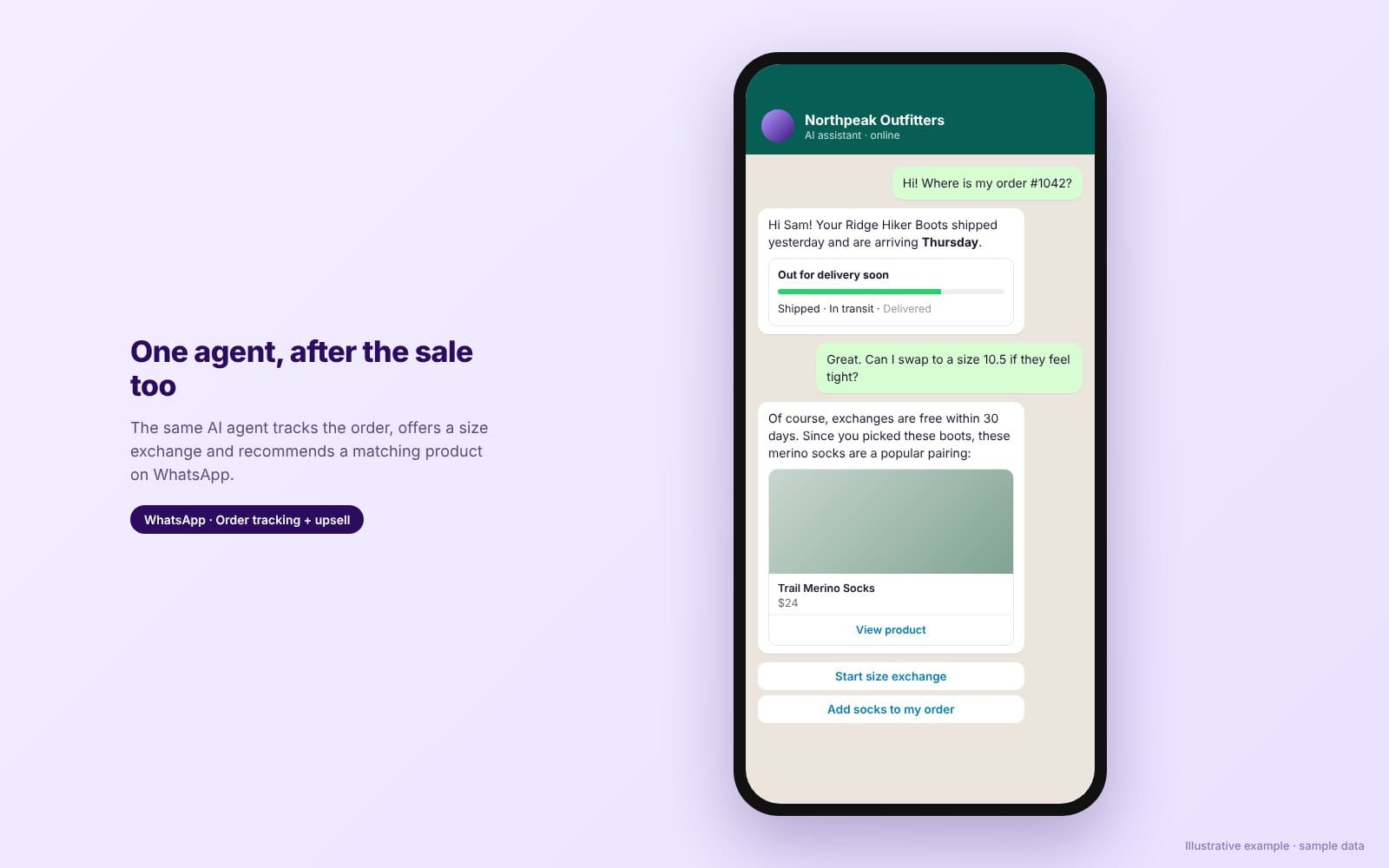
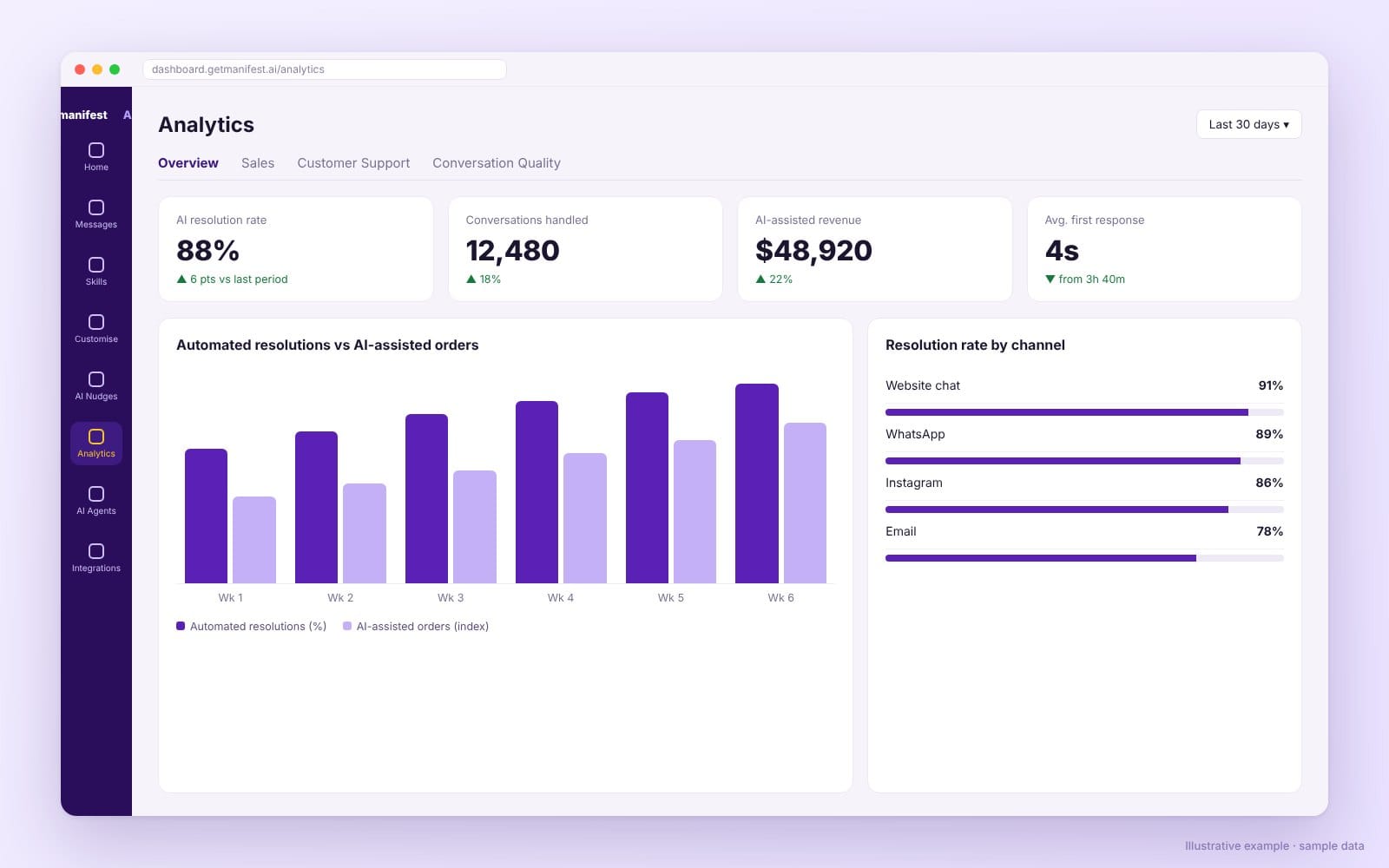
The same agent handles both sides of the customer journey. Before purchase, it helps shoppers discover products, recommends items and upsells, and recovers abandoned carts. After purchase, it answers FAQs, tracks orders and handles returns. Brands report up to 90% ticket automation, and the company reports conversion rate improvements of 20-45% from its AI shopping assistant.
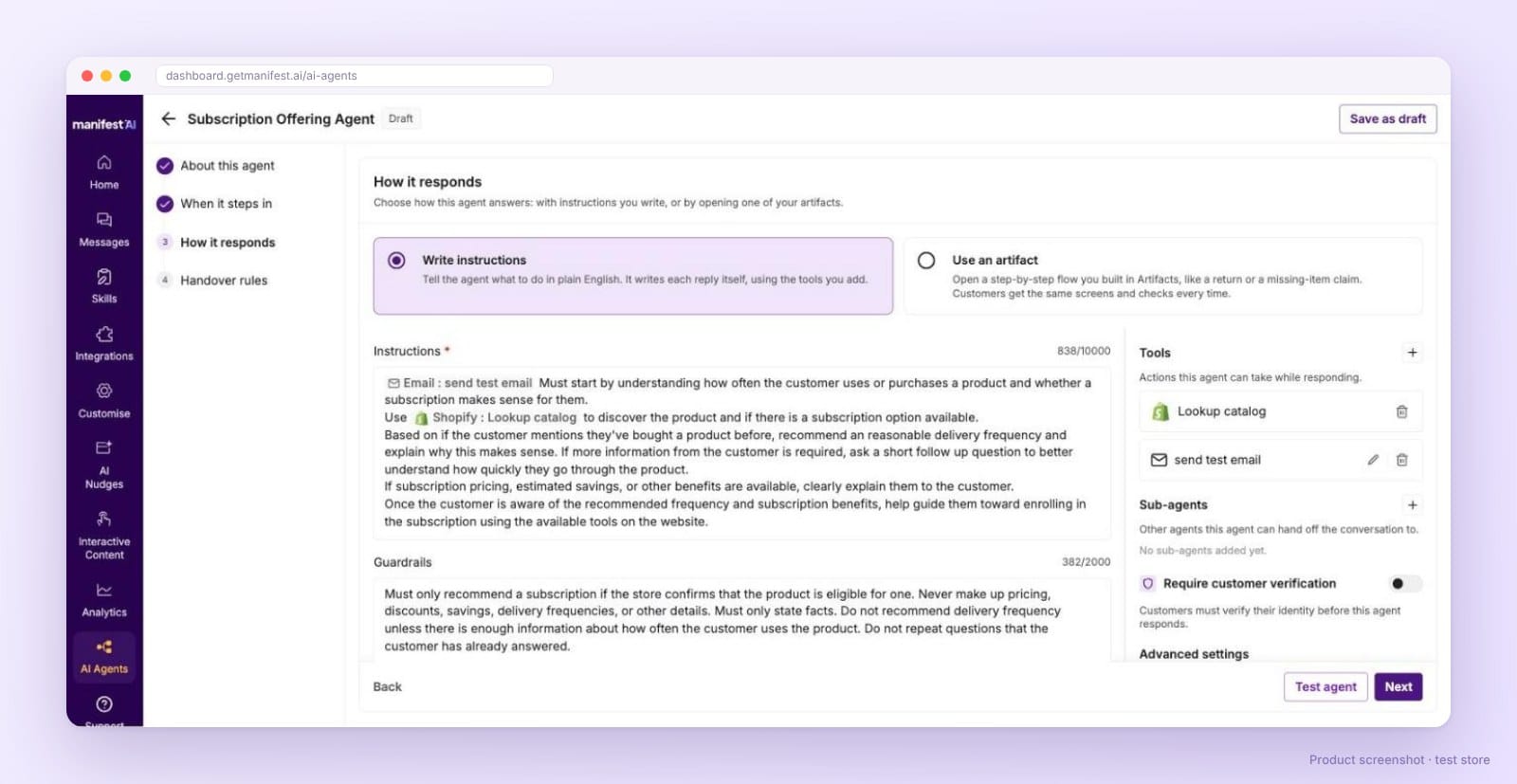
Manifest also includes AI Voice Calling for multi-language cart recovery calls, Campaign Manager for WhatsApp, email, SMS and Instagram campaigns, an omnichannel support inbox, and AI search for Shopify. More than 500 brands use the platform.
Where Manifest is strong
- Sales and support in one agent, so pre-purchase and post-purchase context stays together.
- Native WhatsApp and Instagram, plus voice calling, beyond web chat and email.
- No-code Agent Studio, so your team can build and change agents directly.
- Predictable starting price for SMB and mid-market brands.
Key differences
1. Support layer vs sales-and-support platform
Yuma is built to reduce support workload inside the helpdesk you already run. Manifest is built to own the customer conversation across channels, including the revenue side. If your main goal is to cut ticket costs, Yuma is purpose-built for that. If you also want the agent to drive conversion and recover carts, Manifest covers more ground.
2. Channels
Yuma covers helpdesk tickets, website chat, and Facebook and Instagram through Social AI. Manifest covers website, WhatsApp, Instagram and email, adds AI voice calling, and runs campaigns on WhatsApp, email, SMS and Instagram. For brands where WhatsApp is a primary channel, this is often the deciding factor.
3. Helpdesk fit
Yuma works with six major helpdesks, which is ideal if your support team is settled on one. Manifest includes its own omnichannel inbox with automated routing and closure. It also integrates with Gorgias, Zendesk, Freshdesk and Kustomer for human handover, so teams can keep their helpdesk.
4. Pricing
Yuma charges per fully resolved ticket on annual plans. Its pricing page lists a Starter plan at $14,400/year (about $1.20 per resolution for 12,000 resolutions), with lower per-resolution rates at higher volumes, no seat fees and no implementation fee. Sales AI and Social AI are priced separately. Manifest starts at $500/month with flexible tiers up to enterprise, plus a startup plan for newer brands. Model both against your real monthly ticket volume and the channels you need.
5. Platform coverage
Yuma supports Shopify, WooCommerce, Magento and BigCommerce. Manifest is Shopify-first and also supports WooCommerce, BigCommerce and custom storefronts through its APIs.
Why Manifest AI is the most cost-effective option
Sticker price is only part of what an AI agent costs. Per-seat and per-resolution pricing gets more expensive as conversation volume grows, and most tools leave you to build, test and maintain the agents yourself. Manifest AI is built to be the highest-ROI platform in this category: it has the lowest cost once real usage kicks in, and it includes the expert help other tools charge extra for or leave to your team.
- Lowest cost at real usage. As your conversation volume grows, your cost per conversation on Manifest AI stays among the lowest in the market, so support savings and AI-driven revenue compound instead of being eaten by usage fees.
- Bespoke, done-for-you agents. Our team builds all of your AI agents during onboarding, and keeps building new ones for as long as you are with us. Submit a request and we build it, so you do not need an in-house AI team or an agency.
- Customer support 7 days a week. Our support team is available every day, including weekends, when ecommerce traffic and support volume often peak.
- Live in about two weeks. Because we build the agents with you, most brands go live in about two weeks.
How to choose
Choose Yuma AI if:
- Your main goal is reducing support ticket volume and cost.
- You are committed to Gorgias, Zendesk, Kustomer, Gladly, Re:amaze or Salesforce and want AI inside it.
- Most of your volume is email-based post-purchase tickets.
- You run on Magento.
- You prefer to pay only for fully resolved tickets.
Choose Manifest AI if:
- You want one agent to sell and support, not two separate tools.
- Your customers reach you on WhatsApp and Instagram as well as web and email.
- You want AI voice calls and campaigns for cart recovery alongside support.
- You want your team to build and edit agents without code.
- You are a Shopify-first SMB or mid-market brand that wants a predictable starting price.
Some brands run a support-only tool alongside a separate shopping assistant. If you are considering that, compare the combined cost and the experience of two disconnected agents against a single platform.
Verdict
Yuma AI is a strong, focused choice for automating post-purchase tickets inside an existing helpdesk, with outcome-based pricing and wide integrations. Manifest AI is the better fit when you want one no-code agent that drives revenue and resolves support across web, WhatsApp, Instagram, email and voice. Pick based on whether your priority is ticket deflection alone or the full customer conversation.
FAQ
Is Manifest AI a Yuma AI alternative?
Yes. Both automate ecommerce support. Manifest AI also covers sales (product discovery, upsell, cart recovery) and messaging channels like WhatsApp, which makes it an alternative for brands that want more than ticket automation.
Does Yuma AI work with WhatsApp?
Yuma's site highlights helpdesk tickets, website chat, and Facebook and Instagram through Social AI. Check with Yuma for current WhatsApp support. Manifest AI supports WhatsApp natively.
How does Yuma AI pricing compare to Manifest AI?
Yuma charges per fully resolved ticket on annual plans, starting at $14,400/year on its Starter plan. Manifest AI starts at $500/month with flexible tiers and a startup plan. Both offer a free trial period.
Which has higher automation rates?
Yuma claims up to 89% of conversations automated, and Manifest AI brands report up to 90% ticket automation. Actual rates depend on your ticket mix and integrations, so test both on your own data.
Do I need to replace my helpdesk to use either tool?
No for Yuma, which runs on top of major helpdesks. Manifest AI includes its own omnichannel inbox and also hands off to Gorgias, Zendesk, Freshdesk and Kustomer, so you can keep your helpdesk.
Want one AI agent that sells and supports on every channel? Start a free trial or book a demo of Manifest AI.