
.png)
How Patagonia Built a Mission-First Digital Strategy | AMA with VP of Digital
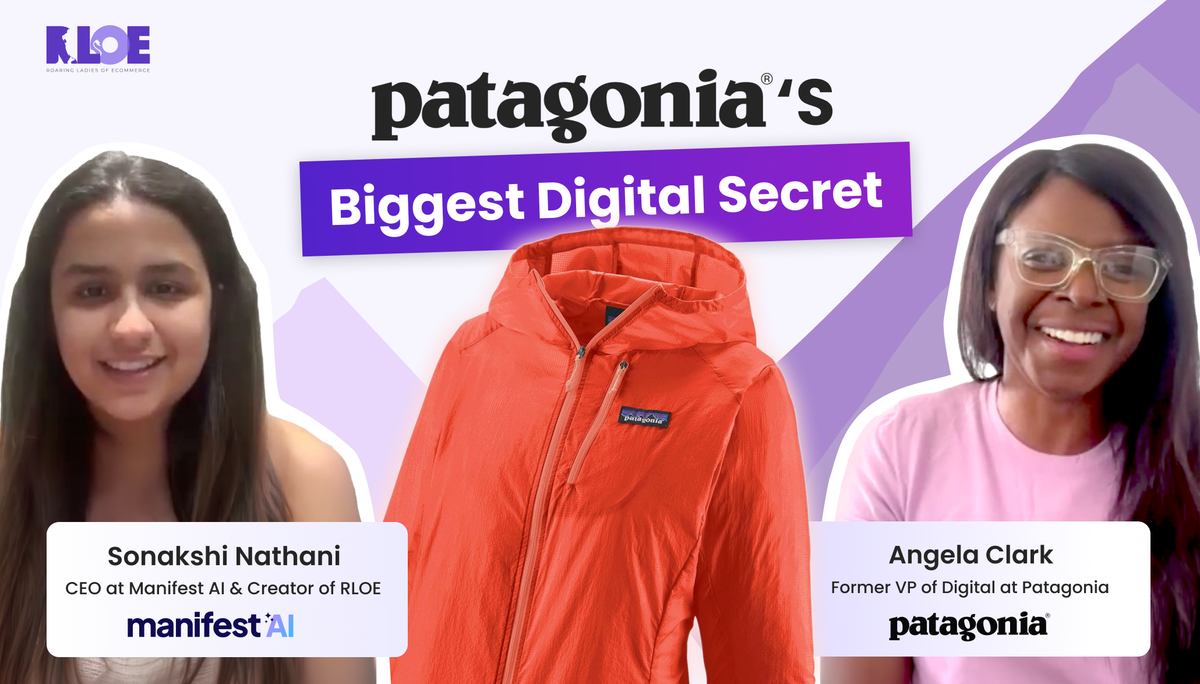
A Roaring Ladies of eCommerce Ask Me Anything Session with Angela Clark
Hosted by Sonakshi Nathani, Founder & CEO of Manifest AI & Creator of RLOE
Quick Context
RLOE hosts monthly AMA sessions for women in eCommerce.
In this session, Sonakshi sits down with Angela Clark (Former VP of Digital at Patagonia) to unpack:
- What it really means to lead Patagonia's digital strategy
- How to balance growth with brand integrity
- How to think about data, strategy, and scaling
About Manifest AI & RLOE
This AMA was sponsored by Manifest AI — an AI shopping assistant helping eCommerce brands boost conversions and reduce support tickets.
RLOE is a private community for women leading eCommerce brands and agencies. Join leaders from brands like Glossier, Patagonia, SKIMS, Sephora, and Steve Madden. RLOE brings together ambitious women in eCommerce through meaningful connections, career support, and monthly sessions with top industry leaders.
The Conversation (Q&A) between Angela & Sonakshi
Q1. Sonakshi: Angela, before we dive in, tell us about your journey. What shaped your career?
Angela:
Yeah, thank you so much. So, I’ll go a little backwards. Like I said, most recently, I’ve been at Patagonia about 4 years. It was a pretty big step-up role for me. It was a business probably 5 times the size of True Religion that I was running before. A much bigger team. I went from a team of, I think, maybe 10 people to a team of almost 60 people.
And so it was definitely some moments of fake it till you make it type situation, but it was an incredible learning experience. I’ve probably spent the last 10 years solely in digital, solely in e-commerce. I’ve worked a lot in apparel. I’ve also worked in the home furnishing world, Pottery Barn to name one. That’s what moved me out to California many, many years ago.
My career started in merchandising. I was a merchandiser for a department store, then I moved into doing product development and product design, physical product. And then I really loved direct-to-consumer, and because of my age, direct-to-consumer was catalog before it was digital. And so I was working in catalog business, Spiegel Catalog being another one that I worked for for many years, and in the Pottery Barn catalog.
And from that, what I loved about direct-to-consumer is I didn’t really love the store experience as a merchandiser. I loved that I combined my mathematical brain of being able to get real feedback from customers and data, which we now call it, and then be able to communicate to customers through photo and through text, which kind of fed the creative side of my brain.
So to me, it was like a perfect storm, and I’ve really enjoyed digital over the last decade or so because it’s just always evolving. There are always new channels, there’s always new ways to think of, and talk about acceleration now is just next level. It’s a really exciting time. It’s also a really challenging time.
And so there are moments where I’m just really glad I’ve had so many different experiences with so many different brands, so many different types of leaders, so many different types of teams, that I really, really draw from every day now. So that’s a little bit about me.
Q2. Sonakshi: What does it mean to handle digital at Patagonia? What were your north-star metrics and team structure?
Angela:
Yeah, so Patagonia was definitely a little unique. You obviously have your normal KPIs of sales, conversion, traffic, but at Patagonia, my conversion metrics are probably a little softer than it would have been at a brand like True Religion. That was a brand I was with previously. At that brand, it was a highly promotional brand, so we’re constantly trying to get people to see what’s happening for the latest drops and things of that nature.
And Patagonia is pretty much the opposite, right? We have the same core product for the majority of it. It’s not fast fashion. It’s on the opposite end of the spectrum. We want you to buy something and have it forever.
And then there’s a lot of services and benefits at Patagonia that you don’t have at other brands. So you might have the ability to trade in something, the ability to buy used. They had all these other brand entities that were very disparate.
So for me, that role was really about the engagement of getting customers involved in a brand who really believed in a brand, and maybe didn’t know that they could trade something in and get money and buy a new one if they want one, or they could repair their favorite item, or that we sell food, like all these things are happening, or communicate or participate in some of our missions to save the home planet.
So a lot of my goals were really around not only getting — were more long-term, so that long lifetime value metric, again, became more than just transactional. It also is about how could I have people visit most frequently, participate maybe in an activism mission, participate in some other things as well. So those were some of the things that made it a very unique experience.
I had a very broad team. So I had site experience, I had an operations team, I had a product development team that worked on customer experience, user-facing on the site. I had a customer analytics team, which is really fun, because I love data and insights so much, and I think it’s so powerful to help us do our jobs.
I also had a secondary website called Patagonia Action Works, and that was a non-for-profit angle of our company, so they support grassroots organizations. And then digital marketing, of course. So those were sort of all the teams that I had that worked across.
Q3. Sonakshi: How did you plan growth when your goals were more long-term vs transactional?
Angela:
Yeah, so absolutely, there are sales goals, so my growth metrics were slower because it was a bigger brand, more established. But then from there, I usually would break this down. This is something of practice I started at Levi.
Where we would actually say, okay, if I have a 10% sales growth coming for the next year, what are the levers that I think I can utilize to get that sales growth? So do I think I can throw a bunch of marketing dollars and get a bunch of new traffic, and then that way I have my traffic metrics where I’m gonna really lean into? Or do I think, actually, my retention’s really, really strong, so can I lean into retention? Does that mean I’m actually going to expand my SMS campaigns, or whatever that might be?
And so I’m gonna take down my traffic goal and lean more into the conversion goal. Or maybe the product is changing, and maybe we’re introducing some more high-value product, or we’re doing bundles, or our AOV’s gonna increase, so then I’m gonna put pressure more on there.
So really kind of looking at what the business plan is, and what the strategy is for product. I’ll just use apparel as an example. Is there some new product category that’s really exciting that we think we’re gonna break through? e.l.f. Cosmetics is a great one. When I was there, they had just introduced skincare, and the difference between color cosmetics versus skincare is you get a skincare customer, they don’t change much, right? They’re more loyal. So that kind of changed the strategy of how I would think about growth going on now that we’ve introduced this whole new product category.
And so sort of thinking about those things helped me to define which KPIs I want to lean on, and then I try to build multiple scenarios — best case scenario, like a high, medium, low. And then I kind of calibrate and play with those KPIs to kind of get to that goal.
So ideally, I always tell my team, I like to have 3 different paths to get to my target. If for some reason marketing budgets are always the first thing to get cut in a tough year, so I might say, I’ve got X amount of dollars, and I’m gonna have this huge marketing growth. And then two months in, somebody might say, just kidding, we’re taking 10% of your marketing budget, now I gotta pivot, right?
And so instead of starting from scratch, have a backup plan already. Maybe I spent all that money on marketing, and maybe those people don’t convert as well as I thought, so I need to lean into something else. What’s gonna be my backup plan?
So to me, that’s the fun part of it. It’s challenging, but I think that’s really fun.
Q4. Sonakshi: How do you manage global launch strategies across regions?
Angela:
Yeah, that’s a great question. I only ran the North America website. That being said, I worked a lot with my cross-functional teams around the globe.
Patagonia is an organization where we had multiple offices. So there’s an EMEA office, there’s a LATAM office, we had an APAC office as well, and some of those platforms around the world were on the same platform as our North America platform. So EMEA and Japan, any changes we made to the site impacted their business as well. So we had to build really strong partnerships with those teams to make sure changes and things that we’re doing aren’t doing detriment to their business. They might have unique things that they’re doing.
And then the other regions were on different platforms, so us being the biggest business, a lot of times it relied on us as sort of what tactics we were working on, where we were going with things. But they had some flexibility to do their own regional activities.
I think when I was at Levi, it was a little bit different, where we had very disparate businesses around the world, and we tried to centralize it all in San Francisco. And so what happened with that team was we would actually sort of bring in other regions, and then we would actually test new things in a smaller region, which is really smart, because then you could kind of learn a little bit, and then bring it back to the bigger North America business, and then we kind of travel it around the globe that way.
Which I learned a ton from that experience as well.
Q5. Sonakshi: How do you stay true to brand identity while still driving growth?
Angela:
Yeah, I mean honestly, it’s pretty easy there, because it’s so clear on what our mission is. And the challenging part is you spend a lot of time thinking and re-evaluating.
There have been times where I’m like, I don’t have all the same levers that I had at a previous brand. We don’t do paid advertising on Instagram or any Meta property, so we had to use other tools. So we leaned into CTV more. We leaned into Pinterest. Pinterest was like, nobody cared about Pinterest at other brands I worked for, but it had a lot of meaning for us at Patagonia.
And so trying to just find where there are those glimmers of light and hope and lean into those things.
The reason I came to Patagonia is I really wanted to be more challenged. I just kind of really lost interest in working for brands that are only messages to be on sale, and the latest color of the season. That just kind of got old for me. So to be able to lean into storytelling and have really meaningful things to talk about and engage with was what drew me to Patagonia.
So what that meant is at times, you’d have really drawn-out meetings and really drawn-out conversations about things to try to get to that place. But I think the brand internally has so much clarity on what makes Patagonia tick that it’s pretty easy to kind of feel when you’re going off the rails a little bit.
And everyone there is really quick to raise their hand and be like, I don’t know if this really works. Everyone really challenges everybody. I like to say that it’s like a community of activists. People have very strong opinions. And so you do a lot of communal leadership, you talk through a lot of things.
I think sometimes that could be challenging. You’re used to working really fast and kind of moving on to the next thing. I’ve worked for brands where it’s like, just fly the plane as you’re building it, and that’s not Patagonia’s mentality.
So trying to find that happy balance, because I am a little bit of an impatient person, and so I like to see results quickly, and I like to test and learn things really fast, but there are some times where it’s just like, this is an area to protect.
And I think that actually means a lot of times that our growth plans and our conversions and tactics are not as aggressive as other brands. Because if I were to implement a new tool, like we were starting to build a web app idea, I would take whatever the norms are and pretty much cut them in half, because I know that I don’t have these 10% offers to sign up, or whatever these things are that a lot of people use to kind of hook people in.
It’s going to be a longer road. So therefore, let’s just take the pressure off ourselves and set it at an expectation that makes sense for the brand.
Q6. Sonakshi: For early-stage brands, how do you define a clear mission and priorities?
Angela:
Yeah, I think you have to take some time to do an assessment of whatever the brand mission is. I do this every year with the brand I even work for. What’s the ultimate goal we’re trying to achieve?
A lot of times, that doesn’t change year to year. It’s pretty consistent. How we want to achieve it might be the thing that changes.
So I really lean into what can be the most impactful thing. Because there’s a thousand things we’re gonna do. We’re all in e-com, right? There are so many software tools, there’s so many things we could be doing, and a lot of times it’s like, okay, out of the 10 things that we could actually implement this year, what are the 3 things that are going to make the most impact?
We can’t do all the things on our wish list. What are the things that we think can drive the biggest impact, however we want to measure impact? Impact might be growth, might be followers, it might be overall customer growth, or it might just be sales revenue, or it might be frequency of purchase, whatever that might be.
And then I try to think about, and then test and learn and research. I love communities like this. I use them heavily. I like to talk to other people who have similar roles and be like, hey, I’m getting all these pitches about a new agentic AI for chatbot, or whatever it might be. Have you seen success in that? Or, I worked for this company, I see that you guys are using that same company, what’s going on with that?
And what I love about these communities is I think a lot of people are really open to discussing at least if they’ve seen successes, or wins, or what some of their challenges might be. Like, they’re a great service provider, but here’s some things to watch out for. We tried them, then we moved to this, and here’s why. And that may or may not apply to your business.
I think that’s just such a valuable tool that I’ve learned pretty late in my career, but it’s a reason I’m in like 3 different women’s organizations right now that are around retail in particular, because it’s just invaluable.
A lot of people do — you only have so many resources: people, money, time. So you’re trying to find how to use that most effectively and efficiently.
So, a lot of reflection. I like to look into data and see what are the customers kind of telling us that they want from us. So doing surveys, getting feedback from your core customer, is really important too.
Q7. Sonakshi: How can someone improve their data analysis skills in eCommerce?
Angela:
That is a great question, because it’s something I’m so passionate about that I actually designed a college course about it at FIDM some years ago in teaching digital analytics, especially because I think in eComm, people come from so many different types of backgrounds, that not everybody even understands how much we lean into data until they get into a role, and you’re like, holy crap, how am I gonna get into this?
So, if you can find a mentor, that would be helpful. I wish I could think of a single source. You might give me an idea of what to do with my free time.
But I think a lot of times, you’re in those meetings, and you know that person who just kind of has it and gets it. I’d be like, can I grab lunch with you?
I think a lot of times, and this is something that I’ve been really mindful of, even in group meetings where people go through recaps of business, or whatever it is, and the digital marketing people are spewing out all these acronyms and all these things and charts and things, and sometimes I’ll just pause and be like, does everyone understand what’s happening here?
Some people don’t want to say it in that meeting, but I think it’s important to be like, maybe your company can do brown bag lunches, where you can ask somebody who’s running digital analytics, could you guys just teach us a one-on-one? Don’t assume everybody knows what AOV means. Don’t assume everybody knows what all these KPIs are, key performance indicators.
Why don’t you do a brown lunch session on that, and just answer people’s questions, or just go through a report and find somebody who can walk you through each one. If AOV goes up, what’s the relationship between the KPIs?
I think that’s something that I really like to teach people, at least because I’ve always run a merchandising team as well. Like, the difference between why we say if conversion suddenly goes up, we will expect this other thing to drop, or if traffic has doubled, of course the conversion’s gonna drop, but where does it make sense, and when should we be alarmed by it, and when shouldn’t we be alarmed by it?
So to me, it’s almost more important to know the relationship part of it. But you can reach out to me. I’d love to chat with you about it, not a problem. She’s very active on LinkedIn.
Q8. Sonakshi: How do you transition from operator to strategic leader?
Angela:
I think my best advice is there’s a mental shift that definitely needs to happen, because I think when you’re in an operator role, a lot of times you’re used to being hands-on and the person doing the thing.
And I think for strategy, there’s a mental shift of freeing your mind a little bit to just explore, ask a lot of questions, don’t assume that you know the answer. To me, that’s the best thing. I don’t assume I know my customer. The brand thinks the customer’s this, like, what does the data tell me about those things, and then kind of form my ideas from there.
And then I think the biggest tip I have to be successful in whatever strategies you’re executing is to bring people along as early as possible. Help them help you orchestrate what that strategy is.
So what I mean by that is, I needed to push a revolutionary change on the digital experience on e-com, because we were just in this conundrum of having so much technical debt, so much work that’s behind the scenes that needs to be done, but the site’s starting to feel old, and of course leadership wants shiny things, but you know you have to stabilize the platform and do all the non-sexy stuff.
And so what I did was, I knew what I wanted to build. So I brought in, I talked to the head of creative a lot. We sat down, what’s your vision? Because he has a lot of power and authority of what the site looks like. This is what I’m thinking, what are your thoughts about that?
And then I’d go over to the head of IT, and I’m like, I’m starting to think about an idea about how can I have a completely different user experience, and I know I’m going to rely on your engineering team, and have you been thinking about this idea, and can I share with you my thoughts? I’d love to get your input.
And so when you start to do that, you’re starting to build advocates for your idea and strategy, and that’s the secret behind it, right?
So then once you’ve kind of started to coordinate it and get that idea and that strategy to a place that feels really tight, now when you go pitch that idea to leadership or somebody, you’ve got advocates, you’ve got people who already buy in.
And to me, the most powerful thing with strategy is that the strategy or idea keeps going even when you’re not in the room to advocate for it. Because other people really get it, they understand it, they’re like, yeah, Angela and I talked about that already, and do you think we should be investing in that? Yeah, I do. And here’s the 5 things that she’s thinking about.
And I love to build a strategy where I feel like everybody feels like they’re winning. That can’t always be the case, but most times, you can find a win for them and a win for yourself.
And then you’ve got — then it’s just like a steamship is just gonna go. I think I really learned that trick, actually, at Levi.
Q9. Sonakshi: Many brands get stuck at $100–200K/month. How do you scale past that?
Angela:
Yeah, I think those are the points where you have to sort of assess, is the stagnation in growth market share? Is it maybe you’re the biggest player in the market now, or you own such a large piece of that market share that it’s going to force you to think about product expansion, or a new category to enter into?
There’s a life cycle to every brand. I think Patagonia has reached a point where we spent a year and a half talking about what’s the right size for our business. Should we be a $2 billion, $4 billion brand, or should we stay smaller, depending on what it is we’re trying to accomplish?
So I think those sort of breakthroughs really kind of go like, it’s a good opportunity to go back and assess again. Like I was saying, I think a lot of times we tell our own narrative of what our customer is and what our customer wants from us, and that’s a really good time to sort of dig in and see if there are signals there, or opportunities that maybe you hadn’t thought of, or maybe your customers evolved over time.
I think that’s the thing. The biggest thing I did in 4 years at Patagonia was, the average customer in digital was 45+, and by the time I left 4 years later, we were down into the 20s, 30s, and we definitely moved the age down.
And that was a lot from our communication channels that we were using, the channels which we were talking to people in, and some of the sales tactics of product, like leaning into used product. We found that younger customers were buying our used goods versus brand new products.
And so there’s things like that you can kind of utilize to kind of see where you might have some wins, and then hopefully there’s easy ways to test into it that don’t cost a lot of money to kind of learn if there are opportunities there.
Q10. Sonakshi: One piece of advice for everyone here?
Angela:
Yeah, so I think a really easy one is take someone to lunch that you don’t know, that you work with. There’s just such a power in just kind of connecting with people one-to-one. A lot of times, I’m like, I just had open calendar time, like whoever wants to meet me, let’s meet. Or just sometimes, there’s something about that person that seems really cool, I just want to get to know them and see what that’s about.
And it’s amazing what comes out of those connections. I think that’s a big one.
And then secondly, just know you’re doing awesome. I think we’re so hard on ourselves. It’s really challenging times right now. I’ve seen a lot. Like I said, I’ve been here 30 plus years in the industry. The things that are happening in the industry right now — one is accelerated pace, there’s so many challenges — and just give yourself grace.
You guys are all smart, you’re all gonna figure it out, and know that it’s okay. It’s gonna be okay. I think we need to hear that more these days.
Closing Note
This AMA was part of the Roaring Ladies of eCommerce community — a space for women in eCommerce to learn, share, and grow together.
Angela is available inside the RLOE community for follow-up questions.
Stay tuned for the next AMA 💜
If you want to watch the full AMA video, here it is:
