.png)
The Complete Guide to Shopify AI Automation (2026)
How Shopify brands use AI to automate product discovery, multi-channel marketing on WhatsApp, Instagram and email, cart recovery and customer support, plus what to automate first and how to measure ROI.

Shopify AI automation means using AI agents to run the repetitive parts of your store across the whole customer journey: helping shoppers find products, recovering carts, sending personalized campaigns on WhatsApp, Instagram and email, and resolving support questions. Done well, it raises conversion and repeat purchase while your team spends less time on routine work. This guide explains where AI fits in a Shopify store, what to automate first and how to measure whether it's working.
Manifest AI and BIK are our products. We mention them where they're relevant and have tried to keep this guide useful whichever tools you use.
What is Shopify AI automation?
Traditional ecommerce automation is rule-based: "if a cart is abandoned, send email 1 after an hour." AI automation adds judgment. An AI agent can read a shopper's question, understand your catalog, decide which product to recommend, choose the right channel and message, and take actions such as looking up an order or creating a discount.
For a Shopify brand, AI automation usually covers four areas:
- Product discovery and on-site selling: AI shopping assistants, AI search, product quizzes and proactive nudges.
- Marketing automation: segmented campaigns and journeys across WhatsApp, Instagram, email and SMS.
- Revenue recovery: abandoned cart and browse recovery, including AI voice calls and WhatsApp follow-ups.
- Customer support: order tracking, returns, exchanges and FAQs, with human handoff for the rest.
Why Shopify brands are moving to AI automation
- Shoppers expect answers instantly. A pre-purchase question left unanswered for an hour is often a lost sale.
- Catalogs are harder to navigate. Filters and menus don't help a shopper who knows the problem ("dry skin in winter") but not the product.
- Conversations have moved to messaging. For many D2C brands, WhatsApp and Instagram DMs now carry a large share of pre- and post-purchase conversations.
- Support costs scale with orders. Every sale creates "where is my order?" tickets unless you automate them.
- Generic blasts are losing effectiveness. AI makes it practical to personalize messages by segment, behavior and product interest.
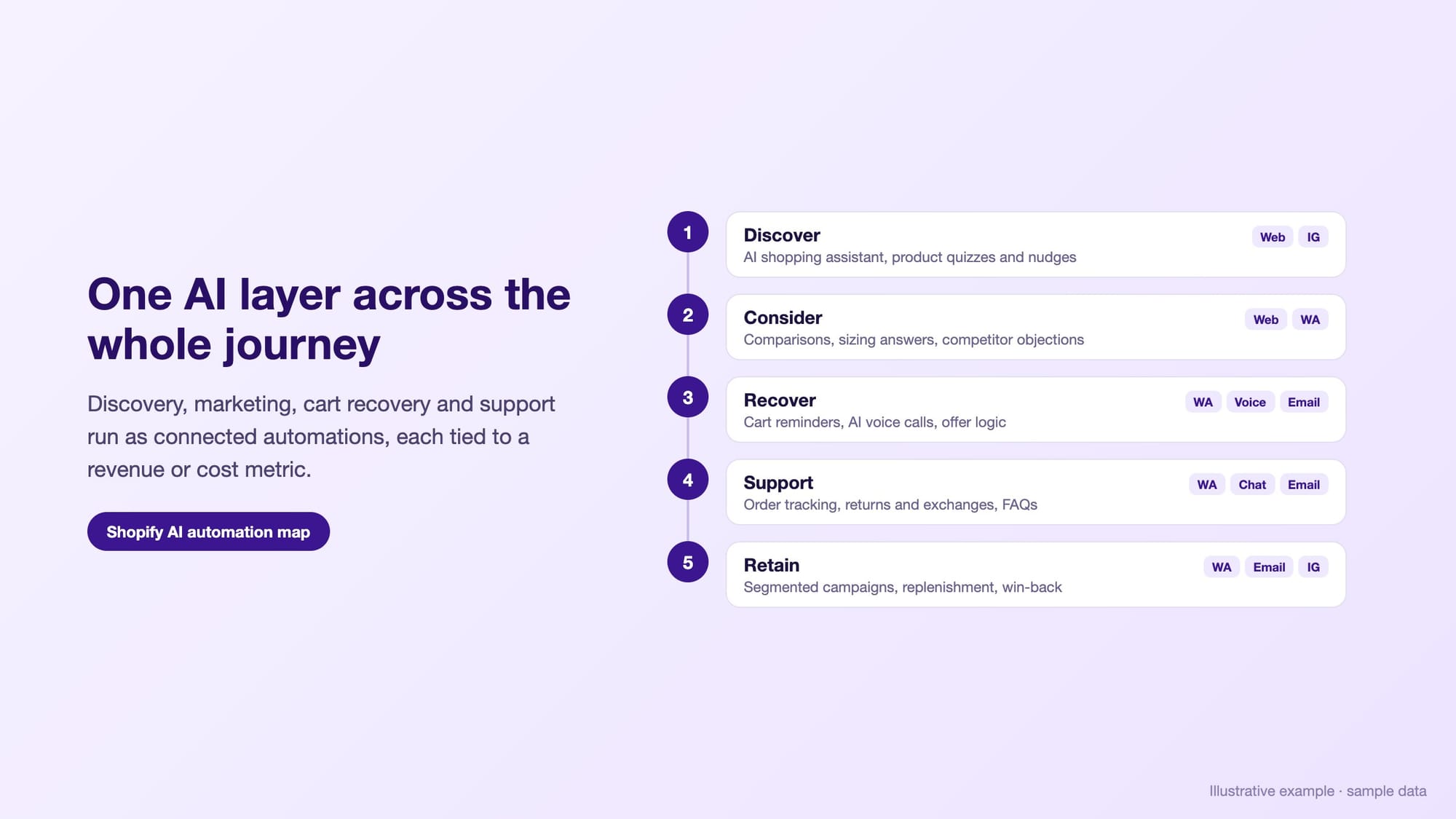
AI automation across the Shopify customer journey
| Journey stage | What to automate with AI | Main channels | Metric to watch |
|---|---|---|---|
| Discovery | AI shopping assistant, AI search, product quizzes, proactive nudges | Storefront, Instagram | Add-to-cart rate, conversion rate |
| Consideration | Product comparisons, sizing and fit answers, competitor objections | Storefront chat, WhatsApp | Conversion rate, AOV |
| Checkout | Cart recovery messages and AI voice calls, offer logic | WhatsApp, email, voice | Recovered revenue |
| Post-purchase | Order tracking, returns, exchanges, reviews | WhatsApp, email, chat | Automation rate, CSAT |
| Retention | Segmented campaigns, replenishment and win-back journeys | WhatsApp, email, Instagram | Repeat purchase rate, LTV |
1. AI for product discovery
Product discovery is where AI has the most direct effect on revenue. An AI shopping assistant reads your Shopify catalog, asks clarifying questions and shows products shoppers can add to cart in the chat, the way a good store associate would.
What good looks like:
- Guided selling, not link dumps. The assistant asks about budget, size or use case before recommending.
- Help on product pages. Shoppers get answers to "will this fit?" or "is this good for sensitive skin?" exactly where they hesitate.
- Interactive content. Product quizzes and AI embeds bring guided discovery into the page, not only a chat bubble.
- Proactive nudges when a shopper lingers or is about to leave.
In Manifest AI, you set an AI sales strategy that defines how the assistant should recommend and sell, enable the assistant on product pages, and add Smart AI Embeds, AI Nudges and interactive content. A competitor conversion agent handles shoppers who are comparing you with other brands. For a side-by-side look at the tools in this category, see our comparison of Shopify AI chatbots for product discovery.
2. AI marketing automation across channels
Multi-channel marketing automation means reaching each customer on the channel they actually use, with a message based on what they did. For many Shopify brands that now means WhatsApp and Instagram alongside email.
- Segments from real behavior: viewed but didn't buy, bought once, high-value repeat buyers, lapsed customers.
- Journeys, not one-off blasts: welcome, browse abandonment, cart recovery, post-purchase cross-sell, replenishment and win-back.
- Recurring campaigns that run on a schedule once you set them up.
- Two-way messaging. When a customer replies to a WhatsApp campaign, an AI agent should answer and sell, not leave the message in a queue.
BIK, Manifest AI's marketing automation app for Instagram, WhatsApp and email, brings campaigns, segments, templates, journeys, popups and an AI helpdesk into one place. Voice of Shoppers analyzes thousands of AI conversations to show which topics motivate customers and which concerns hold them back, which you can feed straight back into your campaigns.
3. AI for cart recovery
Cart recovery is the easiest AI automation to measure. A typical setup combines:
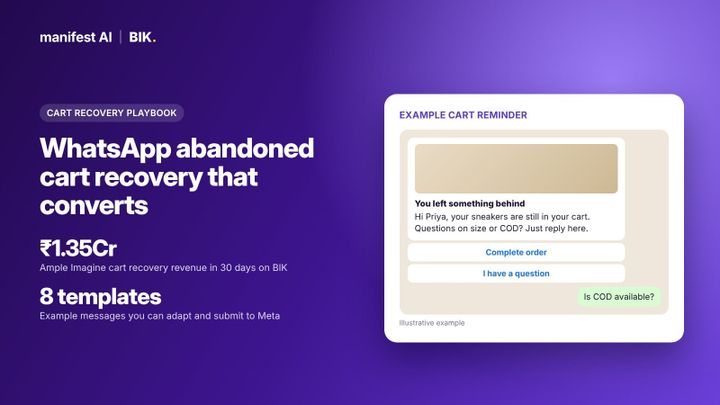
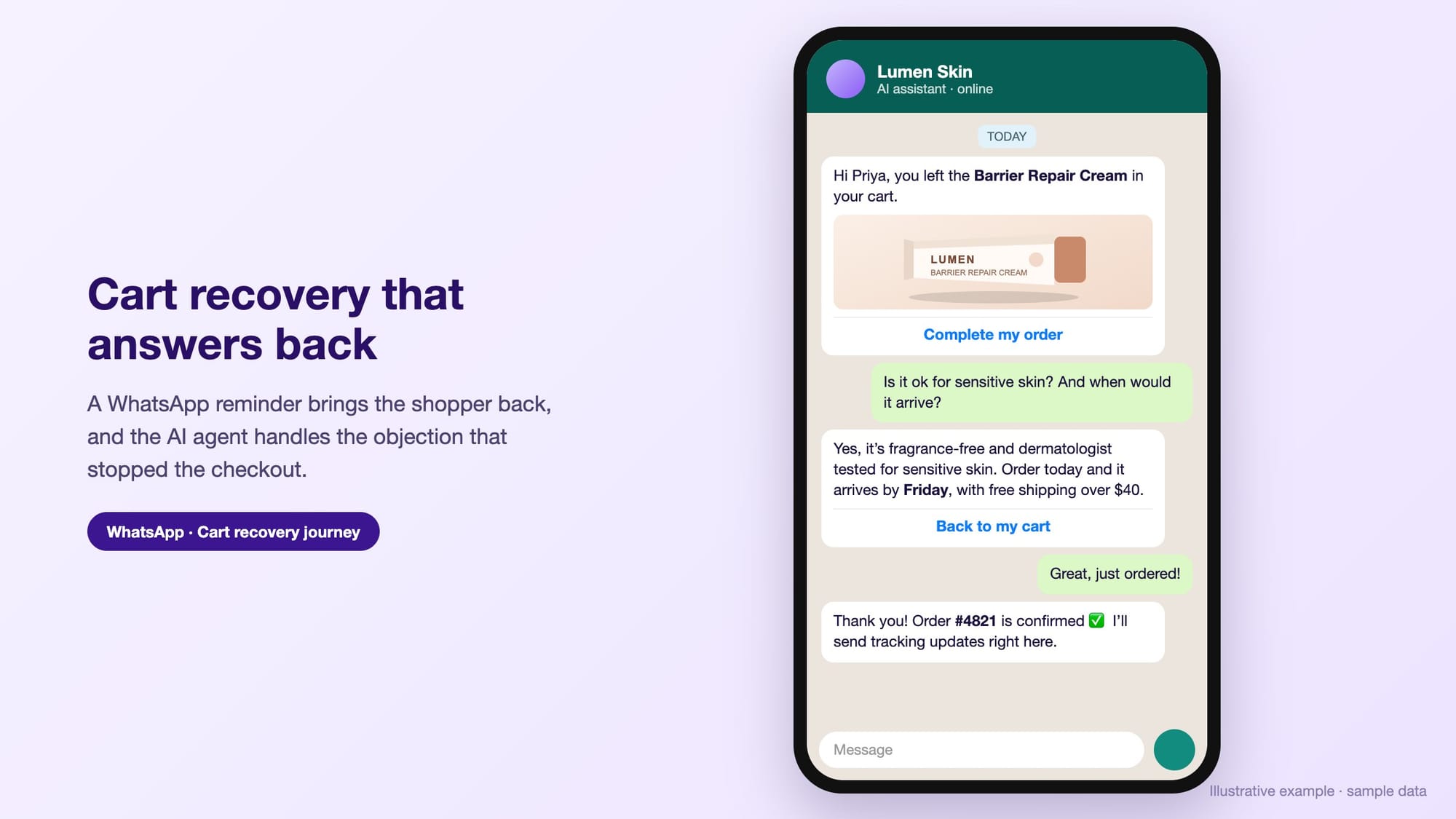
- A WhatsApp reminder with the product image and a one-tap link back to the cart.
- An AI agent that answers objections such as shipping cost, sizing or delivery dates when the shopper replies.
- AI voice calls for high-value carts, where a short conversation can resolve the hesitation.
- Email as the fallback for shoppers without a messaging opt-in.
Manifest AI's AI Voice Calling and WhatsApp journeys in BIK can run these steps automatically and report recovered revenue by channel. You can see a cart recovery flow built for your store in a short demo.
4. AI for customer support
Support is where most brands start with AI, because the ticket types are predictable: order status, returns, exchanges, shipping and product FAQs. A good AI agent connects to Shopify order data, resolves these end to end and hands complex cases to a human with the full context.
- Train the agent on order handling, shipping and returns, store offers and product guidance.
- Track unsatisfactory responses and correct them so accuracy keeps improving.
- Use one inbox for chat, WhatsApp, Instagram and email so agents see the whole history.
Brands using Manifest AI report up to 90% ticket automation. Results vary by catalog and ticket mix.
How to get started with Shopify AI automation
- Pick one revenue goal and one cost goal. For example, lift conversion on product pages and automate order-status questions.
- Clean up your product data. AI recommendations are only as good as your titles, descriptions, tags and variants.
- Start with discovery and WISMO. An AI shopping assistant and order tracking automation usually deliver measurable results within weeks.
- Add channels where your customers already are. Turn on WhatsApp and Instagram once the storefront agent is performing well.
- Build journeys, then campaigns. Cart recovery, post-purchase and win-back journeys run every day; campaigns add the peaks.
- Review conversations weekly. Read a sample, correct weak answers and add the questions shoppers actually ask.
How to measure ROI from AI automation
- Run an A/B test. Compare add-to-cart rate, conversion rate and AOV for shoppers who interact with the AI against those who don't. Manifest AI's dashboard shows this sales funnel with and without the assistant.
- Track recovered revenue from cart recovery by channel: WhatsApp, voice and email.
- Measure automation rate and CSAT for support, not just ticket volume.
- Watch repeat purchase rate and LTV for customers in your retention journeys.
Common mistakes to avoid
- Automating everything at once. Launch one journey at a time so you know what's working.
- Treating AI as a support-only tool. The biggest gains often come from discovery and recovery, not deflection.
- Ignoring messaging rules. WhatsApp templates, opt-ins and messaging limits matter; plan for them.
- Setting and forgetting. Catalogs, offers and questions change; your agents need regular tuning.
Verdict
Shopify AI automation works best when it covers the whole journey: AI that helps shoppers find the right product, follows up on WhatsApp, Instagram and email, recovers carts and resolves support questions, all measured against revenue. Start with product discovery and order tracking, prove the impact with an A/B test, then expand into multi-channel journeys. Manifest AI and BIK are built to cover that full journey for Shopify brands in one stack.
FAQ
What is AI marketing automation for Shopify?
It's the use of AI to decide what to send, to whom and on which channel, based on shopper behavior, and to respond to customers automatically when they reply. On Shopify it typically covers WhatsApp, Instagram, email and SMS campaigns and journeys.
What can AI automate in a Shopify store?
Product recommendations and search, product quizzes, cart and browse recovery, segmented campaigns, order tracking, returns and exchanges, FAQ answers, review requests and win-back journeys.
How does AI help with product discovery on Shopify?
An AI shopping assistant understands what the shopper is looking for, asks follow-up questions, searches your catalog and shows products they can add to cart. Brands using Manifest AI's shopping assistant report conversion lifts of up to 20-45%, though results vary.
What is multi-channel marketing automation?
It means running coordinated messages across channels such as WhatsApp, Instagram, email and SMS from one platform, so each customer gets the right message on the channel they use, without duplicate or conflicting sends.
Is AI automation worth it for small Shopify stores?
Yes, if you start small. Order tracking automation and an AI shopping assistant on your top product pages can pay back quickly. Add multi-channel journeys as your list and order volume grow.
How long does it take to set up AI automation on Shopify?
Simple automations can go live in a day. A full setup across discovery, marketing and support takes longer; with Manifest AI's team building the agents with you, most brands go live in about two weeks.
Ready to automate discovery, marketing and support on your Shopify store? Book a demo with Manifest AI and see what AI can do with your own catalog and customers.