
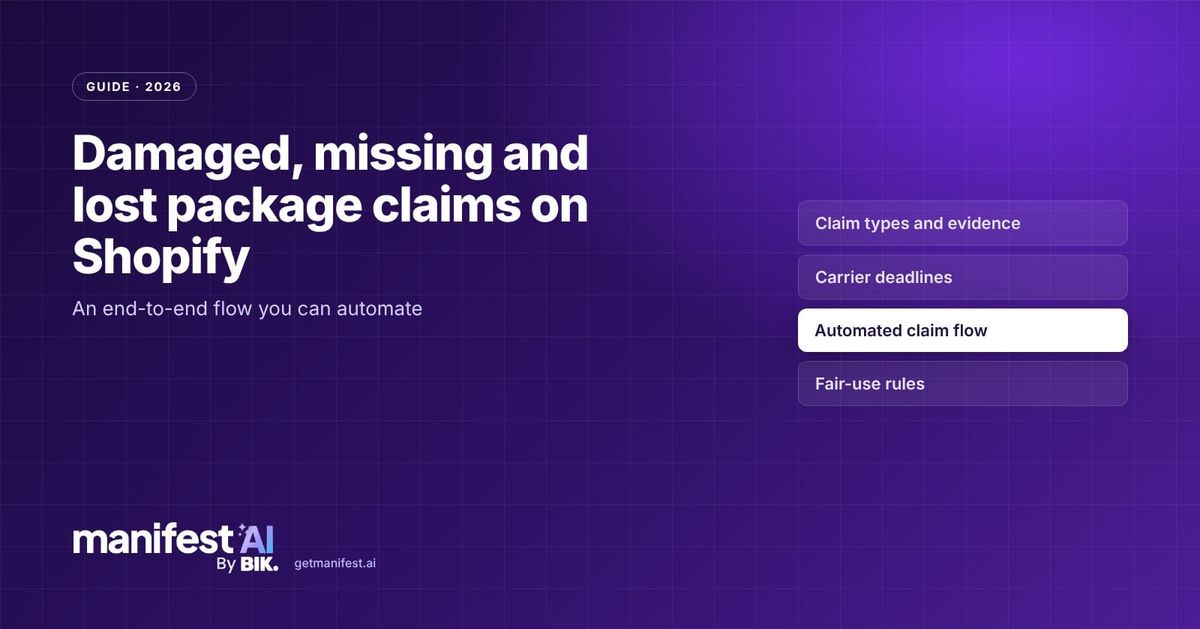
Damaged, Missing and Lost Package Claims on Shopify: An End-to-End Guide (2026)
How to automate damaged, missing and lost package claims on Shopify: evidence, carrier and insurance deadlines, resolution rules and where AI fits.
To automate damaged, missing and lost package claims on Shopify, set up four pieces: proactive delivery tracking so problems surface before the customer writes in, a claim intake flow that collects the order number, photos and a description in one go, clear resolution rules (reship, refund or store credit, by order value and customer history), and a back-office step that files the carrier or insurance claim within the deadline. An AI agent can run the customer-facing half; your team, an insurer or a shipping protection app handles recovery. Done well, a "where is my package?" message becomes a resolved ticket in minutes instead of a week of back-and-forth.

Manifest AI is our product; we've tried to describe other tools fairly. Carrier and insurance rules change, so check the current terms with your carrier or insurer. This is general guidance, not legal or insurance advice.
The three claim types and what each needs
| Claim | What happened | What to check | Evidence to collect |
|---|---|---|---|
| Lost in transit | Tracking stalled and the package never arrived | Days since last scan; the carrier's waiting period | Order number, tracking history, value |
| Missing (marked delivered) | Tracking says delivered, customer says no | Delivery scan, GPS or photo proof from the carrier, the address on the order | Customer's confirmation they checked neighbours and safe places; for insured theft, a signed statement |
| Damaged | Arrived broken or with items missing from the box | Whether damage happened in transit or at packing | Photos of the item, the box and the label; keep the packaging until the claim closes |
Carrier and insurance deadlines to plan around
Every claim route has a waiting period before a package counts as lost, and a hard deadline to file. Build your automation around the shortest one you use.
- USPS: wait about 7 business days after mailing for Priority Mail, and longer for ground services, before filing a loss claim; most domestic claims must be filed within 60 days of mailing.
- UPS and FedEx: claims can usually start about 24 hours after the expected delivery date, and domestic claims are generally due within 60 days.
- Shopify Shipping insurance (US): run by Shipsurance. It covers loss, damage in transit and theft after delivery, up to $5,000 per package on most carriers. File with Shipsurance, not the carrier, within 120 days of the ship date; for USPS losses, wait 20 days first (domestic). Damage hidden inside the box has to be found within 15 days of delivery.
- Shipping protection apps: apps such as Route, Corso, ShipAid and Seel let shoppers pay a small fee at checkout for protection, then handle the claim and pay out or reship. Each sets its own rules, so check the claim window and who decides the outcome.
An end-to-end claim flow you can automate
- Detect early: watch tracking for stalled scans and "delivered" orders, and message the customer before they write in. A proactive "your package seems delayed, here's what we're doing" message cuts angry tickets.
- Take the claim in one conversation: confirm the order, the problem type and the items affected. For damage, ask for photos of the item, box and label. For "delivered but missing", ask the customer to check with neighbours and safe places first, since many turn up within a day or two.
- Apply resolution rules: for example, reship automatically under a set order value, refund or offer store credit if the item is out of stock, and send anything high-value, repeat or suspicious to a person.
- Tell the customer what happens next: the resolution, the timeline and any reference number, in the same channel they used.
- File the recovery claim: your team, insurer or protection app files with the carrier using the evidence already collected. Log the claim date so nothing misses the deadline.
- Close the loop: track claim outcomes by carrier, product and packaging, and fix the root cause, whether that's a fragile SKU, a weak box or a delivery area with repeat theft.
Looking for an AI agent built for ecommerce? Manifest AI sells and supports across chat, email, Instagram and WhatsApp.
Rules that keep claims fair and abuse low
- Value limits: let automation resolve low-value claims instantly, and route larger ones for review.
- Customer history: flag customers with repeated "not received" claims or recent chargebacks.
- Proof of delivery: for high-value orders, use signature confirmation so theft claims are insurable.
- Packaging standards: insurers exclude damage from poor packaging, so document how fragile items are packed.
- Consistent outcomes: the same problem should get the same resolution in chat, email and WhatsApp.
Where shipping apps fit
Claims are much easier when label, tracking and carrier data sit in one place. A multi-carrier shipping app such as PluginHive generates labels across carriers, adds tracking and handles return labels inside Shopify, which gives you the shipment records a carrier claim asks for. Pair it with tracking alerts and either Shopify Shipping insurance or a shipping protection app for the payout side.
See what your brand could automate. Our team builds the agents for you, and most brands are live in about 2 weeks.
How Manifest AI handles the customer side
Manifest AI is an AI shopping assistant and support agent for ecommerce brands, used by 500+ brands and backed by Y Combinator. It answers "where is my order?" with live tracking, follows your policy for reships, returns, exchanges and cancellations in Shopify, and hands damage and loss claims that need review to your team with the order details and a summary of the conversation, across web chat, WhatsApp, Instagram and email. Our team sets up these rules with you. For refund guardrails, see our guide to letting an AI agent handle refunds safely.
Pricing: $0.05 per AI reply with a $500/month minimum and a 30-day free trial.
Verdict
You can't stop every package going missing, but you can make the claim painless. Catch problems from tracking data, collect the right evidence in one conversation, resolve by clear rules, and file recovery claims before the deadline. Automate the customer side and the paperwork stops piling up, while your team focuses on the claims that really need a person.
FAQ
What should I do when a Shopify order says delivered but the customer didn't get it?
Check the carrier's delivery scan and any photo proof, confirm the shipping address, and ask the customer to check neighbours and safe places. If it doesn't turn up within a day or two, reship or refund under your policy and file a theft claim if the package was insured.
How long do I have to file a lost package claim?
Most US domestic carrier claims are due within 60 days of shipping, after a waiting period. Shopify Shipping insurance claims are due within 120 days of the ship date. Check your carrier's current terms.
Does Shopify Shipping include insurance?
In the US, you can add insurance when you buy labels in Shopify Shipping. It's run by Shipsurance and covers loss, transit damage and theft after delivery, up to $5,000 per package on most carriers, with exclusions.
Can an AI agent handle damaged package claims?
Yes, for the customer side: it can confirm the order, collect details, apply your reship or refund rules and send complex cases to your team. Filing the carrier or insurance claim usually stays with your team or a protection app.