
7 Challenges Shopify Brands Face Without Multichannel AI Marketing Automation
Email-only reach, manual WhatsApp and Instagram, slow DM replies and generic messaging hold Shopify brands back. Here are the 7 biggest challenges and how multichannel AI marketing automation solves them.
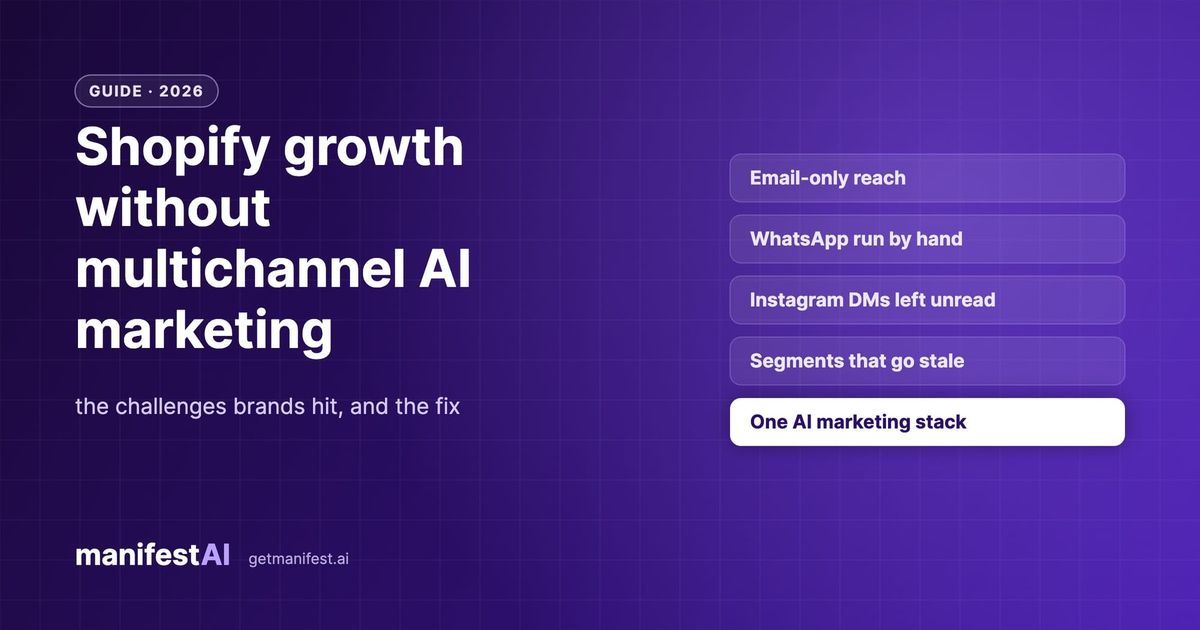
Shopify brands without multichannel AI marketing automation usually depend on email alone, run WhatsApp and Instagram by hand, and send the same message to everyone. That makes it hard to reach customers where they actually reply, slows down responses to high-intent DMs, leaves abandoned carts and repeat purchases to a single channel, and ties growth to how many people are on the marketing team. Multichannel AI marketing automation connects email, WhatsApp, Instagram and SMS to one customer profile, so journeys, campaigns and AI replies run on every channel automatically.

7 challenges Shopify brands face without multichannel AI marketing automation
1. Too much depends on email
Email is still valuable, but when it is the only automated channel, every cart reminder, launch and win-back message competes for attention in a crowded inbox. Customers who rarely open email effectively drop out of your retention programme.
2. WhatsApp and Instagram are run manually
Many shoppers prefer to message a brand on WhatsApp or Instagram. Without automation, those channels become a manual inbox and an occasional broadcast, so their potential for cart recovery, order updates and repeat purchases goes unused.
Running email, WhatsApp and Instagram by hand? Manifest AI and BIK run journeys, campaigns and AI replies across every channel from one customer profile.
3. High-intent conversations wait too long
A shopper who comments "price?" on a reel or asks about sizing in a DM is ready to buy now. If the reply comes hours later from a busy team, the moment has passed. AI agents can answer in seconds, recommend the right product and send a checkout link.
4. Personalisation doesn't scale
Personalised messages need live data: what someone browsed, bought, asked about and how they prefer to be contacted. When channels are disconnected, teams fall back to generic broadcasts because building a segment in each tool takes too long.
See what your brand could automate. Our team builds the agents for you, and most brands are live in about 2 weeks.
5. Recovery flows stop at one channel
Abandoned cart and browse-abandonment flows that only send email miss customers who would have responded on WhatsApp, SMS or a call. A multichannel journey can try the best channel first and fall back to the next, without double-messaging. See our guide to WhatsApp abandoned cart recovery.
6. Retention and repeat purchase are left to chance
Post-purchase cross-sells, replenishment reminders, loyalty points expiry and win-back offers are where repeat revenue comes from. Without automation across channels, they are sent irregularly or not at all, and acquisition spend has to carry growth.
7. Growth is capped by headcount
When every campaign, segment and reply needs a person, the team becomes the bottleneck. Adding a new channel means adding work, so brands avoid it, even when customers are already there.
What multichannel AI marketing automation looks like
- One customer profile that combines Shopify orders, browsing, consent and conversations from every channel.
- Journeys across channels: abandoned cart, browse abandonment, post-purchase cross-sell, COD to prepaid, replenishment and win-back, each able to use WhatsApp, email, Instagram and SMS.
- Campaigns from one place with shared segments and frequency caps.
- AI agents on every channel that answer questions, recommend products and hand off to a human when needed.
- Revenue reporting per journey and campaign, so you can see what is working.
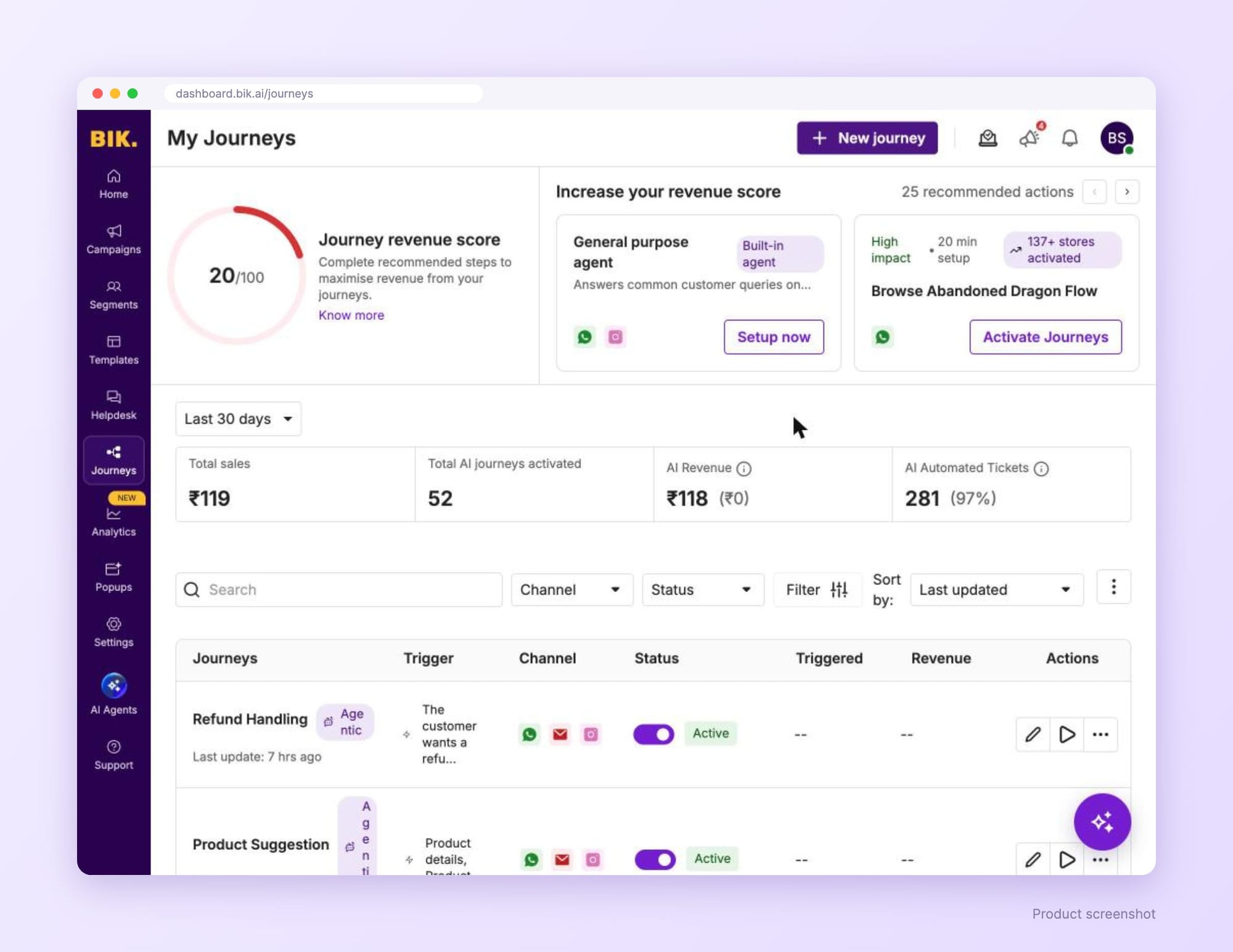
Five automations to start with
- Abandoned cart: WhatsApp first, email as fallback, AI agent answering replies.
- Post-purchase cross-sell: a recommendation a few days after delivery, on the channel the customer used to buy. LEGO India runs a post-purchase cross-sell flow on WhatsApp.
- Instagram comment-to-DM: reply to product questions in comments with a DM and a product link. Read more about Instagram chatbots.
- COD to prepaid: confirm COD orders and offer a reason to pay online.
- Win-back: reach lapsed customers on the channel they last engaged with.
For campaign ideas you can copy, see 25 WhatsApp campaign examples from ecommerce brands.
How BIK and Manifest AI solve this
BIK is an AI-first multichannel marketing platform for Shopify brands, covering WhatsApp, Instagram, email and SMS with campaigns, journeys, segments and a helpdesk on one customer profile. Manifest AI adds the AI agents that sell and support across the same channels, from product discovery on your website to replies on WhatsApp and Instagram. Brands on BIK report results such as a 35% increase in repeat purchases within three months at Fuaark and a 70% increase in repeat purchase rate at Recode Studios. Comparing tools? Read BIK vs Klaviyo for WhatsApp and email.
80%+ of tickets automated, or your money back. That's the Manifest AI guarantee, written into your contract.
FAQ
What challenges do Shopify brands face without multichannel AI marketing automation?
Heavy dependence on email, manual WhatsApp and Instagram, slow replies to high-intent messages, generic messaging, single-channel recovery flows, weak repeat purchase programmes and growth limited by team size.
What is multichannel AI marketing automation?
It is software that runs marketing journeys and campaigns across email, WhatsApp, Instagram and SMS from one customer profile, with AI agents that answer and sell in conversations on those channels.
Is WhatsApp marketing worth it for Shopify brands?
For many brands, yes, especially in markets where customers already use WhatsApp daily. It works best for cart recovery, order updates and repeat purchases, with message costs that depend on the country and message category. Our WhatsApp marketing for Shopify guide covers setup and costs.
Can I keep my email tool and add WhatsApp and Instagram automation?
Yes. Many brands start by adding WhatsApp and Instagram journeys alongside their existing email tool, then consolidate once they see the results.
How long does it take to set up multichannel automation?
Core journeys such as abandoned cart and order updates can be live within days on Shopify. A full programme with segments, campaigns and AI agents typically takes a few weeks.
See multichannel journeys and AI agents running on your Shopify store. Book a demo.