.png)
Sierra Alternatives for Ecommerce Brands (2026)
Looking beyond Sierra? We compare six AI agent platforms for ecommerce brands, including Manifest AI, Decagon, Ada, Intercom Fin, Yuma AI and Gorgias AI Agent, by focus, channels, pricing and who each is best for.

The best Sierra alternatives for ecommerce brands in 2026 are Manifest AI, Decagon, Ada, Intercom Fin, Yuma AI and Gorgias AI Agent. Sierra is a strong enterprise conversational AI platform, but brands that want a commerce-specific agent, published pricing or a faster no-code setup often find a better fit elsewhere. The right pick depends on your size, your helpdesk and whether you need the agent to sell as well as support.
Manifest AI is our product; we've tried to represent every tool fairly. Competitor details were checked against each company's own website in October 2026.
Why ecommerce brands look for Sierra alternatives
Sierra (sierra.ai) builds conversational AI agents for large consumer brands across retail, financial services, telecom, healthcare and travel. Its platform includes Agent Studio, Ghostwriter (an agent that builds agents from SOPs and transcripts), Insights for monitoring and testing, and deployment across chat, SMS, WhatsApp, email and voice. It uses outcome-based pricing and lists customers such as Wayfair, SiriusXM and CarMax.
That is a lot of platform. Ecommerce teams usually start looking at alternatives for one of these reasons:
- Fit for mid-market budgets. Sierra does not publish prices, and its sales motion is built around large enterprise contracts.
- Commerce depth. Sierra serves many industries. Some brands want an agent built around Shopify, product catalogs, carts and orders from day one.
- Selling, not only support. Many brands want the same agent to recommend products and recover carts, not just resolve tickets.
- Helpdesk fit. Some teams want an AI layer that plugs into the helpdesk they already run.
Sierra alternatives at a glance
| Tool | Best for | Ecommerce focus | Sells and supports | Pricing model |
|---|---|---|---|---|
| Manifest AI | Shopify-first brands, SMB to mid-market and enterprise | Built for ecommerce | Yes | From $500/month, free trial |
| Decagon | Large enterprises across industries | Cross-industry, some retail customers | Mostly support | Not published, demo required |
| Ada | Enterprises with complex support operations | Cross-industry | Mostly support | Not published, demo required |
| Intercom Fin | Teams wanting an AI agent on top of an existing helpdesk | Cross-industry | Mostly support | $0.99 per resolution |
| Yuma AI | Shopify D2C brands automating tickets in their helpdesk | Built for ecommerce | Support first, sales widget | Outcome-based, 30-day trial |
| Gorgias AI Agent | Shopify brands already on Gorgias | Built for ecommerce | Yes | Pay per resolution on top of helpdesk plan |
1. Manifest AI
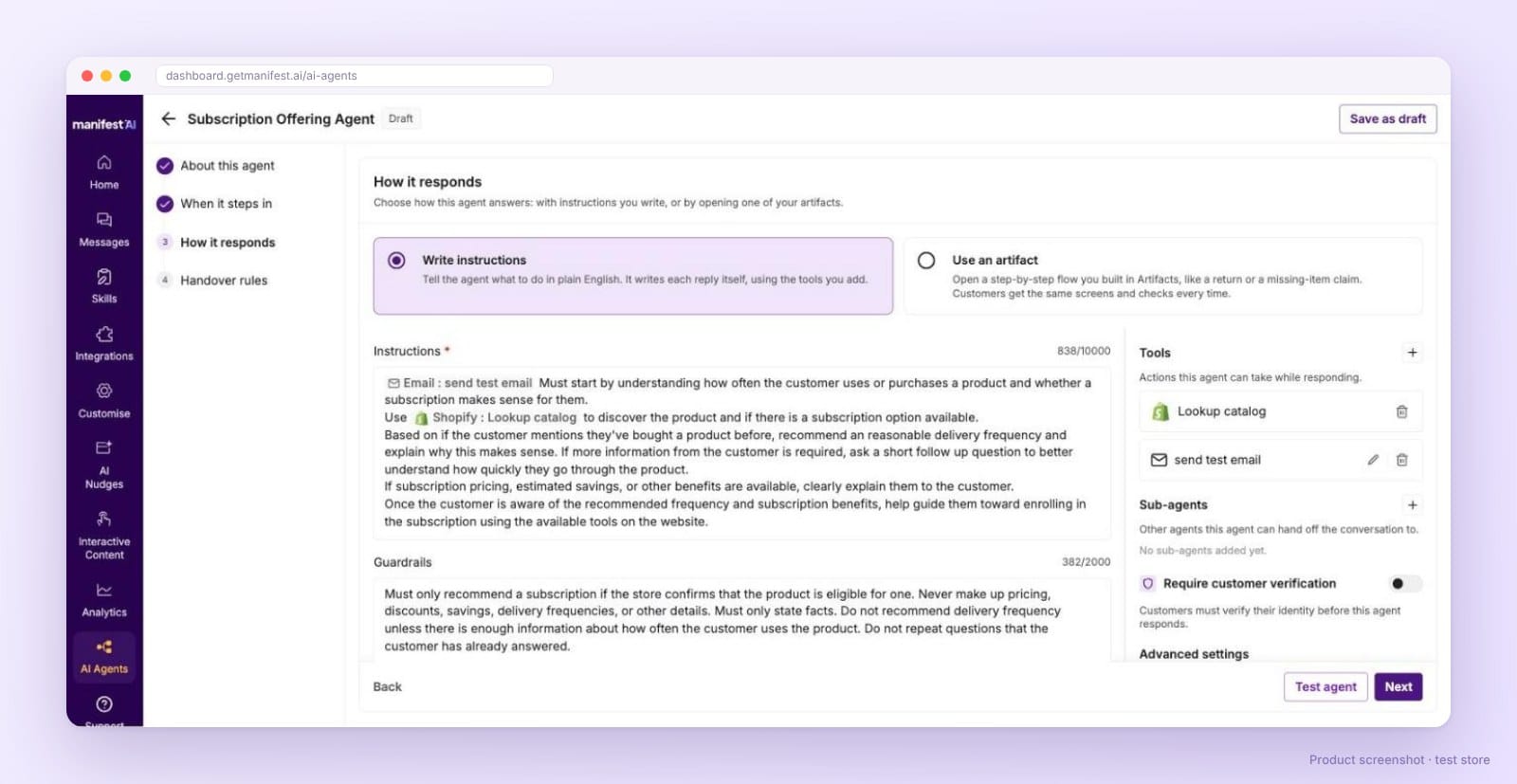
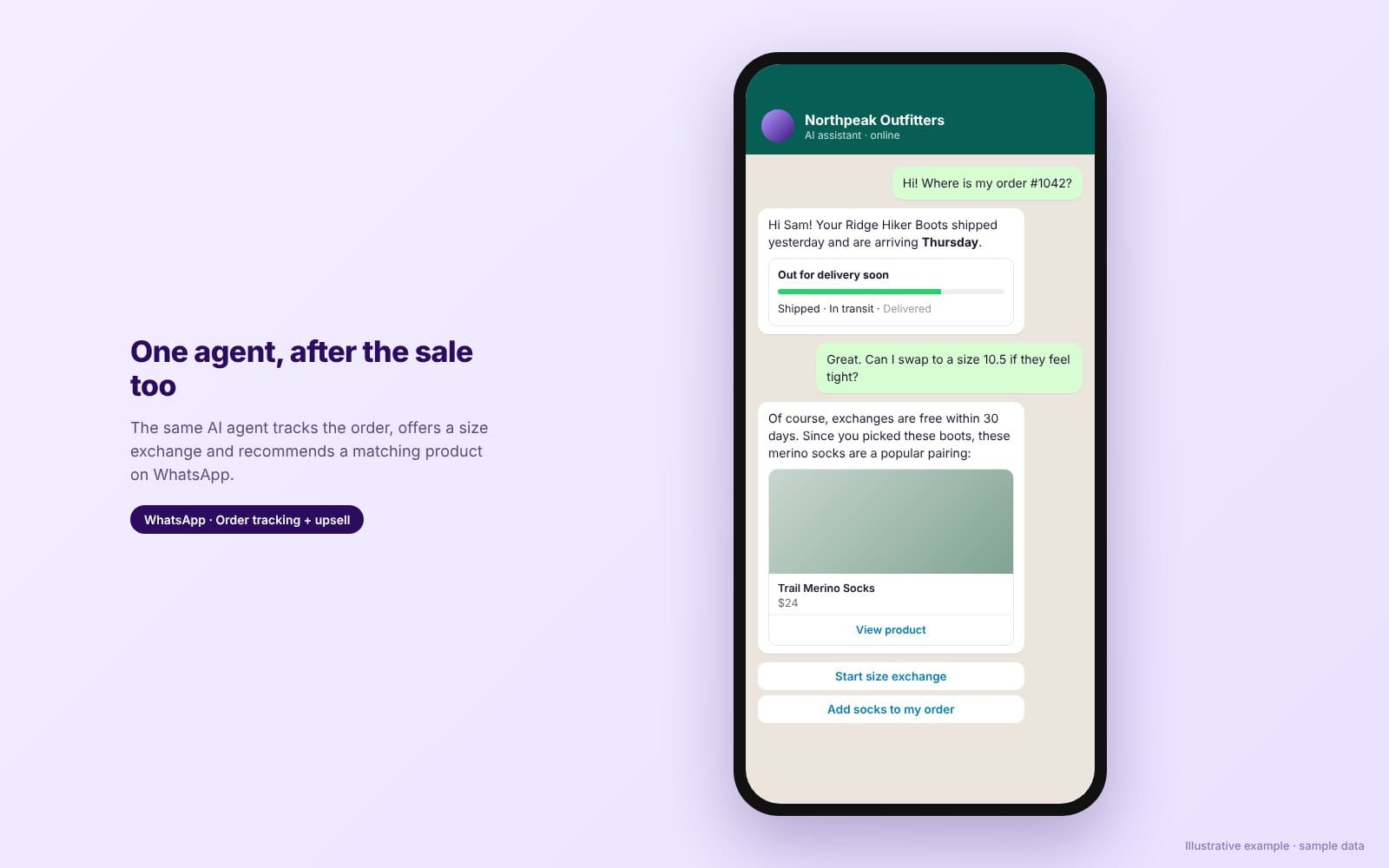
Manifest AI is an agentic AI platform built specifically for ecommerce and retail brands. Its no-code Agent Studio lets your team build AI agents that sell and support across the storefront, WhatsApp, Instagram, email and post-purchase journeys like order status, returns and WISMO.
Key strengths
- One agent for sales and support: product discovery, recommendations, upsell and cart recovery alongside FAQs, order tracking and returns.
- Omnichannel by default, including WhatsApp and Instagram, which matter for many D2C brands.
- No-code Agent Studio, so ecommerce and CX teams can build and change flows without engineering.
- Related products in the same stack: AI Voice Calling for cart recovery, Campaign Manager, an omnichannel inbox and AI search for Shopify.
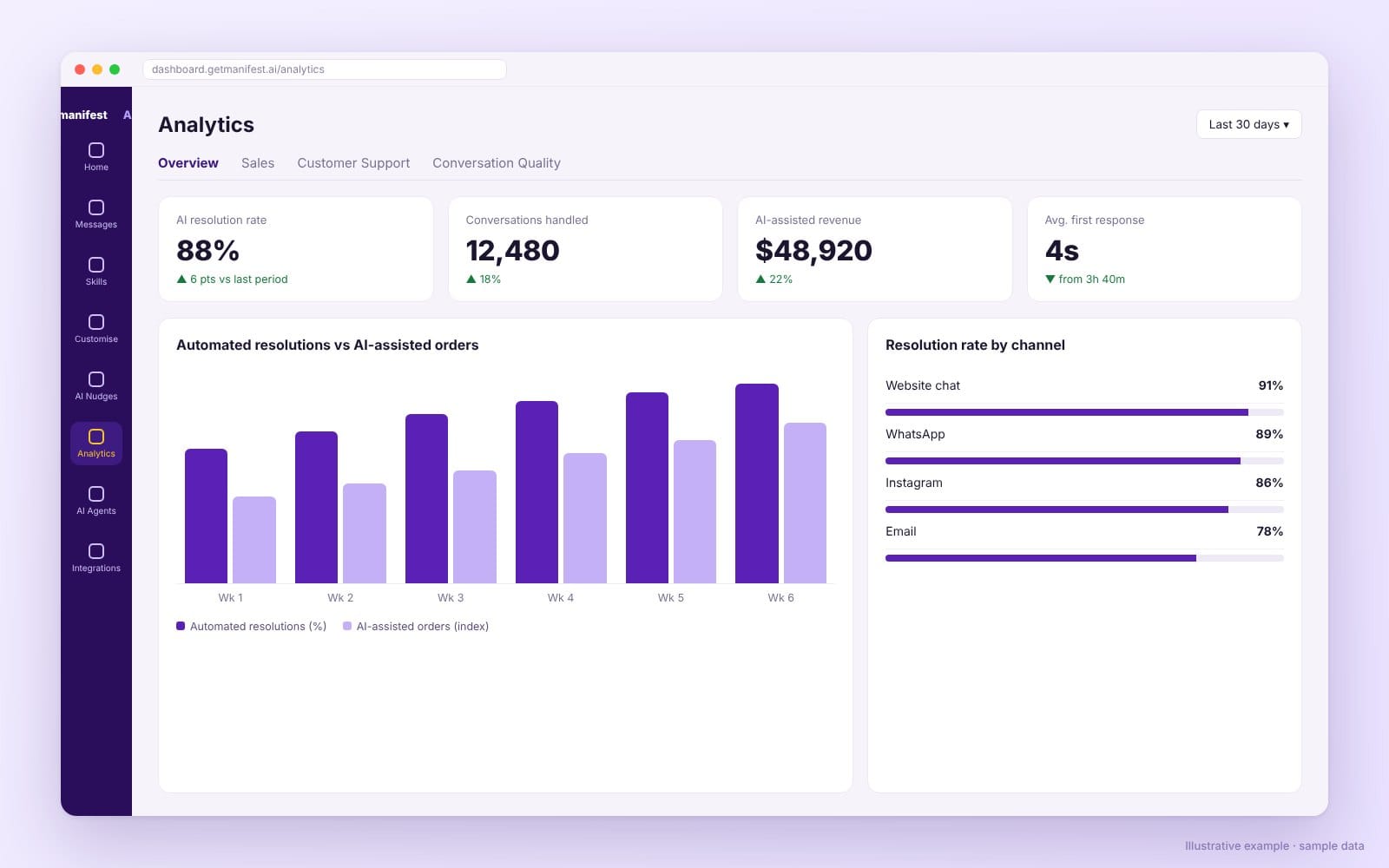
- Brands report up to 90% ticket automation and conversion lifts of 20-45% from the AI shopping assistant. Results vary by catalog and traffic.
Considerations: Manifest AI is built for commerce. If you run a bank, an airline or a telecom, a cross-industry platform like Sierra, Decagon or Ada will be a closer match.
Pricing: starts at $500/month with tiers from small business to enterprise, plus a startup plan. There is no free plan, but there is a free trial.
2. Decagon
Decagon positions itself as an AI concierge for every customer. Brands define agent behavior with Agent Operating Procedures (AOPs), which are workflows written in natural language, and deploy across voice, chat and email. It includes testing, A/B experimentation, analytics and a QA layer called Watchtower.
Key strengths: a mature enterprise platform, natural-language workflow control and strong analytics. Its customer list includes consumer brands such as Rituals Cosmetics, Fanatics and Hunter Douglas.
Considerations: Decagon serves many industries and is aimed at large enterprises. Pricing is not published, so expect a sales-led process.
Best for: enterprise brands that want a Sierra-class platform with a different workflow model.
3. Ada
Ada describes itself as an enterprise agentic customer experience platform. It offers Playbooks to automate complex SOPs, "Ada Computer" for taking actions through APIs, code and MCP tools, and deployment across voice, messaging and email. Ada lists HIPAA, SOC 2, GDPR and PCI DSS compliance.
Key strengths: long track record in support automation, strong compliance and a broad customer base that includes beauty subscription brand IPSY.
Considerations: Ada is support-focused and cross-industry. Pricing is not published.
Best for: large support organizations with strict compliance needs.
4. Intercom Fin
Fin is Intercom's AI agent. It works inside Intercom and also on top of other helpdesks, including Salesforce, HubSpot, Freshworks, Front, Zoho and Gorgias. Fin runs on chat, email, voice and social channels such as WhatsApp, SMS and Instagram.
Key strengths: transparent pricing at $0.99 per resolution (with a 50-resolution monthly minimum when used with a non-Intercom helpdesk), quick setup and a polished product.
Considerations: Fin is a general-purpose support agent. It is not built around product catalogs, carts or shopping journeys.
Best for: teams that want predictable per-resolution pricing and do not want to replace their helpdesk.
5. Yuma AI
Yuma AI is built for ecommerce customer service, mainly Shopify D2C brands. It works inside your existing helpdesk (Gorgias, Zendesk, Kustomer, Gladly, Re:amaze, Salesforce Service Cloud and Front) and handles WISMO, returns, refunds and subscription changes with pre-built automations. It also offers a sales recommendation widget and social comment automation.
Key strengths: deep ecommerce support workflows, outcome-based pricing and a 30-day free trial with onboarding included.
Considerations: Yuma is support-first and sits on top of your helpdesk rather than acting as a full omnichannel commerce agent.
Best for: Shopify brands that want to automate a high volume of helpdesk tickets.
6. Gorgias AI Agent
Gorgias is a helpdesk widely used by Shopify brands, and its AI Agent is available on every plan. You pay per resolved conversation on top of your helpdesk plan, with voice and SMS as usage-based add-ons.
Key strengths: native to a helpdesk many Shopify teams already use, with ecommerce context built in.
Considerations: it makes the most sense if Gorgias is your helpdesk. If you are not on Gorgias, you are buying a helpdesk too.
Best for: Shopify brands already running support in Gorgias.
Why Manifest AI is the most cost-effective option
Sticker price is only part of what an AI agent costs. Per-seat and per-resolution pricing gets more expensive as conversation volume grows, and most tools leave you to build, test and maintain the agents yourself. Manifest AI is built to be the highest-ROI platform in this category: it has the lowest cost once real usage kicks in, and it includes the expert help other tools charge extra for or leave to your team.
- Lowest cost at real usage. As your conversation volume grows, your cost per conversation on Manifest AI stays among the lowest in the market, so support savings and AI-driven revenue compound instead of being eaten by usage fees.
- Bespoke, done-for-you agents. Our team builds all of your AI agents during onboarding, and keeps building new ones for as long as you are with us. Submit a request and we build it, so you do not need an in-house AI team or an agency.
- Customer support 7 days a week. Our support team is available every day, including weekends, when ecommerce traffic and support volume often peak.
- Live in about two weeks. Because we build the agents with you, most brands go live in about two weeks.
How to choose a Sierra alternative
- Decide if the agent should sell. If you want product discovery, recommendations and cart recovery from the same agent that handles support, shortlist commerce-native platforms like Manifest AI. If you only need ticket deflection, Fin, Yuma, Decagon and Ada are all strong.
- Map your channels. List where customers actually talk to you. For brands where WhatsApp and Instagram drive a large share of conversations, check how native each tool's support for those channels is.
- Check your helpdesk. If you want to keep your helpdesk, Fin, Yuma and Gorgias plug in cleanly. If you want one platform for agent, inbox and campaigns, look at Manifest AI.
- Be honest about scale and budget. Sierra, Decagon and Ada are built for large enterprise contracts. Mid-market brands often get faster value from tools with published pricing and self-serve trials.
- Ask who builds and maintains the agent. A no-code builder lets your CX team iterate weekly. A vendor-managed build can be powerful but slower to change.
- Run a pilot on real conversations. Test each shortlisted tool against your top 20 ticket types and a handful of shopping questions before you sign.
Verdict
Sierra is an excellent choice for large enterprises that want a cross-industry platform and a vendor partnership. For ecommerce brands, the best alternative depends on what you need. Choose Manifest AI if you want one no-code agent that sells and supports across web, WhatsApp, Instagram and email at mid-market pricing. Choose Decagon or Ada for enterprise-scale support across many lines of business. Choose Intercom Fin, Yuma AI or Gorgias AI Agent if you want to add AI resolution to the helpdesk you already run.
FAQ
What is Sierra AI?
Sierra is a conversational AI company that builds customer-facing AI agents for large enterprises. Its platform covers agent building, monitoring and deployment across chat, SMS, WhatsApp, email and voice, with outcome-based pricing.
Is there a cheaper alternative to Sierra for ecommerce?
Yes. Sierra does not publish pricing and focuses on enterprise contracts. Manifest AI starts at $500/month, Intercom Fin charges $0.99 per resolution, and Yuma AI and Gorgias AI Agent charge per resolved ticket. Your total cost depends on conversation volume.
Which Sierra alternative is best for Shopify brands?
Manifest AI, Yuma AI and Gorgias AI Agent are all built with Shopify brands in mind. Manifest AI covers sales and support across channels, Yuma focuses on helpdesk ticket automation, and Gorgias AI Agent is native to the Gorgias helpdesk.
Can an AI agent increase sales, not just reduce tickets?
Yes, if it is built for commerce. Agents that understand your catalog can recommend products, answer pre-purchase questions and recover carts. Brands using Manifest AI's shopping assistant report conversion lifts of up to 20-45%, though results vary.
Which Sierra alternatives support WhatsApp?
Manifest AI, Intercom Fin and Sierra itself all list WhatsApp support. Check each vendor for the depth of WhatsApp features you need, such as order updates and product messages.
How long does it take to switch from Sierra?
It depends on how many workflows you have built. Most of the work is re-creating your SOPs, connecting order and catalog data, and testing. No-code builders like Manifest AI's Agent Studio let your own team rebuild flows without waiting on engineering.
Looking for an AI agent built for ecommerce that sells and supports on every channel? Start a free trial or book a demo with Manifest AI and see it working on your own catalog.