.png)
Zendesk Alternatives for Ecommerce Brands (2026)
Zendesk is powerful but generic. We compare seven Zendesk alternatives built for ecommerce, from Shopify-native helpdesks to AI agents that sell and support, with pricing models and who each one fits.
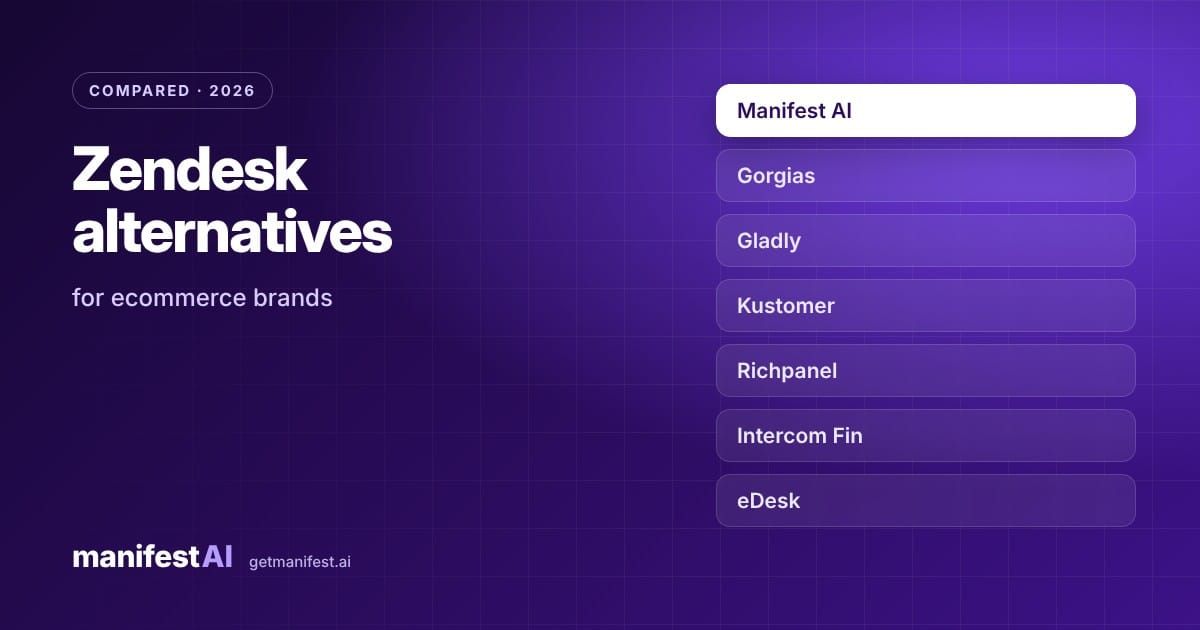
The best Zendesk alternatives for ecommerce brands in 2026 are Manifest AI (an AI agent platform that sells and supports across web, WhatsApp, Instagram and email), Gorgias (the Shopify-native helpdesk), Gladly (customer-centric service for premium retail), Kustomer (CRM-style service for larger brands), Richpanel (ecommerce helpdesk with automation guarantees), Intercom with Fin (a leading AI support agent) and eDesk (marketplace sellers). Mid-market brands usually switch because they want ecommerce context out of the box, simpler setup and AI that drives revenue, not only deflection.
Manifest AI is our product; we've tried to represent every tool fairly. Pricing and features were checked against each vendor's public site in October 2026 and can change.
Why ecommerce brands outgrow Zendesk
Zendesk is a capable, mature helpdesk used across nearly every industry. Its AI agents are positioned around autonomous, multi-step resolution, and its Suite plans cover messaging, email and voice. That breadth is also why mid-market ecommerce teams sometimes find it heavy:
- Generic by design. Zendesk serves SaaS, finance, travel and more. Order lookups, returns and product questions usually need apps, custom fields and admin time to configure.
- Per-agent pricing. On the October 2026 pricing page, Suite Team is $55 and Suite Professional is $115 per agent/month (annual). Plans include 5 or 10 automated resolutions per agent per month, with more at $1.50 (committed) or $2.00 (pay as you go).
- Support-only AI. Ecommerce teams increasingly want the AI that answers "where is my order" to also answer "which size should I get" and recover the cart.
- Admin overhead. Smaller CX teams may not have a dedicated Zendesk admin.
Zendesk alternatives at a glance
| Tool | Best for | Ecommerce focus | Pricing model (Oct 2026) |
|---|---|---|---|
| Manifest AI | Mid-market brands wanting one AI agent for sales and support on every channel | Built for ecommerce, Shopify-first | From $500/month, free trial, startup plan |
| Gorgias | Shopify brands wanting an ecommerce-native helpdesk | Ecommerce-only | Ticket-volume tiers, unlimited seats; AI Agent billed per resolution |
| Gladly | Premium retail brands focused on lifelong customer relationships | Retail and consumer brands | Not published; contact sales |
| Kustomer | Larger brands wanting a CRM-style, customer-centric platform | Strong in retail, plus other industries | Custom, usage-based |
| Richpanel | Ecommerce teams prioritizing automation rate | Ecommerce-only | $99 per seat/month (annual) plus AI usage; $299/month minimum |
| Intercom (Fin) | Teams wanting a top-tier AI support agent | Dedicated Fin for Ecommerce for Shopify stores | $29 to $132 per seat/month; Fin from $0.99 per resolution |
| eDesk | Sellers on Amazon, eBay, Walmart plus a webstore | Ecommerce and marketplaces | From $39/month (annual); AI Agent $0.99 per outcome |
1. Manifest AI
Best for: Shopify-first, mid-market brands that want AI to resolve support and grow revenue in the same conversation.
Manifest AI is an agentic AI platform built specifically for ecommerce and retail. In Agent Studio, teams build their own AI agents without code. One agent can run as an AI shopping assistant on the storefront and also on WhatsApp, Instagram, email and post-purchase flows such as order status, returns and WISMO.
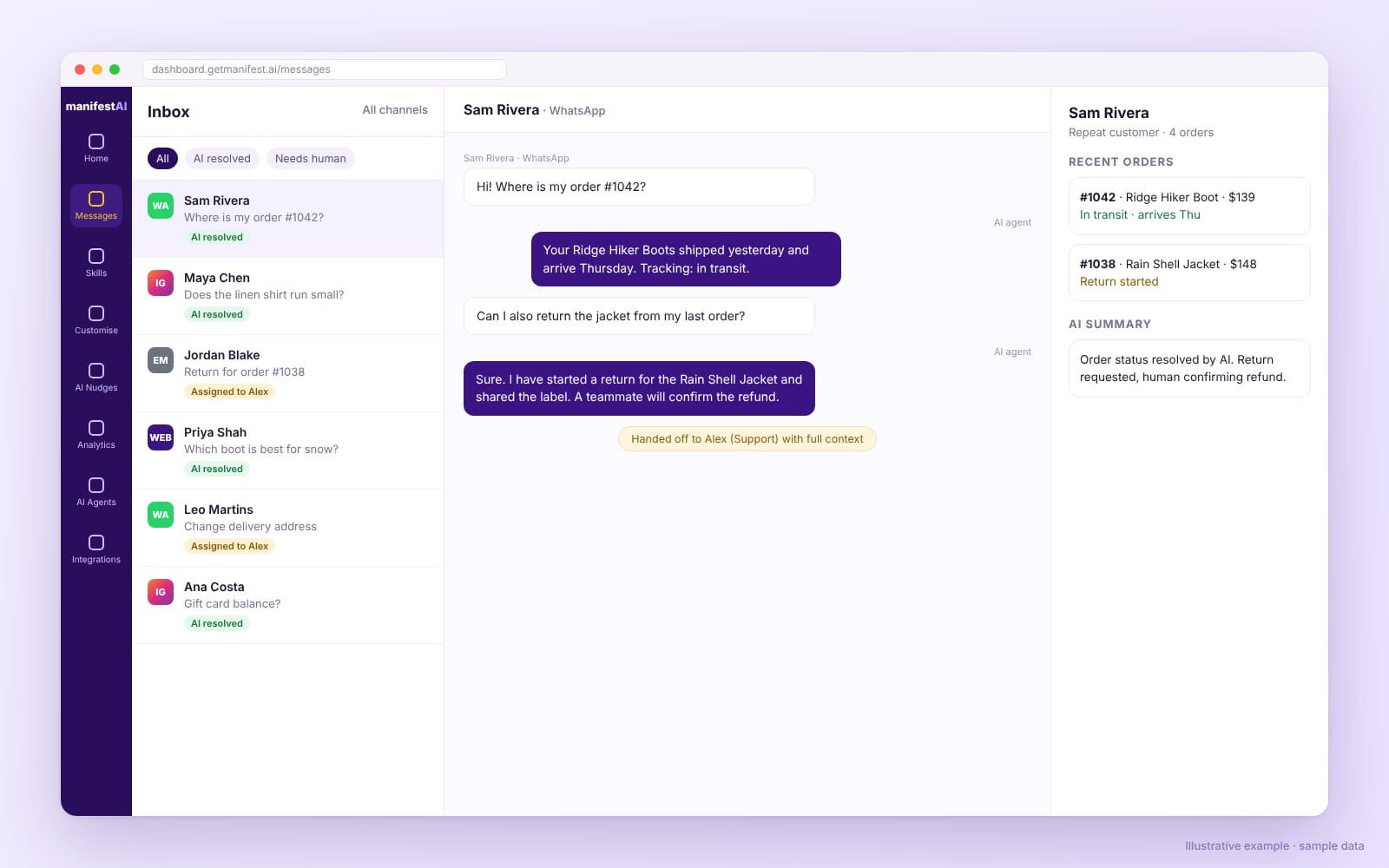
Where Zendesk's AI is focused on resolving tickets, Manifest AI agents also sell: product discovery, recommendations, upsell and cart recovery. Brands report up to 90% ticket automation, and the AI shopping assistant has been reported to lift conversion rates by 20-45%. Your results will depend on catalog, traffic and configuration.
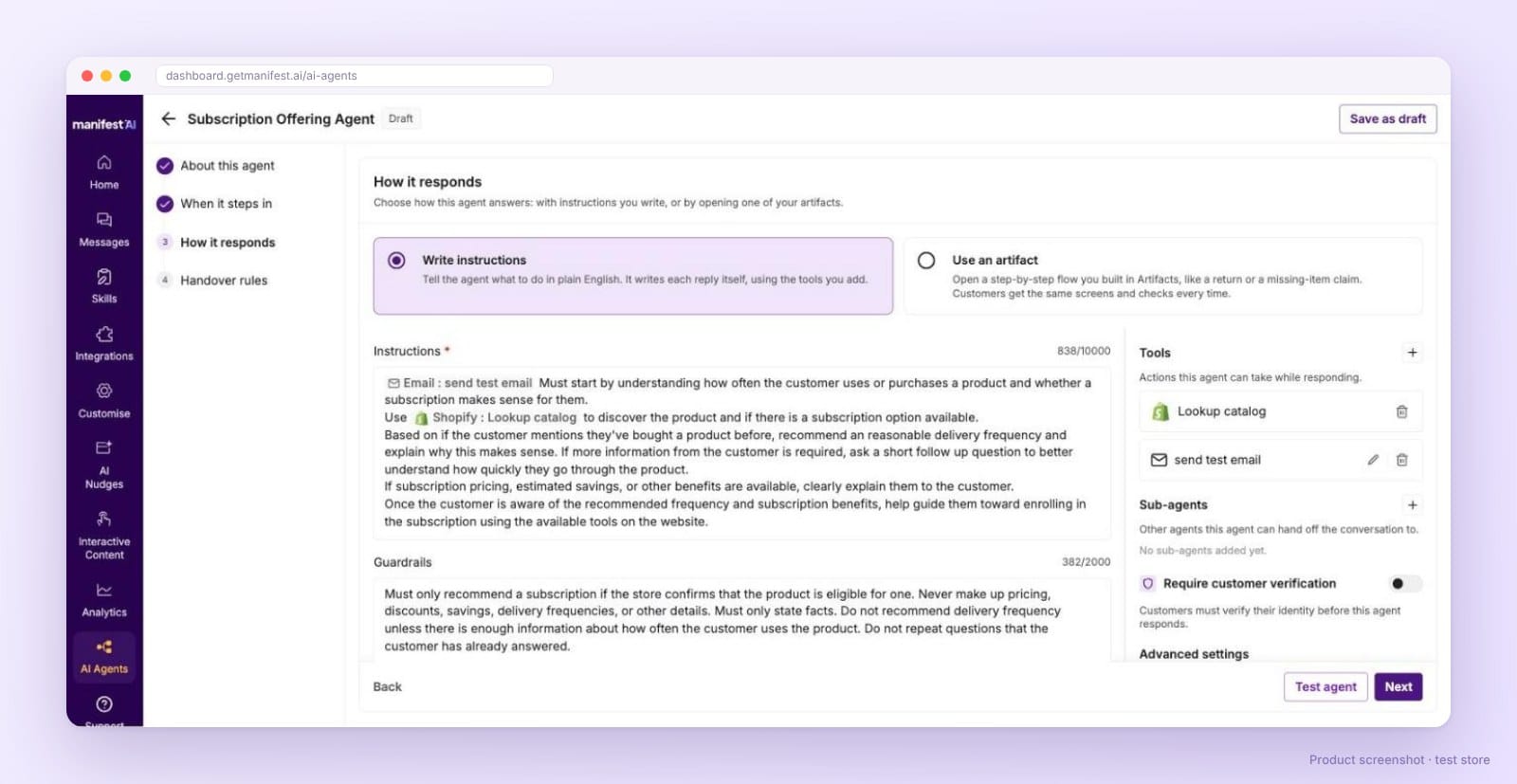
The platform also includes omnichannel support with a unified inbox and automated routing and closure, AI search for Shopify, a Campaign Manager for WhatsApp, email, SMS and Instagram, and AI Voice Calling for multi-language cart recovery. More than 500 brands use it, from SMB to enterprise.
Strengths: ecommerce context built in; sales and support in one agent; WhatsApp and Instagram as first-class channels; no-code building.
Trade-offs: no free plan (free trial available); less of a fit for non-commerce support use cases.
2. Gorgias
Best for: Shopify brands that want a helpdesk built only for ecommerce.
Gorgias puts Shopify order and customer data next to every conversation, supports email, chat, SMS, WhatsApp, Instagram and Facebook in one inbox, and offers 300+ integrations including Recharge, Klaviyo and Loop Returns. Pricing is based on ticket volume (50 to 5,000 tickets a month on standard tiers) with unlimited seats, and its AI Agent is billed when it resolves a conversation. Gorgias says it automates up to 60% of support.
Strengths: deep Shopify integration, no per-seat fees, large ecosystem.
Trade-offs: volume-based costs grow with ticket count; its core is still a ticketing workflow.
3. Gladly
Best for: premium and high-end retail brands that organize service around the customer rather than the ticket.
Gladly keeps a lifelong conversation history per customer across channels and now positions a single AI that handles both sales and service, including product guidance, conversational commerce and voice AI. Its public customer list leans toward large consumer brands. Pricing is not listed publicly.
Strengths: customer-centric model, strong retail pedigree, sales plus service AI.
Trade-offs: typically aimed at larger brands; budget and implementation should be scoped with sales.
4. Kustomer
Best for: larger brands that want a CRM-style service platform with a unified customer timeline.
Kustomer combines omnichannel messaging with a rich customer data model and a family of AI assistants for workflows, knowledge and automation. It serves retail alongside financial services, travel and other sectors, and uses custom, usage-based pricing.
Strengths: flexible data model, enterprise scale, customer timeline.
Trade-offs: more configuration than an ecommerce-native tool; pricing requires a sales conversation.
5. Richpanel
Best for: mid-market ecommerce teams that want high automation with a guarantee.
Richpanel offers AI agents for order and subscription updates, a self-service portal, AI QA across conversations and a returns add-on. The helpdesk is $99 per seat/month on annual billing with usage-based AI and a $299/month minimum. It advertises a money-back guarantee if automation does not reach 50% within 30 days.
Strengths: ecommerce focus, self-service, clear guarantee.
Trade-offs: per-seat model; primarily a support tool.
6. Intercom (Fin)
Best for: teams that want a leading AI support agent and a modern inbox.
Fin is one of the strongest general AI agents on the market. Intercom offers "Fin for Ecommerce," which it says is only available to Shopify-powered businesses, covering recommendations, order tracking, returns and exchanges. Fin runs across chat, email, voice and social messaging including WhatsApp and Instagram. Seats are $29 to $132 per month, and Fin starts at $0.99 per resolution.
Strengths: answer quality, multi-step Procedures, polished UI.
Trade-offs: seat plus outcome pricing to model; ecommerce is one of several focus areas.
7. eDesk
Best for: brands that sell heavily through marketplaces as well as their own store.
eDesk unifies Amazon, eBay, Walmart and other marketplace messages with Shopify and social channels. Plans start at $39/month on annual billing, and its AI Agent costs $0.99 per outcome.
Strengths: marketplace breadth, AI translation, accessible pricing.
Trade-offs: less focused on on-site conversational selling.
Why Manifest AI is the most cost-effective option
Sticker price is only part of what an AI agent costs. Per-seat and per-resolution pricing gets more expensive as conversation volume grows, and most tools leave you to build, test and maintain the agents yourself. Manifest AI is built to be the highest-ROI platform in this category: it has the lowest cost once real usage kicks in, and it includes the expert help other tools charge extra for or leave to your team.
- Lowest cost at real usage. As your conversation volume grows, your cost per conversation on Manifest AI stays among the lowest in the market, so support savings and AI-driven revenue compound instead of being eaten by usage fees.
- Bespoke, done-for-you agents. Our team builds all of your AI agents during onboarding, and keeps building new ones for as long as you are with us. Submit a request and we build it, so you do not need an in-house AI team or an agency.
- Customer support 7 days a week. Our support team is available every day, including weekends, when ecommerce traffic and support volume often peak.
- Live in about two weeks. Because we build the agents with you, most brands go live in about two weeks.
How to choose a Zendesk alternative for ecommerce
- List your top ticket types. If 50% or more are order status, returns and product questions, an ecommerce-native platform will save setup time.
- Decide whether AI should sell. If pre-purchase questions and cart recovery matter, shortlist tools whose agents recommend products and recover carts, such as Manifest AI or Gladly.
- Check your channel mix. WhatsApp, Instagram and marketplaces vary a lot across tools.
- Compare pricing models at your volume. Per-agent, per-ticket, per-resolution and flat platform fees behave very differently as you scale.
- Ask for a migration plan. Historical tickets, macros, routing rules and reporting all need a home.
Verdict
If Zendesk feels heavy for your ecommerce team, Gorgias and Richpanel give you ecommerce context in a helpdesk. Gladly and Kustomer suit larger brands that want a customer-centric platform. Intercom with Fin is strong for AI support quality, and eDesk fits marketplace sellers. If you want one AI agent that both sells and supports across web, WhatsApp, Instagram and email, with a no-code builder and mid-market pricing, Manifest AI is built for that job.
FAQ
What is the best Zendesk alternative for Shopify stores?
Ecommerce-native options are Manifest AI, Gorgias and Richpanel. Choose Manifest AI if you want AI that sells and supports across channels, Gorgias for a Shopify-native helpdesk, or Richpanel for an automation guarantee.
Is Zendesk too expensive for mid-market ecommerce?
It depends on team size. Zendesk charges per agent ($55 to $115 per agent/month annually for Suite Team and Professional) plus extra automated resolutions beyond the included allowance. Teams with many agents or high AI usage should compare total cost against platform or volume-based pricing.
Which Zendesk alternative is best for WhatsApp commerce?
Manifest AI and its sister product BIK treat WhatsApp as a core channel for both support and campaigns. LEGO India runs its WhatsApp experience on BIK. Gorgias and Intercom also support WhatsApp.
Can I keep Zendesk and add an AI agent on top?
Yes, many brands start that way, keeping their helpdesk as the system of record while an AI agent handles front-line conversations and hands off exceptions. Manifest AI integrates with Zendesk for human handover and help-article sync, and also works with Gorgias, Freshdesk and Kustomer.
How long does a migration from Zendesk take?
It depends on your routing rules, macros, integrations and data import needs. Ask each vendor for a dated go-live plan during evaluation.
Want ecommerce-native AI without the heavy setup? Start a free trial or book a demo with Manifest AI and test it on your own conversations.