
Letting an AI Agent Handle Refunds Safely: Refund-Abuse Guardrails, Store-Credit-First Flows and Which Agents Can Act
How to let an AI agent handle refunds without inviting abuse: guardrails, value limits, store-credit-first flows, a rollout plan, and which agents can act.
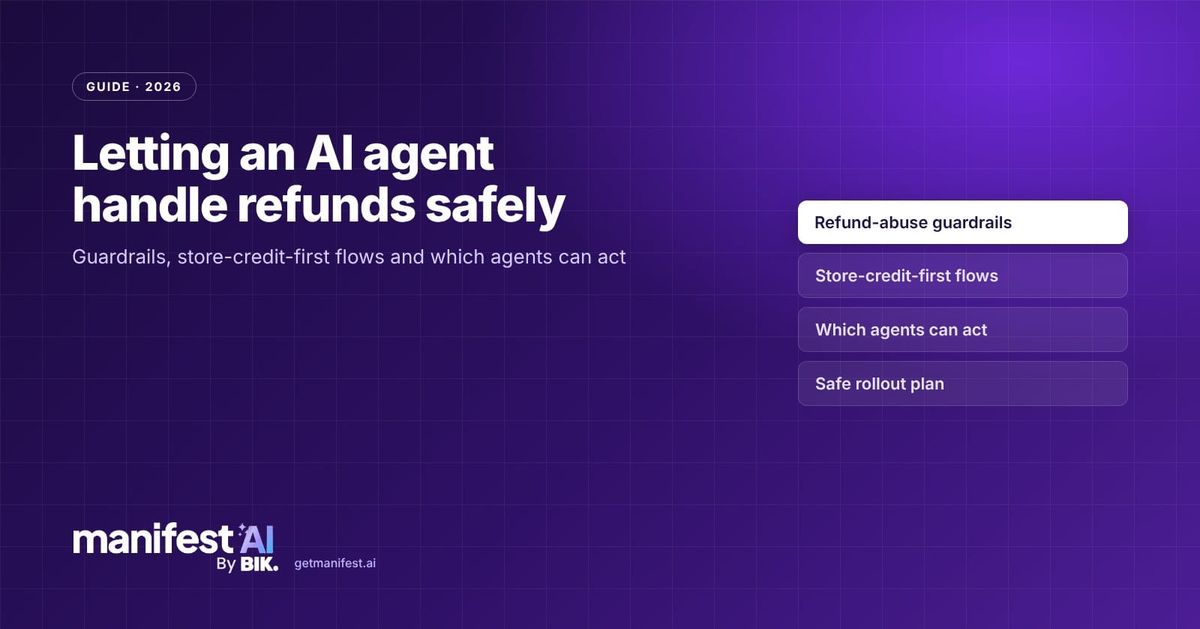
An AI agent can handle refunds safely if it works inside clear guardrails: it checks the order and your policy before acting, offers store credit or an exchange first where your policy allows, sends anything above a value limit or flagged as risky to a person for approval, and logs every action. Without those rules, an AI that refunds on request becomes an easy target for refund abuse, which is growing: in a 2026 Riskified survey of 2,091 consumers, 50% said they had used generative AI to help draft return or refund claims. Manifest AI, Gorgias, Yuma and Siena can all take refund-related actions; the difference is how much control you keep.

Manifest AI is our product; we've tried to describe other tools fairly. Statistics come from Riskified's 2026 returns research. This article is general guidance, not legal advice.
Why refunds need guardrails
- AI-written claims: half of consumers have used generative AI to help draft return or refund claims.
- Return "hacks" spread on social: 51% of consumers have seen return-related content on social platforms, and some act on it.
- Bots are consistent: if an agent refunds every time a certain phrase is used, abusers find it fast.
- Refunds are hard to reverse: once money is out, recovering it costs more than preventing it.
Guardrails every refund-capable AI agent needs
- Policy checks first: confirm the order exists, is within the return window and meets item conditions before offering anything.
- Value limits: let the AI act alone below a set amount; above it, route to a person.
- Customer history: flag customers with high return rates, repeated "item not received" claims or recent chargebacks.
- Evidence for damage claims: ask for photos before refunding damaged or wrong items.
- Delivery data: check carrier tracking before refunding "not received" claims.
- Human approval until trust is earned: start with AI proposing and people approving, then widen autonomy for low-risk cases.
- Full audit log: record what the AI looked up, what it offered and why.
Looking for an AI agent built for ecommerce? Manifest AI sells and supports across chat, email, Instagram and WhatsApp.
Store-credit-first flows
Offering store credit or an exchange before a cash refund keeps revenue and discourages abuse, as long as it's fair and matches your published policy.
- Exchange first for size and color issues: the shopper keeps the product they wanted.
- Store credit with a bonus (for example 10% extra) as an alternative to a refund.
- Refund to original payment when the customer asks or the law requires it; never hide the refund option.
- Be transparent: state the options clearly; consumer law in many markets gives buyers refund rights.
Which AI agents can act on refunds
| Tool | Refund-related actions | Controls |
|---|---|---|
| Manifest AI | Starts returns, exchanges and cancellations in Shopify; can offer an exchange first per your policy | Policy rules, value limits and human handoff configured by our team |
| Gorgias AI Agent | Refunds, cancellations and order edits from Gorgias | Rules and handover settings in Gorgias |
| Yuma AI | Refunds and order actions inside your helpdesk | Per-action approvals and rules |
| Siena AI | Order actions via helpdesk and Shopify | Workflow-level controls |
| Macha | Refunds and order changes via Shopify, Stripe or your APIs | Human approval per action until autonomy is switched on |
A safe rollout plan
- Week 1: AI answers return questions and collects details; people approve every action.
- Weeks 2 to 3: AI completes exchanges and store credit under a value limit; refunds still need approval.
- Week 4 onward: AI completes low-value refunds for customers with clean history; review weekly.
See what your brand could automate. Our team builds the agents for you, and most brands are live in about 2 weeks.
How Manifest AI handles refunds and returns
Manifest AI is an AI shopping assistant and support agent for ecommerce brands, used by 500+ brands and backed by Y Combinator. It resolves returns, exchanges and cancellations in Shopify following your policy, can offer an exchange first where you choose, and hands refunds and risky cases to your team with a summary. Our team builds and tunes these rules with you.
Pricing: $0.05 per AI reply with a $500/month minimum, a 30-day free trial, and a guarantee of 80%+ automation within 30 days or your money back.
Verdict
Let AI handle refunds the way you'd train a new agent: clear policy, value limits, evidence for risky claims and human approval until it proves itself. Store-credit-first flows protect revenue when they're fair and transparent. With those guardrails, an AI agent can resolve most return requests in seconds without opening the door to abuse.
80%+ of tickets automated, or your money back. That's the Manifest AI guarantee, written into your contract.
FAQ
Is it safe to let an AI agent issue refunds?
Yes, with guardrails: policy checks, value limits, customer-history flags, evidence for damage claims, human approval for risky cases and a full audit log.
Should I offer store credit before a refund?
Offering an exchange or store credit first can keep revenue, but always make the refund option clear and follow consumer law in your markets.
How common is refund abuse?
Riskified's 2026 research found 50% of consumers have used generative AI to help draft return or refund claims, and 85% see some strategic return behavior as normal.
Which AI agents can process refunds in Shopify?
Manifest AI, Gorgias AI Agent, Yuma, Siena and Macha can all take refund-related actions, with different levels of control.