.png)
Best AI Agents for Ecommerce Customer Support (2026)
A fair comparison of six AI agents for ecommerce customer support: Manifest AI, Yuma AI, Siena AI, Gorgias AI Agent, Intercom Fin and Ada, with channels, pricing models and who each one is best for.
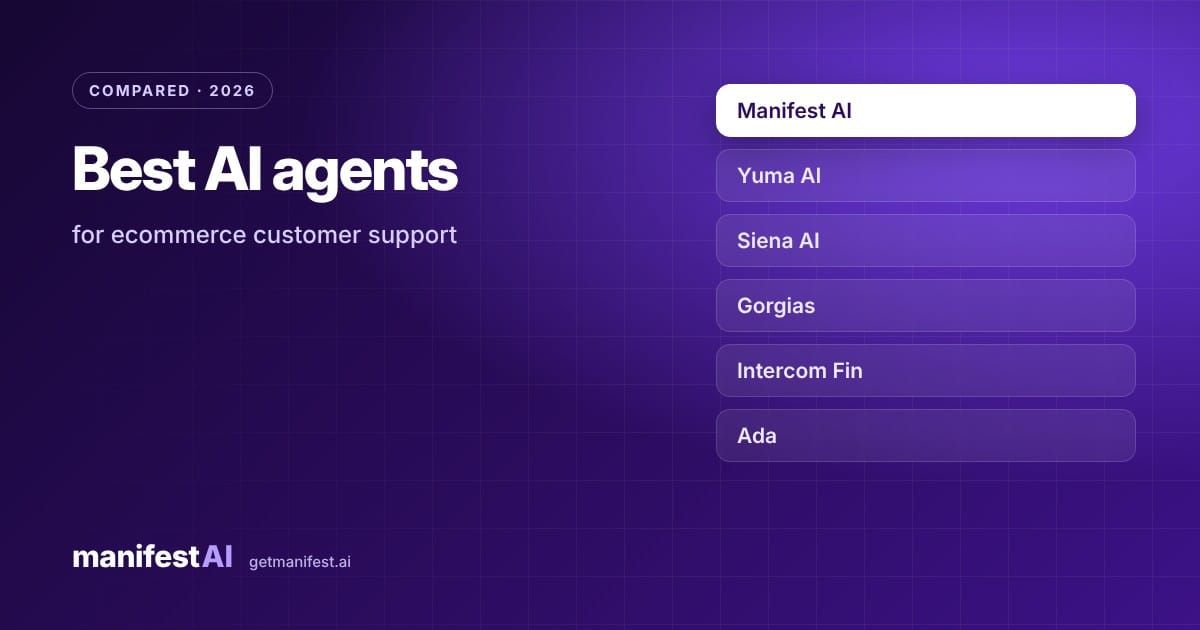
The best AI agents for ecommerce customer support in 2026 are Manifest AI, Yuma AI, Siena AI, Gorgias AI Agent, Intercom Fin and Ada. Manifest AI fits Shopify-first brands that want one agent to sell and support across web, WhatsApp, Instagram and email; Yuma and Siena fit brands that want to automate tickets inside their existing helpdesk; Gorgias suits brands already on Gorgias; Fin and Ada suit larger teams with complex, multi-industry support operations.
Manifest AI is our product; we've tried to represent every tool fairly. Competitor details were checked on each vendor's own website in October 2026.
What to look for in an ecommerce support AI agent
Generic chatbots answer FAQs. An ecommerce AI agent has to take action: look up an order, start a return, change a subscription, recommend the right size and recover a cart. Before you compare tools, decide what matters most for your store:
- Actions, not just answers. Can the agent read and act on Shopify orders, shipping and returns data?
- Channels. Where do your customers actually message you? Web chat, email, WhatsApp, Instagram, phone?
- Sales vs support. Do you only want ticket deflection, or do you also want the agent to drive revenue?
- Helpdesk fit. Do you want an AI layer on top of your current helpdesk, or a platform that replaces parts of it?
- Pricing model. Per resolution, per ticket, platform fee, or custom enterprise contract.
- Time to value. Weeks with a no-code builder, or months with a services-led rollout.
Comparison table
| Tool | Best for | Channels | Sales + support | Pricing model |
|---|---|---|---|---|
| Manifest AI | Shopify-first SMB to mid-market brands wanting one agent across channels | Website, WhatsApp, Instagram, email, AI voice calling | Yes, built for both | From $500/month, startup plan, free trial |
| Yuma AI | High-volume D2C brands automating tickets in their helpdesk | Email/helpdesk tickets, website chat, Facebook, Instagram | Support-led, Sales AI add-on | Pay per resolved ticket, annual plans, 30 days free |
| Siena AI | Fast-growing consumer brands focused on brand voice | Helpdesk channels, chat | Yes, Customer Service and Shopping agents | $750/month platform fee plus $0.90 per ticket |
| Gorgias AI Agent | Shopify brands already using Gorgias helpdesk | Email, chat, social, plus voice/SMS add-ons | Yes, support plus shopping assistant | Helpdesk plan plus pay per AI resolution |
| Intercom Fin | Teams wanting a strong AI agent on any helpdesk | Chat, email, phone and more | Support-led | $0.99 per outcome, plus seats if on Intercom |
| Ada | Enterprises across many industries with strict compliance needs | Messaging, voice, email | Support-led | Custom quote |
1. Manifest AI
Manifest AI is an agentic AI platform built specifically for ecommerce and retail brands. Its Agent Studio lets teams build their own AI agents without code, then deploy them on the storefront (as an AI shopping assistant), WhatsApp, Instagram, email and post-purchase flows like order status, returns and WISMO ("where is my order") questions.
The main difference from most tools on this list is that a Manifest agent both sells and supports. The same agent can help a shopper find the right product, recommend an upsell and recover an abandoned cart, then later answer a tracking question or start a return. Brands report up to 90% ticket automation, and the company reports that its AI shopping assistant improves conversion rates by 20-45%. Results vary by catalog, traffic and setup.
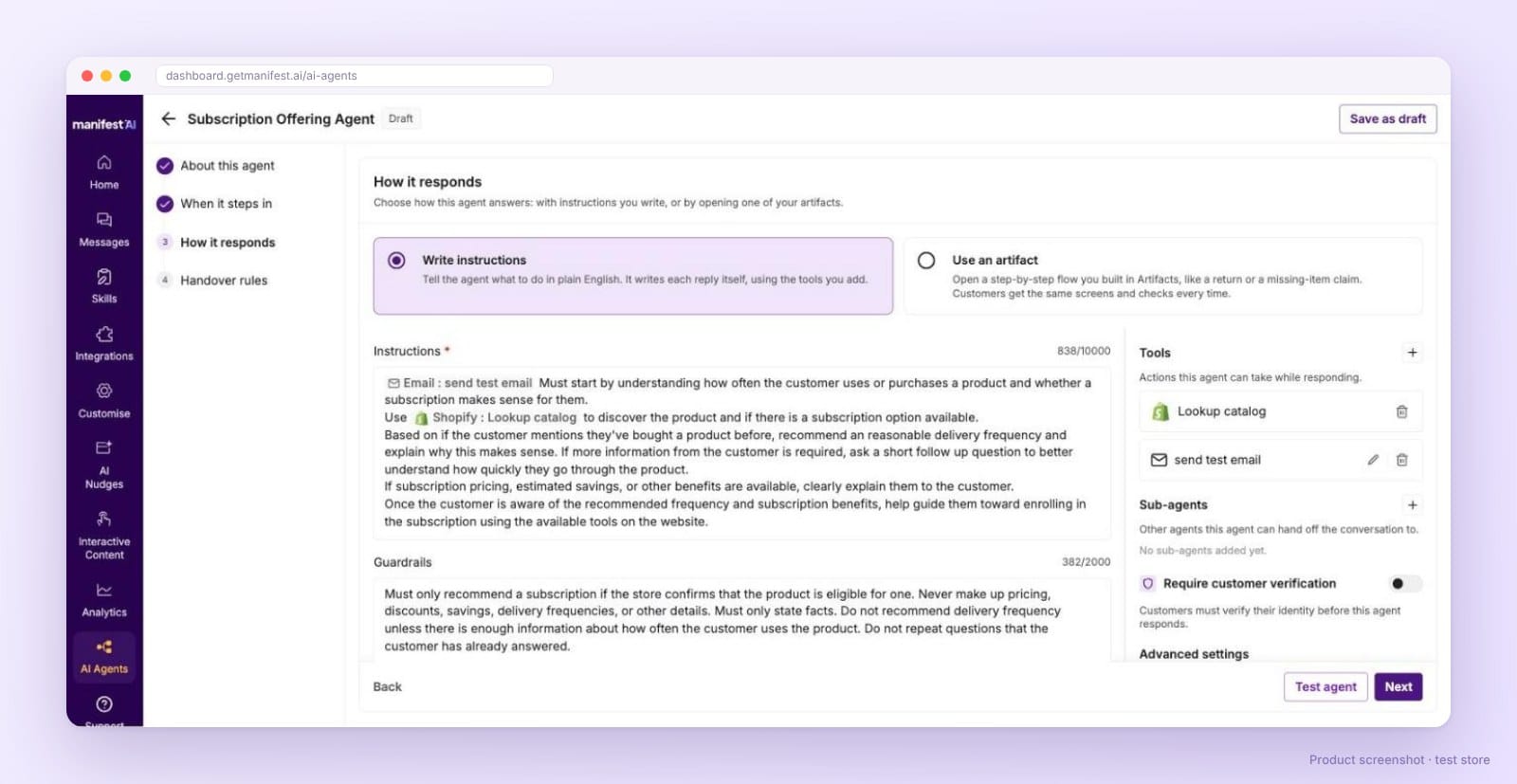
Beyond the agent, Manifest includes AI Voice Calling (human-like calls for cart recovery, in multiple languages), Campaign Manager for WhatsApp, email, SMS and Instagram campaigns, an omnichannel support inbox with automated routing and closure, and AI search for Shopify. More than 500 brands use the platform. Its sister product BIK powers WhatsApp commerce for brands such as LEGO India.
- Strengths: sales and support in one agent, true omnichannel including WhatsApp and Instagram, voice calling, no-code builder, mid-market pricing.
- Trade-offs: no free plan (there is a free trial), and pricing sits above entry-level chat widgets.
- Pricing: starts at $500/month with flexible tiers up to enterprise, plus a startup plan.
- Best for: Shopify brands that sell on WhatsApp, Instagram and web and want revenue plus deflection from one platform.
Manifest AI integrates with helpdesks including Gorgias, Zendesk, Freshdesk and Kustomer for human handover and article sync, and runs on Shopify, WooCommerce, BigCommerce and custom storefronts via API. Brands typically go live in about two weeks.
2. Yuma AI
Yuma AI is an agentic AI platform for ecommerce customer service. It plugs into helpdesks such as Gorgias, Zendesk, Kustomer, Gladly, Re:amaze and Salesforce Service Cloud, and connects to Shopify, WooCommerce, Magento and BigCommerce plus tools like Recharge, Loop Returns and ShipStation. Its Support AI resolves post-purchase tickets like returns, refunds, cancellations and subscription changes, and add-ons cover on-site Sales AI, Social AI for Facebook and Instagram, and Chat AI.
- Strengths: deep post-purchase automation, broad helpdesk and ecommerce integrations, "Ask Yuma" tool to find automation gaps.
- Trade-offs: works as a layer on your helpdesk rather than replacing it; sales and social features are priced separately.
- Pricing: pay per fully resolved ticket on annual plans (Starter listed at $14,400/year), first 30 days free, no seat fees.
- Best for: D2C brands with high ticket volume that want to automate support inside an existing helpdesk.
3. Siena AI
Siena positions itself as an AI CX operating system for consumer brands, with a strong focus on empathetic, on-brand responses. It offers a Customer Service Agent, a Shopping Agent, a Reviews Agent, a QA Agent that scores conversations, and insight tools like Ask Siena and Topics Explorer. It integrates with Shopify, Zendesk, Yotpo, Recharge, AfterShip, ShipBob and Loop.
- Strengths: brand voice and personas, built-in QA and voice-of-customer insights, order tracking across many carriers.
- Trade-offs: fewer messaging channels highlighted than omnichannel platforms; platform fee applies before usage.
- Pricing: $750/month platform fee plus $0.90 per automated ticket, with custom quotes.
- Best for: growing consumer brands that care most about tone, CSAT and support analytics.
4. Gorgias AI Agent
Gorgias is a widely used ecommerce helpdesk; the company says it powers customer conversations for 40% of Shopify brands. Its AI Agent is available on every helpdesk plan and handles support conversations and shopping assistance inside the Gorgias inbox. Voice and SMS are available as add-ons.
- Strengths: native to a helpdesk many Shopify teams already use, no per-seat pricing, simple setup if you are already on Gorgias.
- Trade-offs: you are buying into the Gorgias helpdesk; AI is one part of a ticketing platform rather than the core product.
- Pricing: helpdesk plan based on ticket volume, plus a fee per AI-resolved conversation. [EDITOR: verify current per-resolution price on gorgias.com/pricing]
- Best for: Shopify brands already on Gorgias that want to add AI without changing tools.
5. Intercom Fin
Fin is Intercom's AI agent. It answers across chat, email, phone and other channels and can run on Intercom or on top of another helpdesk such as Salesforce, without requiring seats. It is general-purpose rather than ecommerce-specific, but it is mature and well documented.
- Strengths: strong answer quality, works with your current helpdesk, transparent outcome pricing.
- Trade-offs: not built specifically for commerce, so product discovery and order actions take more configuration.
- Pricing: $0.99 per outcome; Intercom helpdesk seats start at $29/seat/month if you use the full suite.
- Best for: brands with mixed support needs that want a proven AI agent on an existing stack.
6. Ada
Ada is an enterprise agentic customer experience platform covering messaging, voice and email. It serves ecommerce alongside financial services, travel, gaming, SaaS and insurance, and highlights compliance credentials including SOC 2, HIPAA, GDPR and PCI DSS.
- Strengths: enterprise security and compliance, voice support, large deployments.
- Trade-offs: enterprise sales process and rollout; not ecommerce-specific.
- Pricing: custom quote through sales.
- Best for: large retailers or multi-industry enterprises with strict compliance requirements.
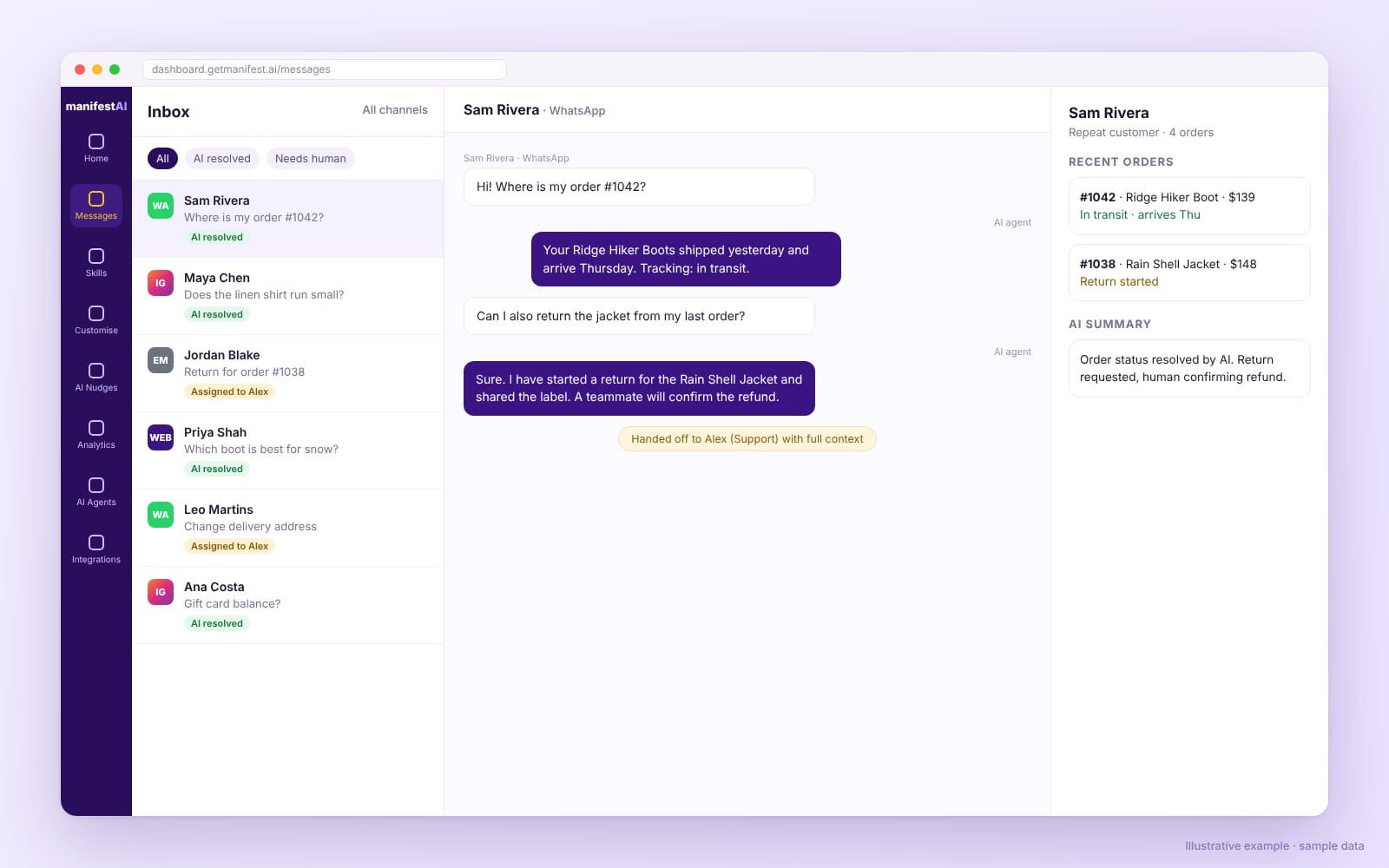
Why Manifest AI is the most cost-effective option
Sticker price is only part of what an AI agent costs. Per-seat and per-resolution pricing gets more expensive as conversation volume grows, and most tools leave you to build, test and maintain the agents yourself. Manifest AI is built to be the highest-ROI platform in this category: it has the lowest cost once real usage kicks in, and it includes the expert help other tools charge extra for or leave to your team.
- Lowest cost at real usage. As your conversation volume grows, your cost per conversation on Manifest AI stays among the lowest in the market, so support savings and AI-driven revenue compound instead of being eaten by usage fees.
- Bespoke, done-for-you agents. Our team builds all of your AI agents during onboarding, and keeps building new ones for as long as you are with us. Submit a request and we build it, so you do not need an in-house AI team or an agency.
- Customer support 7 days a week. Our support team is available every day, including weekends, when ecommerce traffic and support volume often peak.
- Live in about two weeks. Because we build the agents with you, most brands go live in about two weeks.
How to choose
- You want revenue as well as deflection: look at Manifest AI or Siena, which offer shopping agents alongside support. Manifest adds WhatsApp, Instagram and voice calling for cart recovery.
- Your customers message you on WhatsApp or Instagram: Manifest AI (and BIK for WhatsApp-first commerce) is built for those channels.
- You are happy with your helpdesk and only want ticket automation: Yuma, Siena or Fin sit on top of your existing tools.
- You already run Gorgias: start with Gorgias AI Agent and compare against a specialist.
- You are a large enterprise with compliance needs: Ada, or Fin on an enterprise stack.
- Budget is a constraint: compare total cost at your real ticket volume. Per-resolution pricing looks cheap per ticket but adds up at scale; a flat starting plan can be easier to forecast.
Run a pilot on your own tickets. Export a few hundred recent conversations, check how each tool handles your top ten intents (order status, returns, sizing, discounts), and measure resolution rate and CSAT, not just deflection.
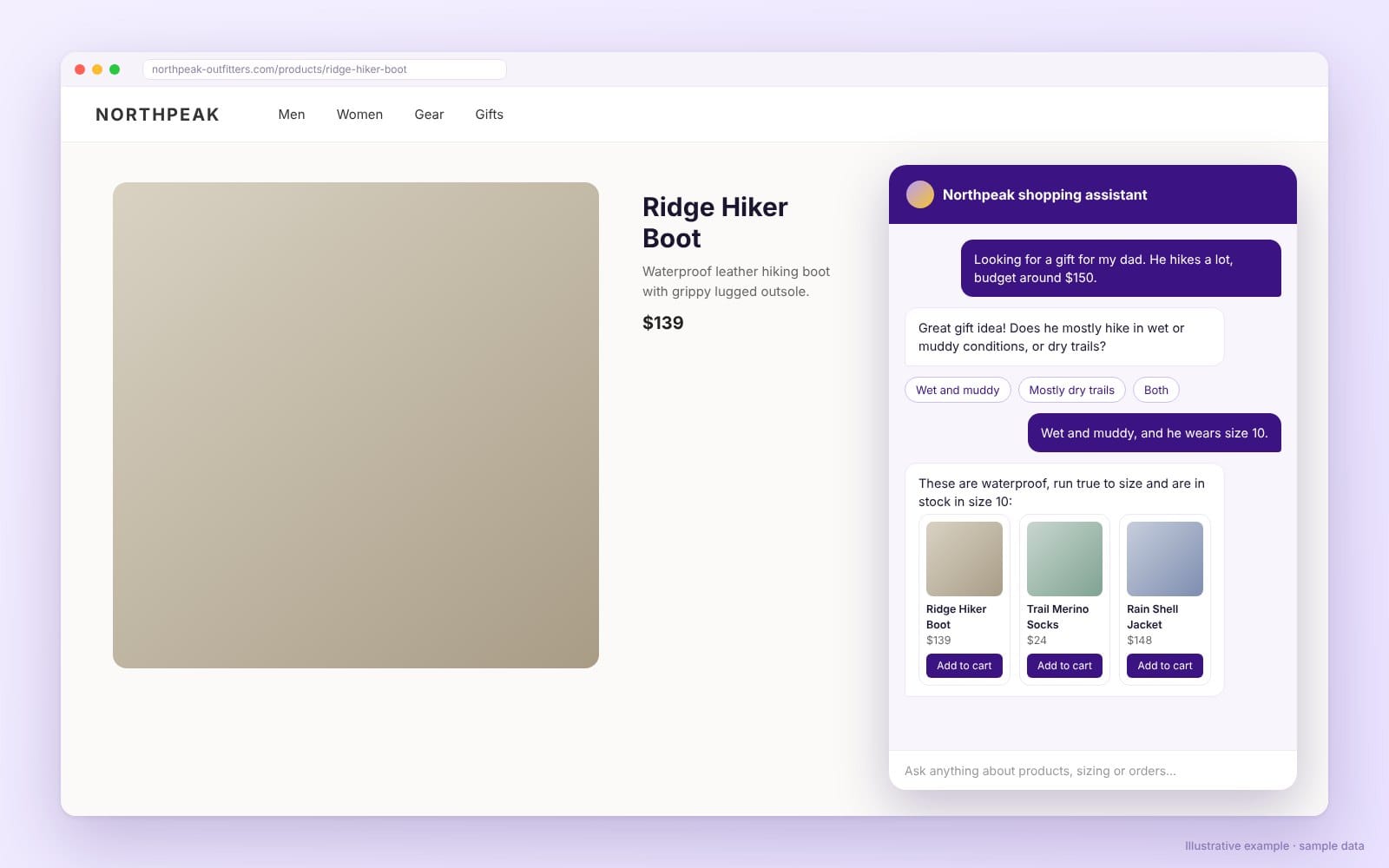
Verdict
There is no single best AI agent for every store. For Shopify-first brands that want one agent to sell and support on web, WhatsApp, Instagram and email, Manifest AI offers the broadest coverage at mid-market pricing. Yuma and Siena are strong choices for helpdesk-centric ticket automation, Gorgias AI Agent is the easiest add-on for existing Gorgias users, and Fin and Ada suit larger, more complex support organizations.
FAQ
What is the best AI agent for Shopify customer support?
It depends on your stack. Manifest AI is built Shopify-first and covers sales and support across channels. Yuma, Siena and Gorgias also integrate closely with Shopify. Test each on your own ticket data.
How much ticket volume can an AI agent automate?
Vendors claim high automation rates: Manifest AI reports up to 90%, Yuma up to 89% of conversations and Siena up to 80%. Real results depend on your ticket mix, data quality and how many actions the agent can take.
Do AI support agents replace my helpdesk?
Some do and some don't. Yuma and Fin can sit on top of your existing helpdesk. Gorgias is a helpdesk with AI built in. Manifest AI includes its own omnichannel inbox alongside its agents.
Which AI agents support WhatsApp?
Manifest AI and BIK support WhatsApp natively for both sales and support. Intercom offers WhatsApp as a pay-as-you-go channel. Check each vendor for current channel coverage.
How are AI customer support agents priced?
Common models are per resolution (Fin, Yuma, Gorgias AI Agent), platform fee plus per ticket (Siena), flat monthly plans (Manifest AI from $500/month) and custom enterprise contracts (Ada).
How long does it take to launch an ecommerce AI agent?
No-code tools built for ecommerce can go live in a couple of weeks; Manifest AI brands typically launch in about two weeks. Enterprise platforms with custom integrations often take longer. Ask each vendor for a realistic timeline for your stack.
Want to see an AI agent that sells and supports across every channel? Start a free trial or book a demo of Manifest AI and test it on your own store.