.png)
Meta's AI Chatbot Ban on WhatsApp: What Brands Can Still Do (2026)
What WhatsApp's AI Providers clause actually bans, the EEA and Brazil exception, whether you can still use ChatGPT models behind a business bot, and how Meta Business Agent and its $2 per 1M token pricing compare with business-specific agents from your BSP.
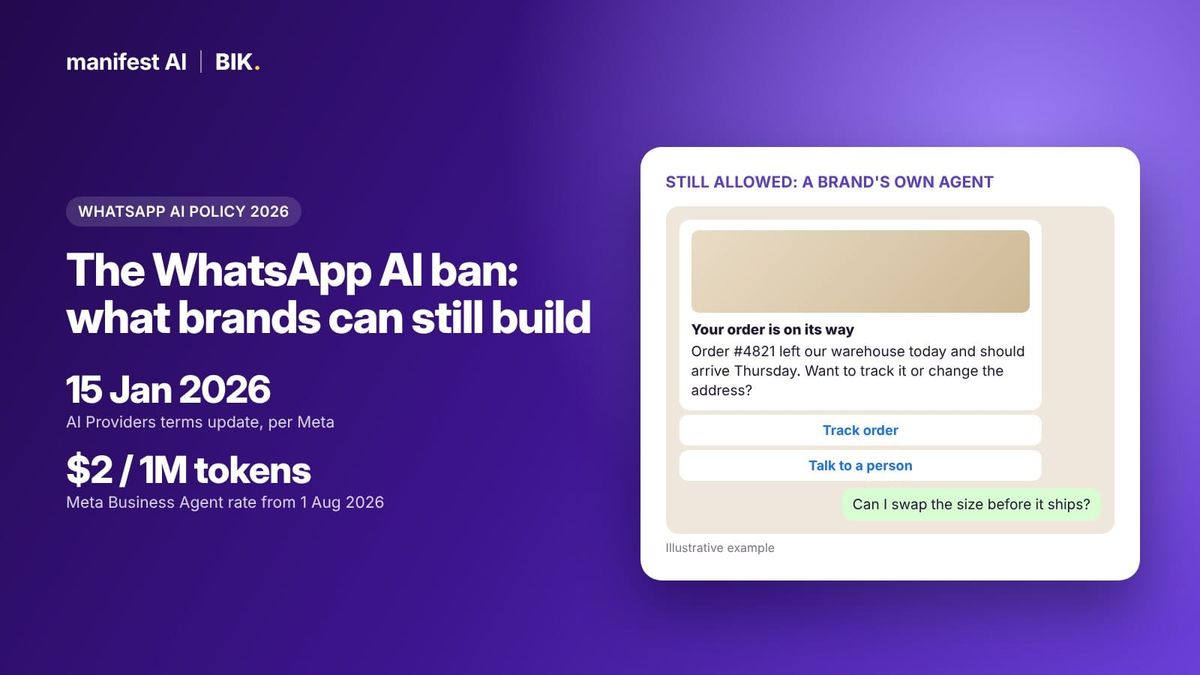
Short answer: Since 15 January 2026, WhatsApp's Business Solution Terms bar "AI Providers" from the WhatsApp Business Platform when a general-purpose AI assistant is the primary thing they offer, as determined by Meta. That is why ChatGPT-style assistants left WhatsApp outside Europe and Brazil. Brands are not banned from AI: a business can still run an AI agent that serves its own customers, such as order tracking, returns or product advice, and can use an AI vendor behind it. BIK and Manifest AI agents are built this way.
The policy change was widely reported as a "WhatsApp AI chatbot ban", and many brands read it as a ban on chatbots in general. It is narrower than that, and it has changed since it was first announced: the current terms, last modified on 6 March 2026, carve out users in the European Economic Area and Brazil. Meanwhile Meta launched its own AI agent for businesses, with token-based billing from 1 August 2026. This guide explains what the terms actually say, what you can still build, and how Meta's own agent compares.
What did Meta change in the WhatsApp Business Solution Terms?
The WhatsApp Business Solution Terms are the contract every business and provider accepts to use the WhatsApp Business Platform. They now include a clause headed "AI Providers". In summary:
- Who it covers: "providers and developers of artificial intelligence or machine learning technologies", including large language models and generative AI, as Meta defines them.
- What it bans: such providers "are strictly prohibited from accessing or using the WhatsApp Business Solution, whether directly or indirectly" to offer those technologies.
- The key condition: the ban applies when the AI is "the primary (rather than incidental or ancillary) functionality" being made available, "as determined by Meta in its sole discretion".
- The exception: the technology may be offered to WhatsApp users whose phone numbers have a European Economic Area or Brazil country code.
- Data rules for everyone: a business can still use an AI provider as a third-party service provider, but must not let Business Solution Data, including anonymous, aggregate or derived forms, train or improve AI models. Fine-tuning a model for your own exclusive use is allowed.
- Enforcement: Meta may terminate the account and revoke access if it finds a breach.
Meta's own pricing documentation gives 15 January 2026 as the date of the terms update. When the change was first reported in October 2025, a Meta spokesperson told TechCrunch that the purpose of the WhatsApp Business API is to help businesses provide customer support and send relevant updates, and that businesses using AI to serve their own customers are not affected.
Who is affected and who is not
The test is whether AI is the product, or a feature that helps a business serve its customers. Here is how that plays out for common cases, outside the EEA and Brazil exception:
| Use case | Allowed under the terms? | Why |
|---|---|---|
| A general-purpose assistant anyone can ask anything, like ChatGPT on WhatsApp | No | The AI is the primary functionality being offered |
| A brand's support agent answering order status, returns and delivery questions | Yes | AI is ancillary to the business's customer service |
| A shopping assistant recommending products from the brand's own catalogue | Yes | It serves the business's own customers and products |
| A campaign reply agent that answers questions about a WhatsApp offer | Yes | It supports the business's own marketing |
| A brand bot built on an OpenAI, Anthropic or Google model | Yes, with data limits | The model vendor is a third-party service provider; your WhatsApp data cannot train its models |
| A brand bot that also answers unrelated general questions at length | Risky | Meta decides what is "primary" at its sole discretion |
The practical takeaway: keep your agent focused on your business, your products and your customers' orders. The further it drifts into being a general chatbot, the harder it is to argue the AI is incidental.
Can I use ChatGPT on the WhatsApp Business API?
You cannot put a general ChatGPT-style assistant on a WhatsApp business number for users outside the EEA and Brazil. That is exactly what the AI Providers clause targets. TechCrunch reported that OpenAI, Perplexity and Microsoft announced their WhatsApp assistants would stop working.
You can use an OpenAI model, or any other model, as the engine behind your own business-specific agent. The terms treat the model vendor as a third-party service provider. Two conditions apply: the agent must serve your business rather than be a general AI product, and your WhatsApp data must not be used to train or improve the vendor's models. Check your AI vendor's data terms for a no-training commitment before you connect it.
The EEA and Brazil exception, and AI Provider pricing
For users with EEA or Brazil country codes, AI providers may still offer their technology. Meta created a separate pricing policy for them: from 16 February 2026 it began charging AI Providers per non-template message in covered markets, starting with Italy and adding Brazil and other European markets from 11 March 2026. Meta has revised the policy several times since, with rate cards updated on 12 May 2026 and further rates from 1 July 2026. If you are an AI company targeting those markets, read Meta's AI Providers pricing page directly, because the rules have moved quickly. For an ecommerce brand, none of this changes what Meta charges you; the page says it does not change how or what Meta charges other businesses.
Meta's own AI agent for WhatsApp: Meta Business Agent
While closing WhatsApp to general AI assistants, Meta launched its own AI for business messaging. The Meta Business Agent Platform went live on 1 July 2026. According to Meta's developer documentation, a business can configure an AI agent that handles customer conversations in its brand voice, answering from business information, FAQs, websites and files, calling the business's own APIs to take actions such as bookings or payment confirmations, and handing off to the business's app for specific flows.
Eligibility rules from Meta's overview:
- The number must be on the WhatsApp Business Platform, not the consumer WhatsApp Business app.
- Some verticals are excluded, including finance, government, health, alcohol, gambling, over-the-counter drugs and matrimony services.
- The business must be in an authorised country, in good standing and meet trust and verification requirements.
- The number must not already be running another AI agent: Meta says an active integration with another authorised agent blocks Meta Business Agent.
How Meta Business Agent is priced
Meta's non-template pricing page states that from 1 August 2026 Meta charges Meta Business Agent messages per token, at one global rate of $2.00 per 1 million tokens, covering input tokens for the customer's message and output tokens for the reply. Meta estimates a typical message uses about 20,000 to 25,000 tokens, or roughly 4 to 5 cents, and applies one charge that covers both the AI and the message. These messages are not free inside the free entry point window from Click-to-WhatsApp ads.
Meta Business Agent vs a business-specific agent from your BSP
| Meta Business Agent | Business-specific agent on your BSP (for example BIK or Manifest AI) | |
|---|---|---|
| Allowed under the AI Providers clause | Yes, it is Meta's own product | Yes, when it serves the brand's own customers |
| Channels | WhatsApp plus other channels the platform supports, such as email, Instagram or website chat | |
| Knowledge | Business info, FAQs, websites and files you supply | The brand's catalogue, live orders, policies and past tickets, through the platform's store integration |
| Actions | Calls APIs you connect yourself | Prebuilt store actions such as order tracking, plus custom flows |
| Billing | $2.00 per 1 million tokens from 1 August 2026, charged by Meta | The provider's own AI pricing, plus Meta's service message fees where they apply |
| Can run alongside the other | Not on the same number, per Meta's eligibility rules: an active integration with another authorised agent blocks Meta Business Agent | |
Both sides now carry a messaging cost. From 1 October 2026 Meta charges service messages, the free-form replies inside a 24-hour window, at the utility rate after 1,000 free per business number per month. Replies sent by a third-party AI agent are service messages, so they fall under this rule. Our service message pricing guide works through the numbers.
What brands can still do with AI on WhatsApp
- Scope the agent to your business. Product questions, sizing, stock, offers, order status, returns, cancellations and store policies.
- Ground it in your own data. Catalogue, order system and policy pages, so answers come from your business rather than general knowledge.
- Decline off-topic requests politely. If someone asks your shoe brand's agent to write an essay, it should steer back to shopping or support.
- Escalate to humans. Hand off on frustration, complex issues or when the customer asks for a person.
- Check data terms with your AI vendor. WhatsApp data must not be used to train or improve the vendor's models.
- Use templates correctly. AI can draft replies inside the 24-hour window, but anything you send first still needs an approved template.
How BIK and Manifest AI agents fit the policy
BIK and Manifest AI build agents for one brand at a time, answering that brand's customers about that brand's products, orders and policies. They are not general-purpose assistants, which is the line Meta's terms draw.
- Campaign Sales Agent (BIK): replies to customers who respond to a WhatsApp campaign, using the campaign's context to answer questions, handle objections and drive purchases.
- AI Chatbot Assistant (BIK, beta) and AI router: answer support questions on WhatsApp and route each conversation to the right journey.
- Escalation to Human Agent (BIK): rules that hand AI conversations to your team based on intent, sentiment, trigger phrases or conversation length.
- Manifest Order Tracking: real-time delivery status on WhatsApp, delay-aware messages, and buttons for cancellations, returns and agent handoff.
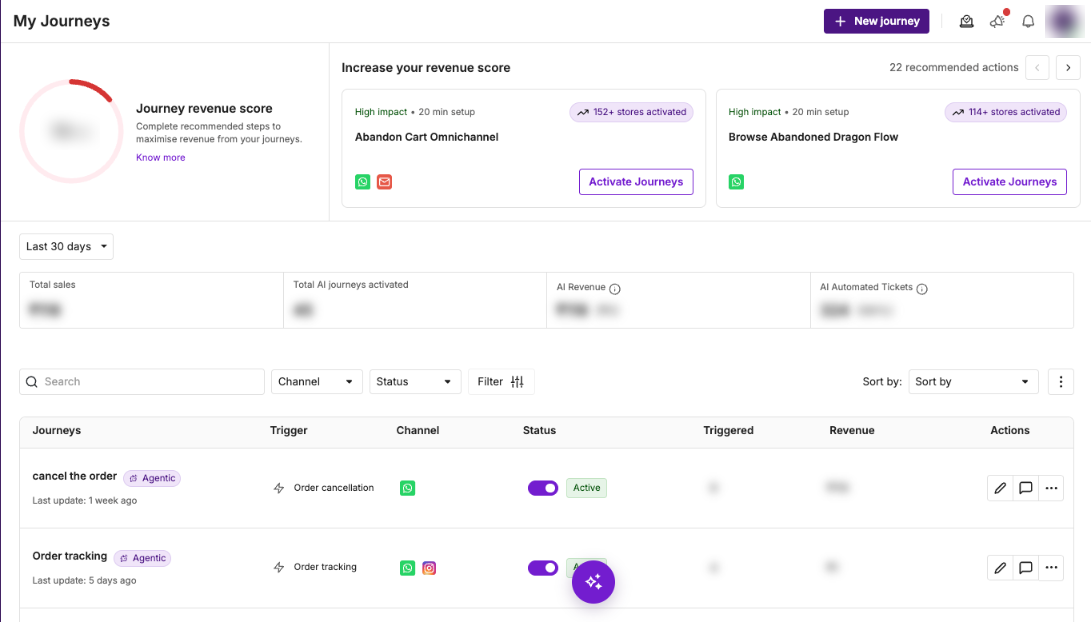
- Agentic AI and prebuilt journeys in Manifest: AI agent workflows across WhatsApp, email and SMS, with a library of ready journeys.
- Auto-training from support tickets (Manifest): closed tickets become structured Q&A knowledge for that brand's agent.
Manifest AI is priced per AI reply. If a brand uses Manifest AI with BIK, the BIK helpdesk is free with unlimited seats and tickets. The BIK platform that runs these agents and journeys is a separate subscription priced on unique contacts, from $250 per month, and messages sent from it are billed at Meta's rate card with no markup. Brands that only need WhatsApp API access can use BIK as a BSP instead: $10 per WhatsApp number per month, no platform fee, no markup. That API-only offering does not include the platform's AI agents or helpdesk.
When another option fits better
- You want Meta to run the AI end to end on WhatsApp only. Meta Business Agent may be simpler, as long as your vertical and country are eligible and you accept token billing.
- You are an AI company offering a general assistant. No BSP can get you around the AI Providers clause; your only route on WhatsApp is the EEA and Brazil exception under Meta's AI Provider pricing.
- You have an in-house AI team and only need a WhatsApp pipe. BIK's BSP (API-only) offering, a developer-focused provider or Cloud API direct may suit you, as long as your bot stays business-specific.
FAQ
Did Meta ban AI chatbots on WhatsApp?
Meta banned general-purpose AI providers from the WhatsApp Business Platform from 15 January 2026, outside the EEA and Brazil. Businesses that use AI to serve their own customers, for support or sales, are not banned.
Can I use ChatGPT on WhatsApp Business API?
Not as a general assistant open to any question. You can use an OpenAI model behind your own business-specific agent, as long as it serves your customers and your WhatsApp data is not used to train the vendor's models.
Is my ecommerce support chatbot affected by the WhatsApp AI policy?
A bot that answers questions about your products, orders, returns and policies is not the target. The clause applies when AI is the primary functionality being offered. Keep the bot focused on your business to stay clear.
When did the WhatsApp AI chatbot ban take effect?
Meta's documentation dates the terms update to 15 January 2026. The current version of the WhatsApp Business Solution Terms was last modified on 6 March 2026 and includes the EEA and Brazil exception.
What is Meta Business Agent and how much does it cost?
It is Meta's own AI agent that businesses configure to answer customers on WhatsApp, launched on 1 July 2026. From 1 August 2026 Meta charges $2.00 per 1 million tokens, which Meta estimates at roughly 4 to 5 cents per typical message.
Can I run Meta Business Agent and another AI agent on the same number?
Meta's eligibility rules say a number with an active integration of another authorised AI agent is blocked from Meta Business Agent. In practice, plan on one AI agent per number and confirm with Meta's eligibility check.
Are BIK and Manifest AI agents allowed on WhatsApp?
Yes. They are built for one brand's customers, using that brand's catalogue, orders and policies, which is the business-specific use Meta's terms permit.