.png)
WhatsApp Service Messages Are No Longer Free: What the October 2026 Change Costs You
From October 1, 2026 Meta charges WhatsApp service messages at the utility rate after 1,000 free per number. Worked costs for India, the US and the UAE, and how to keep them down.
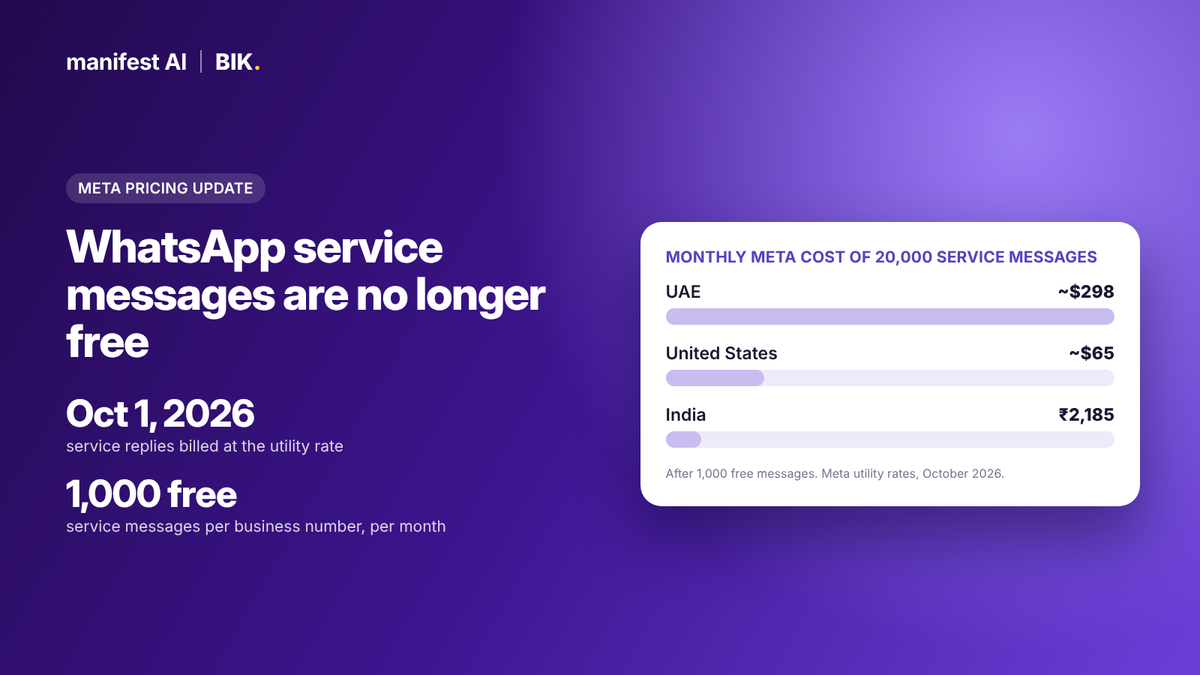
Short answer: from October 1, 2026, Meta charges WhatsApp service messages (the free-form replies you send inside the 24-hour customer service window) at the utility rate of the recipient's country. Each business phone number gets 1,000 free service messages per month, and unused messages do not roll over. For an ecommerce brand sending 20,000 service replies a month, that is roughly ₹2,185 in India, about $65 in the US and about $298 in the UAE, before any markup your WhatsApp provider adds. If your provider charges a fee per message, that fee now applies to your support replies too.
For two years, WhatsApp support was effectively free for brands. Customers wrote in, agents and bots replied, and only template messages showed up on the Meta bill. That ended this month. This guide explains exactly what changed, what it costs at different volumes, where provider markups make it worse, and six ways to keep the cost down without making support slower.
What changed on October 1, 2026
- Service messages are now billable. Free-form messages you send inside an open 24-hour customer service window are charged per message at the utility rate for the recipient's country.
- 1,000 free per number, per month. Each business phone number gets its first 1,000 service messages each month free. The allowance resets monthly and does not roll over.
- Utility templates inside the window. Industry summaries of the update report that utility templates sent inside an open service window are now charged from the first message as well. Check how your provider bills these.
- Free entry points still apply. Conversations that start from a Click-to-WhatsApp ad or a Facebook Page call-to-action button remain free for the free entry point window, which makes ad-driven conversations cheaper to serve than organic ones.
- Marketing, utility and authentication templates are unchanged. They are still billed per message by category and country, as they have been since July 1, 2025.
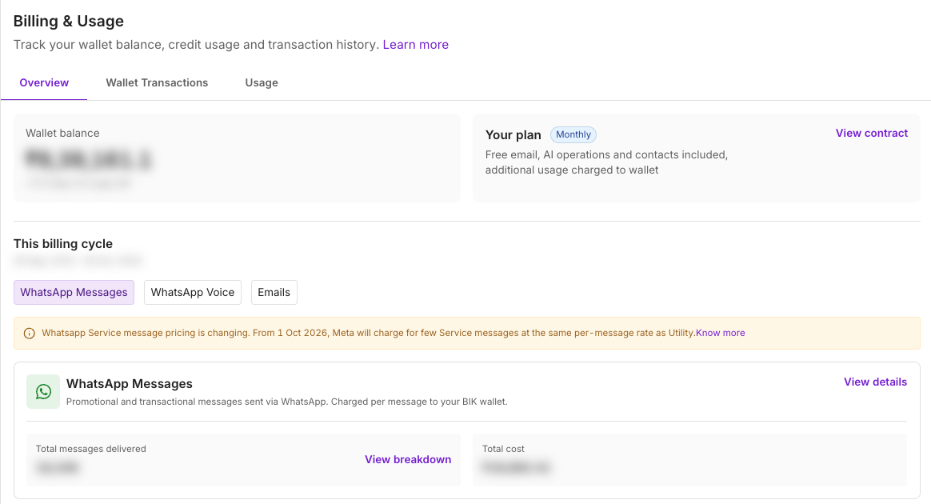
What it costs: worked examples
The table below uses utility rates published in October 2026: ₹0.115 per message for India (Meta's base rate, before GST), $0.0034 for the United States and $0.0157 for the UAE. Each example assumes one business number and subtracts the 1,000 free service messages.
| Service messages per month | India (₹0.115) | United States ($0.0034) | UAE ($0.0157) |
|---|---|---|---|
| 5,000 | ₹460 | $13.60 | $62.80 |
| 20,000 | ₹2,185 | $64.60 | $298.30 |
| 50,000 | ₹5,635 | $166.60 | $769.30 |
| 1,00,000 (100,000) | ₹11,385 | $336.60 | $1,554.30 |
Meta fees only. Rates vary by country and can change; check Meta's current rate card for each market you serve.
How many service messages does a brand send? A useful rule of thumb: count conversations, not tickets. A single "where is my order" chat can easily be four to six messages from your side once you include the greeting, the order lookup, the tracking link and the sign-off. A brand handling 5,000 WhatsApp conversations a month at five replies each is sending 25,000 service messages.
Where your provider's markup makes it worse
Meta's fee is only half the bill. Many WhatsApp providers add their own charge per message, and that charge does not care whether the message is marketing or a support reply.
| Provider pricing model | What it adds on 20,000 service replies |
|---|---|
| Twilio: $0.005 per message, inbound or outbound | $100 on your replies, plus another $0.005 on each inbound customer message. On a typical support conversation that can exceed Meta's own US fee. |
| Gupshup: $0.001 per message on top of Meta | $20 if the fee applies to each reply |
| Percentage markup (for example 15%) | About ₹328 on the India example, about $45 on the UAE example |
| BIK: Meta's rate card at cost, $0 markup | Nothing. You pay Meta's fee, after the 1,000 free messages. |
Provider list prices checked in October 2026. Confirm with each provider how their fee applies to service messages.
We compare provider fees in more depth, including 360dialog's per-number plans, in what your WhatsApp BSP really charges on top of Meta.
Six ways to keep WhatsApp support costs down
1. Measure service volume per number now
The free allowance is per business phone number. Pull last month's outbound service message count for each number, subtract 1,000, and multiply by the utility rate for the countries your customers are in. That is your new monthly line item. Do it before your first October invoice, not after.
2. Answer in fewer, richer messages
Every bubble now has a price. Combine the greeting and the answer. Use interactive messages (reply buttons, lists, product cards) so one message does the work of three. Send the tracking link with the status rather than in a follow-up.
3. Get ahead of "where is my order"
Order status questions are the largest share of ecommerce support. One proactive utility template ("Your order has shipped, here is the tracking link") replaces a multi-message service conversation started by an anxious customer. It is also a better experience.
4. Let AI resolve in one pass
An AI agent with access to order data can answer the question fully in its first reply, instead of a human agent asking for an order number, looking it up, and replying across several messages. Manifest AI averages about three replies per conversation, and it resolves order tracking, returns and product questions end to end on WhatsApp.
5. Use free entry points for ad traffic
Conversations that start from Click-to-WhatsApp ads or Facebook Page buttons stay free during the free entry point window. If you are already buying traffic, routing it into WhatsApp through these entry points makes the follow-up conversation cheaper than an organic one.
6. Remove the markup
The cleanest saving is structural. If your provider adds a fee or percentage to every message, your support cost now carries it. Moving to a provider that passes Meta's rate card through at cost removes that line entirely.
How BIK handles the change
BIK is a Meta Business Solution Provider and charges WhatsApp messages at Meta's rate card with no markup, both on the BIK platform (a separate subscription priced on contacts, from $250 per month) and on its API-only BSP offering ($10 per WhatsApp number per month, no platform fee). That applies to service messages after October 1 exactly as it does to marketing and utility templates, in every country. What you see on Meta's rate card is what you pay, and the 1,000 free service messages per number are not absorbed by a provider fee.
Around that, BIK gives ecommerce brands the tools to send fewer, better messages:
- Proactive order updates on Shopify events (shipped, out for delivery, delivered, delayed) to cut inbound order status chats.
- AI agents in WhatsApp that answer product and order questions in one reply, with a handoff to the BIK helpdesk when a person is needed.
- Interactive messages and product cards, plus checkout inside WhatsApp, so a sales conversation needs fewer turns.
- A helpdesk with order context, so agents do not need to ask for an order number.
- Migration and support. BIK migrates your number from your current provider and gives every client a dedicated WhatsApp group with the team.
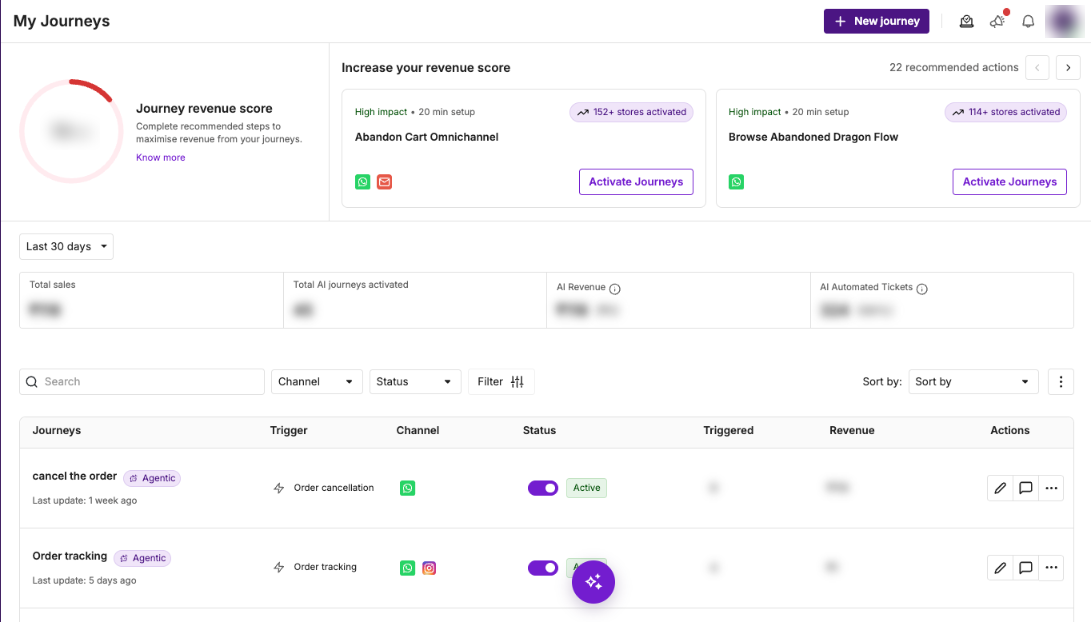
A full month for one brand
Here is how the change plays out for a mid-size Shopify brand selling in India and the UAE from one WhatsApp number. The numbers are illustrative, but the shape is typical.
| Line | Before October 2026 | After October 2026 |
|---|---|---|
| Inbound support conversations | 4,000 | 4,000 |
| Service replies sent (5 per conversation) | 20,000, free | 20,000, of which 1,000 free |
| Split by customer country | 15,200 India, 3,800 UAE (after the free 1,000) | |
| Meta fee on service replies | ₹0 and $0 | ₹1,748 (India) + $59.66 (UAE) |
| With a 15% provider markup | Not applicable | ₹2,010 + $68.61 |
| With BIK (no markup) | Not applicable | ₹1,748 + $59.66 |
Now apply the fixes from the previous section. If proactive shipping updates remove a quarter of order status conversations, and an AI agent brings the average down from five replies to three, the same brand sends about 9,000 service replies instead of 20,000. After the free 1,000, that is 8,000 billable messages, less than half the original bill, and customers get faster answers.
What this means for the rest of your WhatsApp programme
The change is small per message, but it shifts how brands should think about WhatsApp as a channel.
- Support becomes a cost centre on your Meta bill. Track service messages as their own line, by number and by country, next to marketing and utility.
- Efficiency now has a visible price. Long, chatty support flows used to cost only agent time. Now each extra message also shows up on the invoice, which strengthens the case for AI agents and proactive updates.
- Provider choice matters more. Before October, a per-message markup only touched templates. Now it touches every support reply too. Over a year, the gap between a provider at cost and a provider with a markup grows with both marketing and support volume.
- Multi-number setups need a plan. Each business number has its own 1,000 free messages. Brands that run separate numbers for regions or brands should look at volume per number, not in total. Organise numbers around how customers reach you, not around the free allowance.
Checklist for your October invoice
- Export service message counts per number for September and October.
- Confirm with your provider how service messages are billed, and whether any fee or markup applies.
- Confirm that the 1,000 free service messages per number appear on your invoice.
- Check how utility templates sent inside an open service window are billed.
- Identify your top three inbound reasons and add a proactive template or AI flow for each.
- Set a monthly budget alert for service messages, separate from marketing.
FAQ
Are WhatsApp service messages still free?
Not fully. From October 1, 2026 Meta charges service messages at the recipient country's utility rate. The first 1,000 service messages per business phone number each month are free.
Does the 1,000 free allowance roll over?
No. It resets every month, and unused messages are lost.
Is the free allowance per account or per number?
Per business phone number, per month.
Are Click-to-WhatsApp ad conversations affected?
Conversations that start from a Click-to-WhatsApp ad or a Facebook Page button remain free during the free entry point window.
Will my WhatsApp provider add a markup on service messages?
It depends on the provider. Per-message fees (such as Twilio's $0.005 or Gupshup's $0.001) and percentage markups can apply to service replies. BIK charges no markup on Meta's rates, whether you use the BIK platform or its API-only BSP offering ($10 per WhatsApp number per month, no platform fee).
How can I estimate my new monthly cost?
Take your monthly service messages per number, subtract 1,000, and multiply by the utility rate for your customers' country. Then add your provider's fee per message, if any.
Do inbound customer messages cost anything?
Meta's rate card defines what is billable and it changes from time to time, so check Meta's current rate card for how inbound messages are treated. Separately, some providers charge their own fee on inbound messages (Twilio charges $0.005 per message, inbound or outbound), so check your provider's terms.
Which rate applies if my customer is in another country?
The utility rate of the recipient's country, based on their phone number's country code. A brand in India replying to a customer with a UAE number pays the UAE utility rate for that reply.
Should I move support off WhatsApp because of this?
For most ecommerce brands, no. Even after the change, a WhatsApp reply costs a fraction of a rupee in India and a fraction of a cent in the US, and customers answer faster on WhatsApp than on email. The better response is to send fewer, richer messages, get ahead of order status questions, and remove any provider markup.
Does BIK pass the 1,000 free service messages through?
Yes. BIK bills Meta's rate card at cost with no markup, so your Meta allowance and rates are exactly what you pay. On BIK's API-only BSP offering the only BIK fee is $10 per WhatsApp number per month; the BIK platform is a separate subscription priced on contacts.
Sources
- Meta: WhatsApp Business Platform pricing
- AiSensy pricing (India per-message rates, October 2026)
- Twilio WhatsApp pricing
Related reading: Top 10 WhatsApp Business API providers in 2026 and Best WhatsApp marketing tools for Shopify brands.