
WATI Pricing Explained (2026): Plans, Message Costs and Hidden Fees
WATI's Growth, Pro and Business plans, extra-user costs, the $4.99 Shopify add-on and how its own rate card changes your WhatsApp message bill, with a full yearly cost example and a price comparison with BIK.
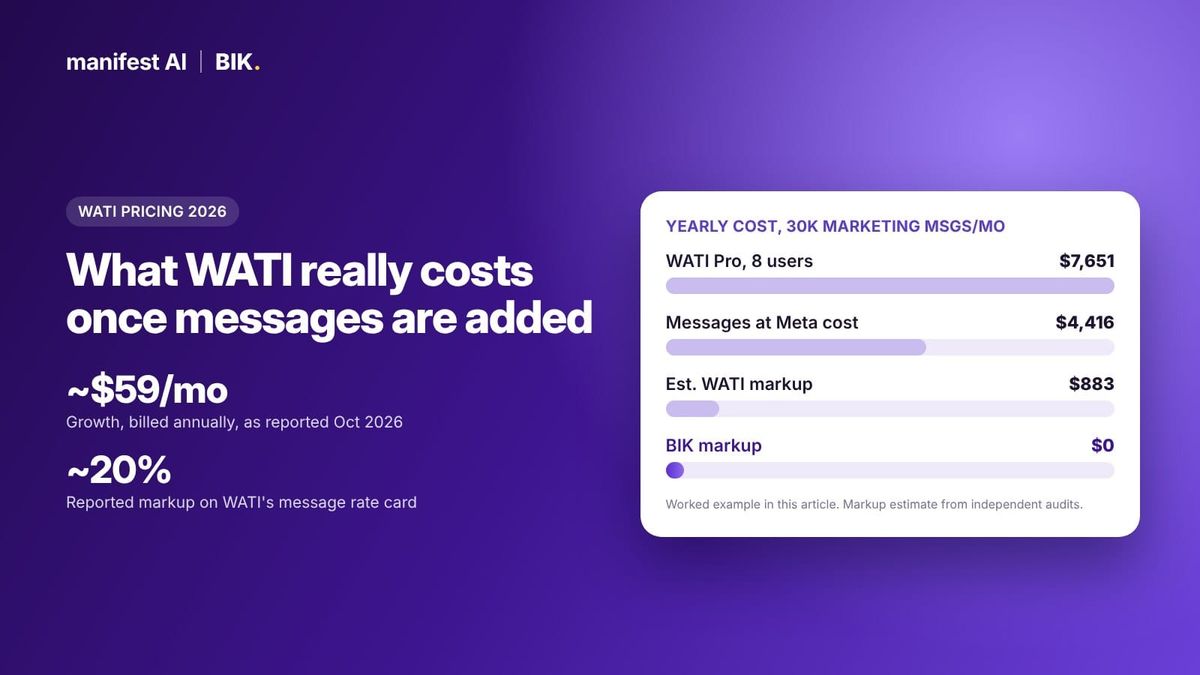
Short answer: WATI sells three main plans, Growth, Pro and Business, plus a ₹999 pay-as-you-go option and a custom Enterprise tier. Independent pricing reviews report Growth at about $59, Pro at about $119 and Business at about $279 per month on annual billing, with Indian rupee pricing lower. On top of the plan you pay for extra users ($24 or $69 per user per month), the $4.99 Shopify add-on, and every WhatsApp message at WATI's own rate card, which audits put at roughly 20% above Meta's rates. BIK charges Meta's rates at cost with no markup.

WATI is one of the best-known WhatsApp Business API tools in India and the Middle East, and its pricing page is designed to show a low entry price. The real bill depends on three things the headline number does not show: how many people on your team need a seat, which integrations you need, and how many messages you send each month. This guide breaks each one down using WATI's own pricing page and two independent audits, then works through a full yearly cost example.
How much does WATI cost in 2026?
WATI's pricing page, as listed in October 2026, shows four options: a Zero Subscription pay-as-you-go plan and three recurring plans called Growth, Pro and Business. An Enterprise tab exists, but no price or plan details are published for it, so it is sold through sales.
The plan prices themselves are rendered by region on WATI's site and did not appear in the page text we could retrieve. The figures below come from two independent audits that recorded them from WATI's page. Treat them as a guide and check the live page for your country before you budget.
| Plan | USD, billed annually | USD, billed monthly | India, billed annually | Users included |
|---|---|---|---|---|
| Zero Subscription | - | - | ₹999 one-time, returned as message credit | 1 |
| Growth | $59 per month | $69 per month | ₹2,499 per month | 3 (cannot add more) |
| Pro | $119 per month | $149 per month | ₹5,999 per month | 5, extra users $24 each per month |
| Business | $279 per month | $349 per month | ₹16,999 per month | 5, extra users $69 each per month |
| Enterprise | Custom, via sales | Custom | ||
USD figures as reported by Chatarmin's WATI pricing review; India figures as reported by Codingclave's India audit. User counts, extra-user prices and the ₹999 plan are taken directly from wati.io/pricing, as listed in October 2026.
WATI says annual billing saves "up to ~25%" and includes free dedicated onboarding, and quarterly billing saves up to 10%. There is a 7-day free trial and no setup fee for the WhatsApp API.
What the ₹999 pay-as-you-go plan includes
The Zero Subscription plan is a one-time ₹999 payment that comes back to you as ₹999 of message credit, which WATI says covers up to 500 messages. It allows a single user and bulk campaigns only, and the account stays valid for three months as long as you keep sending. WATI describes it as the cheapest plan if you send up to about 2,100 messages in three months. It suits a brand testing broadcasts, not one that needs chatbots, a shared inbox or integrations.
Paying for WhatsApp messages that don't convert? Manifest AI and BIK turn WhatsApp conversations into orders, with AI agents that answer questions, recommend products and recover carts.
What each WATI plan includes and limits
The plans differ less in features you can see on day one and more in allowances that start to bite as you grow. These are the limits WATI lists on its pricing page.
| Allowance | Growth | Pro | Business |
|---|---|---|---|
| Broadcasts | 15,000 per month | Unlimited | Unlimited, volume discounts |
| Free automation triggers | 1,000 per month | 2,000 per month | 5,000 per month |
| Integrations | 2 select commerce or CRM | 5, including HubSpot | Unlimited, including Salesforce |
| API calls | 10,000 per month, no webhooks | 200,000 per month, limited webhooks | 20 million per month |
| AI Co-pilot credits | 250 per month | 500 per month | 1,500 per month |
| Support | 24x5 email | 24x7 email and chat | Priority 24x7 plus a customer success manager |
Three limits matter most for ecommerce brands:
- Growth caps broadcasts at 15,000 a month. A store with 20,000 opted-in customers cannot send one campaign to its full list on Growth.
- Growth has no extra seats. If more than three people need to answer customers, you have to move to Pro.
- Automation triggers run out. Abandoned cart, order confirmation and delivery updates all use triggers. WATI lets you buy more each month, even on annual plans, but does not publish the price.
WATI add-ons and the costs that are easy to miss
The plan price is the floor, not the bill. These are the extra charges WATI lists on its own pricing page, as of October 2026:
- Shopify integration: $4.99 per month. WATI says Shopify use "requires purchase" of this add-on. If you run your store on Shopify, add it to every plan.
- Extra users: $24 per user per month on Pro and $69 per user per month on Business. A Business team of 10 pays for 5 extra seats, or $345 a month on top of the plan.
- Additional WhatsApp numbers: charged per number per month. Price not published.
- Extra automation triggers and AI Co-pilot credits: sold by quantity. Price not published.
- Astra AI Agents: WATI's AI agent product is sold as a separate add-on from Pro upwards. Price not published.
- Services: dedicated onboarding (custom one-time fee), technical account management (custom annual fee, Business annual only) and professional services (custom hourly fee).
None of these are unusual in the category. The issue is that most of them only show up once you are already set up and growing. Ask for a written quote that lists every add-on you expect to need in the first year.
How WATI bills WhatsApp messages
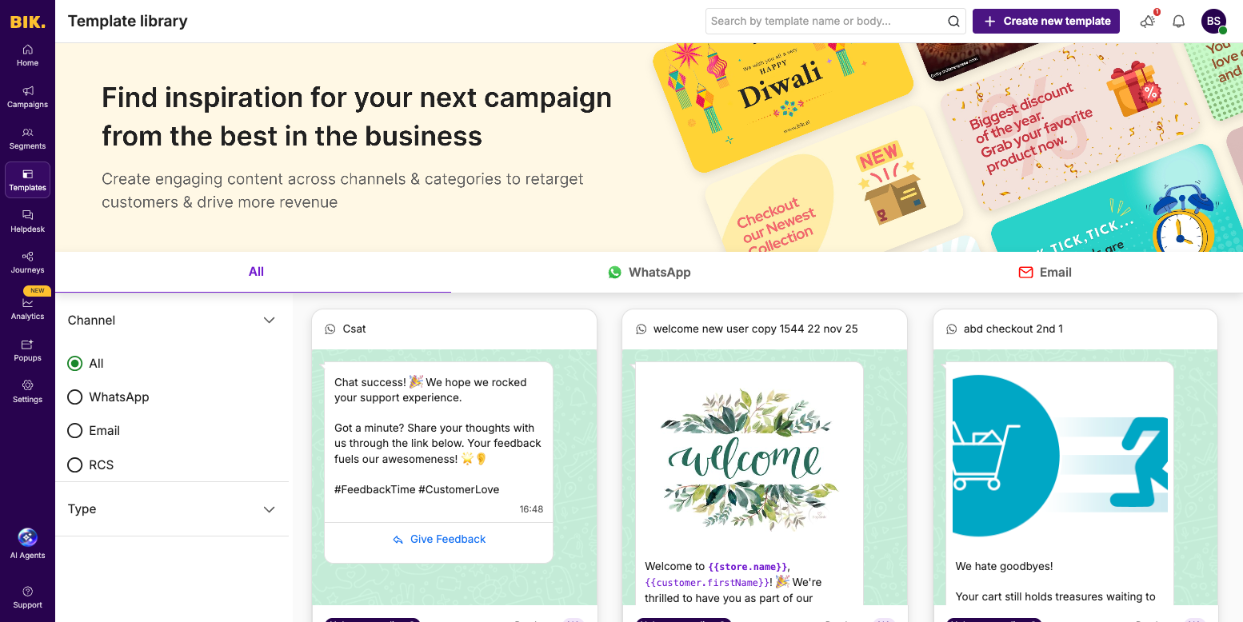
Since 1 July 2025, Meta bills WhatsApp per delivered template message, by category (marketing, utility, authentication) and by the recipient's country code. Every provider passes this charge on to you. What differs is whether they pass it on at cost or add a margin.
WATI says it bills "per message" and that rates vary by category and country. Each paid plan links to WATI's rate card, not Meta's. WATI does not publish a markup figure on its pricing page. Independent reviews have measured the gap:
- Chatarmin's review cites several BSP comparisons that put WATI's markup at about 20% per template message, with an India marketing example of $0.0099 from Meta against $0.0119 from WATI.
- Codingclave's India audit reports a markup of about 19% to 20% on marketing and utility messages.
We could not confirm the current figure on WATI's own rate card, so treat 20% as a reported estimate. The practical step is simple: download WATI's rate card for your top three countries and compare each line with Meta's published rate card. The difference is what you pay WATI per message on top of the plan.
Service messages from 1 October 2026
From 1 October 2026, Meta charges service messages (free-form replies inside the 24-hour customer service window) at the recipient country's utility rate, after 1,000 free service messages per business phone number per month. The allowance does not roll over. If your support team answers a lot of WhatsApp chats, those replies now cost money on every provider, and any markup applies to them as well. Our explainer on WhatsApp service message pricing from October 2026 covers the change in detail.
Worked example: what WATI costs over a year
Here is a realistic mid-size Shopify brand selling in India and billing in USD:
- Pro plan, billed annually: $119 per month
- 8 people in the inbox, so 3 extra seats at $24: $72 per month
- Shopify add-on: $4.99 per month
- 30,000 marketing messages and 10,000 utility messages a month to Indian numbers
Meta's India rates are $0.0118 per marketing message and $0.0014 per utility message (Meta rate card as reproduced by InstantDM, October 2026). At cost, the messages are $354 plus $14, or $368 a month. If WATI's markup is 20%, as audits report, the same messages cost about $441.60.
| Line item | Per month | Per year |
|---|---|---|
| Pro plan (annual billing) | $119.00 | $1,428.00 |
| 3 extra users | $72.00 | $864.00 |
| Shopify add-on | $4.99 | $59.88 |
| Messages at Meta cost | $368.00 | $4,416.00 |
| Estimated markup at 20% | $73.60 | $883.20 |
| Total | $637.59 | $7,651.08 |
The plan is less than a fifth of the total. Messages are the biggest line, and the estimated markup alone costs more per year than the three extra seats. Scale the same brand to 100,000 marketing and 30,000 utility messages a month and the estimated markup grows to about $244 a month, or roughly $2,930 a year, while the plan price stays the same.
See what your brand could automate. Our team builds the agents for you, and most brands are live in about 2 weeks.
Who WATI is a good fit for
WATI is a capable product, and it is a sensible choice for several kinds of business:
- Small teams that mostly need a shared WhatsApp inbox and broadcasts. Growth gives three users, a chatbot builder and 15,000 broadcasts at a low monthly price.
- Businesses outside ecommerce. WATI serves education, real estate, services and other sectors, and integrates with HubSpot and Salesforce on higher plans.
- Teams that want Instagram, Messenger and TikTok DM automations alongside WhatsApp, which WATI lists from Growth upwards.
- Low-volume senders. If you send a few thousand messages a month, a 20% markup is a small amount in absolute terms and the plan price matters more.
WATI fits less well when message volume is high, when the team is large (seat costs add up fast on Business), or when you want WhatsApp to sit inside a wider retention stack with email, SMS and a single customer profile.
How BIK compares with WATI on price
BIK is a premium retention, conversational commerce and helpdesk platform built for established and fast-growing ecommerce brands, and a Meta Business Solution Provider. Its pricing model differs from WATI's in three ways.
| Cost item | WATI (as listed Oct 2026) | BIK |
|---|---|---|
| Platform plan | Growth, Pro, Business by tier; reported from about $59 per month | From $250 per month, priced on unique contacts (100,000 contacts is $300 per month); startup plan available |
| What the plan scales on | Tier, seats, triggers and add-ons | Number of contacts, with AI credits included |
| WhatsApp message rates | WATI's rate card; markup not published, audits report about 20% | Meta's rate card at cost, no markup, in every country |
| WhatsApp number | Additional numbers charged, price not published | Platform priced on contacts; the $10 per number per month price applies only to BIK's API-only BSP offering |
| Shopify | $4.99 per month add-on | Shopify app with a 14-day free trial; rated 4.9 from 139 reviews |
| Migration and setup | Dedicated onboarding is a custom fee | Migration included; a growth manager sets up 30+ flows; dedicated WhatsApp group with the BIK team |
Run the yearly example above on BIK, assuming 100,000 contacts: $300 for the plan and $368 for messages at Meta cost, or $668 a month. That is about $30 a month more than our WATI estimate at 30,000 marketing messages. BIK's standard plans are built for brands at about ₹1 crore or more in monthly revenue, where the retention features drive more revenue than that gap; smaller brands can start on BIK's startup plan. At 100,000 marketing and 30,000 utility messages a month, the order flips: BIK comes to about $1,522 a month against about $1,662 for WATI, because the markup now outweighs the plan difference. The higher your WhatsApp volume, the more zero markup is worth. Brands that only need WhatsApp API access can use BIK as a BSP instead: $10 per WhatsApp number per month, no platform fee, no markup.
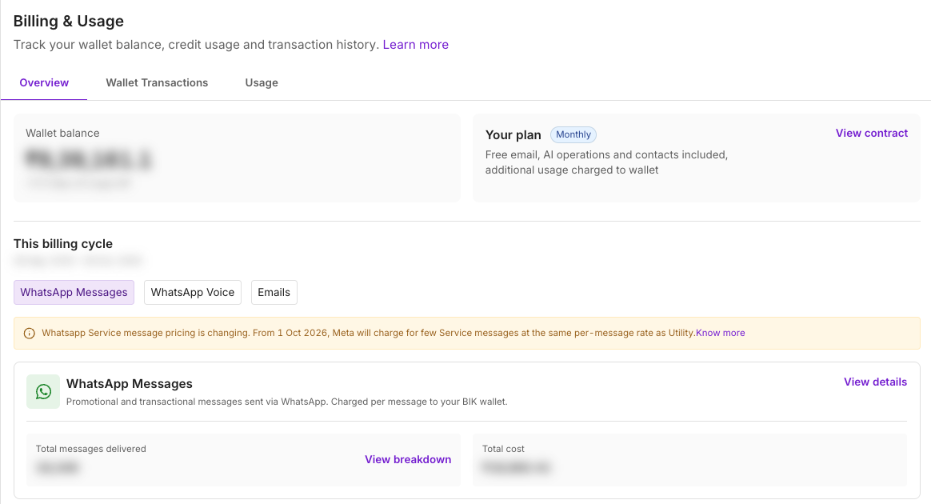
Price is only part of the comparison. BIK puts WhatsApp, Instagram, email, SMS, RCS, web push and live chat on one customer profile, with journeys, segments, AI agents and a helpdesk in the same tool. Features that reduce wasted sends are built in: Smart Retry re-sends campaign messages that failed because of Meta's per-user marketing limits, Fallback AI generates a compliant backup template if your main one is paused, and Messaging Limits cap how often one customer hears from you across channels.
When WATI fits better than BIK
BIK is not the right choice for every business, and WATI will be the better pick in some cases:
- You are not an ecommerce brand. BIK is built around stores, orders, carts and retention. A clinic, school or agency will get more from a general WhatsApp tool.
- You only want a basic WhatsApp inbox and broadcasts. If you have no plans for a retention programme, email, SMS or a unified helpdesk, WATI's Growth or Pro plan covers that. Smaller brands that do want retention can start on BIK's startup plan.
- You need Salesforce on a WhatsApp-first tool. WATI lists a Salesforce integration on its Business plan.
If you are comparing more options, see our list of WATI alternatives and the side-by-side WATI vs Interakt vs AiSensy comparison.
80%+ of tickets automated, or your money back. That's the Manifest AI guarantee, written into your contract.
FAQ
How much does WATI cost per month?
Independent reviews report WATI's Growth plan at about $59 per month, Pro at about $119 and Business at about $279 when billed annually, with monthly billing higher and Indian rupee pricing lower. There is also a ₹999 pay-as-you-go option. Message charges, extra users and add-ons such as the $4.99 Shopify integration are billed on top.
Does WATI charge a markup on WhatsApp messages?
WATI bills messages at its own rate card rather than Meta's, and does not publish a markup figure. Independent audits report a markup of about 20% over Meta's rates. Compare WATI's rate card with Meta's for your main countries to see the exact difference.
Is there a free plan on WATI?
No. WATI offers a 7-day free trial and a ₹999 pay-as-you-go plan where the full ₹999 comes back as message credit. Recurring plans start with Growth.
How much is the WATI Shopify integration?
WATI lists the Shopify integration as an add-on at $4.99 per month, as of October 2026. It is required to connect a Shopify store and is charged on top of any plan.
How many users can I add on WATI?
Growth includes 3 users and does not allow more. Pro and Business include 5 users each, with extra users at $24 and $69 per user per month respectively.
Is WATI cheaper than BIK?
On subscription alone, WATI's entry plans cost less than BIK's standard plans, which start at $250 per month and are built for brands at about ₹1 crore or more in monthly revenue. At higher volumes the total gap closes and can reverse, because BIK charges Meta's rates with no markup while WATI bills on its own rate card. Smaller brands can start on BIK's startup plan.
Do service messages cost money on WATI from October 2026?
Yes. From 1 October 2026 Meta charges service messages at the utility rate after 1,000 free per business number per month, and this applies on every provider. WATI bills these through its own rate card.
Sources
- WATI pricing page (plans, users, add-ons, message billing; accessed October 2026)
- WATI Help Center: Understanding WATI plans
- Chatarmin: WATI pricing review (USD plan prices, markup estimate)
- Codingclave: WATI pricing India 2026 (INR plan prices, markup estimate)
- Meta: Pricing on the WhatsApp Business Platform
- InstantDM: WhatsApp Business API pricing 2026, India and October update (Meta India rates)
Related reading: WATI alternatives for ecommerce brands, WhatsApp BSP markup explained, WhatsApp Business API pricing in India and the best WhatsApp marketing tools for Shopify brands.