.png)
What Is a WhatsApp BSP? Cloud API Direct vs a Business Solution Provider
What the WhatsApp Business API is in 2026, why Cloud API is now the only option, how Meta defines Solution Partners and Tech Providers, and when going direct beats using a BSP. Includes an app vs API comparison and a BSP checklist.
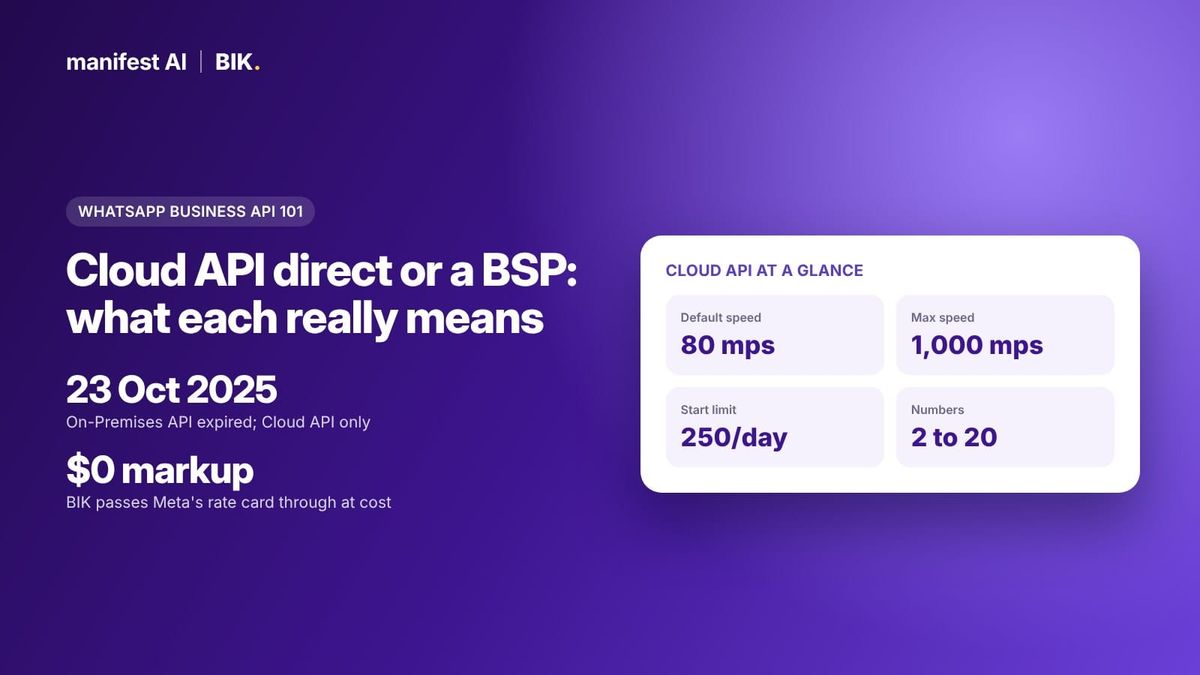
Short answer: The WhatsApp Business API (officially the WhatsApp Business Platform) is Meta's programmable version of WhatsApp for businesses, and today it runs only as the Meta-hosted Cloud API because the On-Premises API expired on 23 October 2025. You can connect to Cloud API directly as your own developer, or through a Business Solution Provider (BSP), a Meta partner that onboards your number, gives you tools and often handles billing. BIK is a BSP: its BSP (API-only) offering passes Meta's rates through at cost, with no markup, a $0 platform fee and $10 per number per month. BIK's marketing and retention platform is a separate subscription from $250 per month, priced on contacts.
Most ecommerce brands meet these terms when the WhatsApp Business app stops scaling: too many chats for one phone, no automation, no way to send order updates from Shopify. At that point you have three choices: build on Cloud API yourself, pay a BSP, or stay on the app. This guide explains what each one is, how Meta itself defines its partner types, and what actually changes in cost and effort.
What is the WhatsApp Business API?
The WhatsApp Business API is the set of APIs Meta offers businesses that need to message customers at scale from their own software. Meta now calls the product the WhatsApp Business Platform, and the messaging API inside it is the Cloud API, hosted on Meta's servers.
What you get on the platform that the app does not give you:
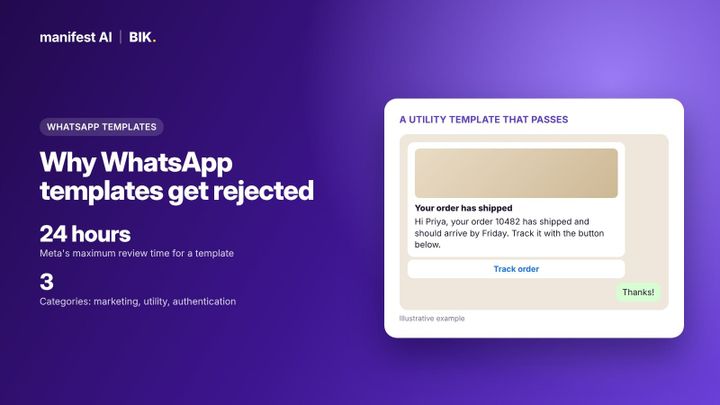
- Template messages you can send to opted-in customers outside a 24-hour chat window, in three categories: marketing, utility and authentication.
- Webhooks that tell your systems when a message is sent, delivered, read or replied to, so tools like a CRM or helpdesk can react.
- Throughput of up to 80 messages per second by default, rising to 1,000 messages per second by automatic upgrade for eligible numbers, according to Meta's throughput documentation.
- Multiple numbers per business portfolio: new portfolios start with 2 registered numbers, and Meta raises the cap to 20 when the business is verified or reaches a messaging limit of 2,000.
Every business on the platform also works within a messaging limit: the number of unique customers it can message outside an open customer service window in a rolling 24 hours. New business portfolios start at 250 and can grow to 2,000, 10,000, 100,000 and unlimited. Since 7 October 2025 this limit is set for the whole business portfolio, not per phone number.
Cloud API vs On-Premises API: is On-Premises still available?
No. Meta ran two versions for years: the Cloud API, hosted by Meta, and the On-Premises API, which businesses or their providers hosted on their own servers. Meta's sunset notice lists the timeline:
- 9 January 2024: new features ship only to Cloud API.
- 1 July 2024: new phone numbers can be registered only for Cloud API.
- 23 October 2025: the final On-Premises client (v2.63) expired, and messages to or from numbers still registered on On-Premises are no longer delivered.
So in 2026, "WhatsApp Business API" and "Cloud API" mean the same thing in practice. If a provider still talks about hosting the API for you, ask what they mean: the API itself runs at Meta.
WhatsApp Business app vs WhatsApp Business API
The WhatsApp Business app is the free phone app for small businesses. The API is infrastructure that you reach through software. They solve different problems.
| Feature | WhatsApp Business app | WhatsApp Business API (Cloud API) |
|---|---|---|
| How you use it | Phone app, plus linked devices | Through your own code or a provider's dashboard |
| Cost from Meta | Free to send | Per delivered template message, by category and country; service messages charged from 1 October 2026 after a free allowance |
| Bulk messaging | Broadcast lists, limited | Approved templates to opted-in customers, within your messaging limit |
| Automation and integrations | Greeting, away messages, quick replies | Full webhooks, so a CRM, store or AI agent can send and respond |
| Team inbox | Limited linked devices | Any number of agents through a helpdesk tool |
| Throughput | Not designed for volume | 80 messages per second by default, up to 1,000 |
| Blue checkmark | Meta Verified subscription in the app | Official Business Account status, requested through WhatsApp Manager |
You no longer always have to pick one. Meta's coexistence feature lets a business onboard its existing WhatsApp Business app number to Cloud API through a Solution Partner or Tech Provider and keep using the app on the same number. There are trade-offs, including a fixed throughput of 20 messages per second and some app features being switched off. We cover them in our guide to migrating your WhatsApp number.
What is a WhatsApp BSP?
BSP stands for Business Solution Provider. It is the industry name for a company approved by Meta to connect other businesses to the WhatsApp Business Platform. Meta's own documentation uses more precise terms, and they matter because they decide who bills you for messages.
| Meta partner type | What Meta says it is | Who pays Meta for messages |
|---|---|---|
| Solution Partner | A Meta Business Partner that provides a full range of WhatsApp Business Platform services | The partner. It extends a credit line to your WhatsApp Business Account and invoices you directly |
| Tech Provider | Offers a similar range of platform services but without a credit line | You. You add your own payment method and Meta bills you; the provider bills only for its software |
| Tech Partner | A Tech Provider that is, or is eligible to become, a Meta Business Partner | You, as with a Tech Provider |
When people say "BSP", they usually mean a Solution Partner, because that is the model where one company sets you up, holds the billing relationship with Meta and sends you one invoice or runs a prepaid wallet. Meta describes becoming a Solution Partner as a lengthy process, which is why many smaller software vendors are Tech Providers instead.
All of these partners onboard you through Meta's Embedded Signup flow. You log in with your Facebook or Meta business credentials, accept Meta's terms, choose or create a business portfolio and a WhatsApp Business Account (WABA), verify your phone number and enter a display name. The WABA stays inside your business portfolio, which is what lets you move to another provider later.
WhatsApp Cloud API direct vs a BSP: which should you use?
Going direct means you create a Meta app, add the WhatsApp product, attach your WhatsApp Business Account and build everything on top yourself: sending, webhooks, template management, an inbox, opt-out handling, reporting and integrations with your store. Meta gives you a free test number that can message up to 5 verified recipients while you build.
| Question | Cloud API direct | Through a BSP |
|---|---|---|
| Setup | Your developers create a Meta app, configure webhooks and register the number | Embedded Signup in the provider's dashboard, usually in one sitting |
| Message fees | Meta's rate card, billed to your payment method | Meta's rate card, plus whatever markup the provider adds (zero at some providers) |
| Software cost | Your engineering time and hosting | Subscription, per-number fee or per-message fee, depending on the provider |
| Inbox, campaigns, flows | You build them | Included, to varying depth |
| Store integration | You build it | Prebuilt for Shopify and similar platforms at most ecommerce-focused providers |
| Support | Meta developer support | The provider's team, plus Meta escalation through the partner |
| Best for | Companies with engineers who want full control and only need messaging | Brands that want campaigns, automation and support live quickly |
The direct route is not free just because Meta does not charge a platform fee. The message fees are identical either way. What you trade is engineering time for a provider's subscription and, at some providers, a per-message markup.
How BSPs charge, and why markup matters
Since 1 July 2025 Meta charges per delivered template message, with the rate set by category and the recipient's country. From 1 October 2026, service messages inside the 24-hour window are also charged, at the utility rate, after 1,000 free service messages per business number per month. Our October 2026 service message pricing guide has the detail.
On top of those fees, providers charge in one of a few ways. Examples, as listed in October 2026:
- Per-message fee on top of Meta: Twilio charges $0.005 per WhatsApp message, inbound or outbound, plus $0.001 per failed message. Gupshup charges $0.001 per message, with Meta's fees passed through at cost.
- Per-number subscription: 360dialog sells Regular (€49), Premium (€99) and Scale (€500) plans per number per month, with Meta's fees on top.
- Plan plus marked-up rate card: many India-focused tools sell a monthly plan and bill messages at their own rate card. For example, AiSensy lists India marketing messages at ₹1.09, above Meta's base rate of ₹0.8631.
Independent audits report markups of 12% to 25% over Meta's base rates on some self-serve plans, and that adds up fast when you send hundreds of thousands of marketing messages a month. We break the models down in WhatsApp BSP markup explained and compare ten providers in the top WhatsApp Business API providers in 2026.
How to choose a WhatsApp BSP: a short checklist
- Ask for the message rate in writing. Is it Meta's published rate card, or the provider's own? For which countries?
- Check who owns the WhatsApp Business Account. It should sit in your own business portfolio so you can migrate later.
- Ask how migration in and out works. A good provider explains Meta's phone number migration and helps you disable two-step verification when you leave.
- Look past messaging. For ecommerce, the value is in abandoned cart flows, order updates, segments and a shared inbox, not the pipe itself.
- Test support before you sign. Ask how fast a paused template or a quality drop gets looked at, and through which channel.
How BIK works as a WhatsApp BSP
BIK is a Meta Business Solution Provider and a retention, conversational commerce and helpdesk platform for ecommerce brands. These are two separate offerings. BIK's BSP (API-only) offering, for brands that only need WhatsApp API access, works like this:
- Meta's rates at cost. Marketing, utility, authentication and service messages are billed at Meta's rate card with no markup, in every country.
- $0 platform fee for the BSP connection and $10 per WhatsApp number per month.
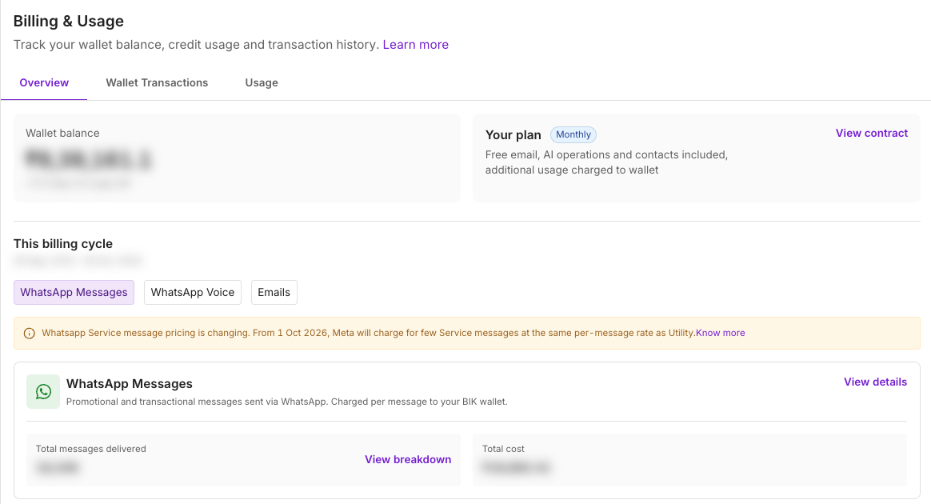
- Prepaid wallet. WhatsApp messages are charged per message to a BIK wallet, so you can see each charge.
- Self-serve onboarding. In the BIK dashboard you click Connect WhatsApp, choose a new number, log in with the Facebook account that is admin of your business portfolio, set the display name and verify the number by SMS or phone call. BIK's Embedded Signup flow sets up two-step verification for you.
- Migration included. If your number is with another provider, BIK's onboarding team runs the migration.
- A dedicated WhatsApp group with the BIK team for every client, which is rare among BSPs.
The BSP connection does not include the BIK platform, which is a separate subscription. The platform adds journeys for abandoned carts and order updates, campaigns with Smart Retry for messages that fail on Meta's per-user marketing limits, Fallback AI templates when a template is paused, a WhatsApp Warm-up guide for scaling messaging limits, end-to-end checkout inside WhatsApp, and a shared helpdesk across WhatsApp, Instagram, email and SMS. Platform plans start at $250 per month, priced on unique contacts with AI credits included (100,000 contacts is $300 per month), and there is a startup plan. Messages sent from the platform are billed at Meta's rate card with no markup.
When BIK is not the right fit
- You have engineers and only need a pipe. If you are building your own messaging product, going direct on Cloud API, or using a developer-first provider like Gupshup or 360dialog, may suit you better. BIK's BSP offering also works API-only, without the platform.
- You only want a basic WhatsApp inbox with no retention programme. The WhatsApp Business app may be enough. BIK's standard plans are built for established brands at about ₹1 crore or more in monthly revenue, and smaller brands can start on BIK's startup plan.
- You are not an ecommerce business. BIK's journeys, segments and integrations are built around online stores. A bank or a clinic with heavy compliance needs may want a CPaaS such as Twilio.
FAQ
What is the difference between WhatsApp Business API and Cloud API?
In 2026 they are the same thing in practice. The On-Premises API expired on 23 October 2025, so every business on the WhatsApp Business Platform now uses the Cloud API, which Meta hosts.
Do I need a BSP to use the WhatsApp Business API?
No. You can connect to Cloud API directly through a Meta developer app and pay Meta yourself. A BSP saves you the build work and adds tools such as an inbox, campaigns and store integrations.
What is the difference between a Solution Partner and a Tech Provider?
Meta lets Solution Partners extend a credit line to your WhatsApp account and invoice you for message fees. With a Tech Provider you add your own payment method and Meta bills you directly, while the provider bills only for its software.
Is the WhatsApp Business API free?
No. Meta charges per delivered template message by category and country, and from 1 October 2026 it charges service messages at the utility rate after 1,000 free per number per month. Some conversations, such as those started from Click-to-WhatsApp ads, stay free during the free entry point window.
Can I use the WhatsApp Business app and the API on the same number?
Yes, through Meta's coexistence onboarding, offered by Solution Partners and Tech Providers. The number is capped at 20 messages per second and some app features, like broadcast lists, are disabled.
Does a BSP own my WhatsApp number?
It should not. During Embedded Signup the WhatsApp Business Account is created or selected in your own business portfolio. Check this before you sign, because it decides how easily you can switch providers.
How much does BIK charge for WhatsApp?
BIK's BSP (API-only) offering passes Meta's rate card through at cost with no markup, charges $10 per WhatsApp number per month and has a $0 platform fee. The BIK marketing and retention platform is a separate subscription, not included in the $10, starting at $250 per month and priced on contacts.