
WhatsApp Abandoned Cart Recovery: Flows, Templates and Tools (2026)
How to build a WhatsApp abandoned cart flow for Shopify: timing sequence, 8 example message templates, omnichannel fallback, AI voice calls, checkout inside WhatsApp, the metrics to track and how the main tools compare.
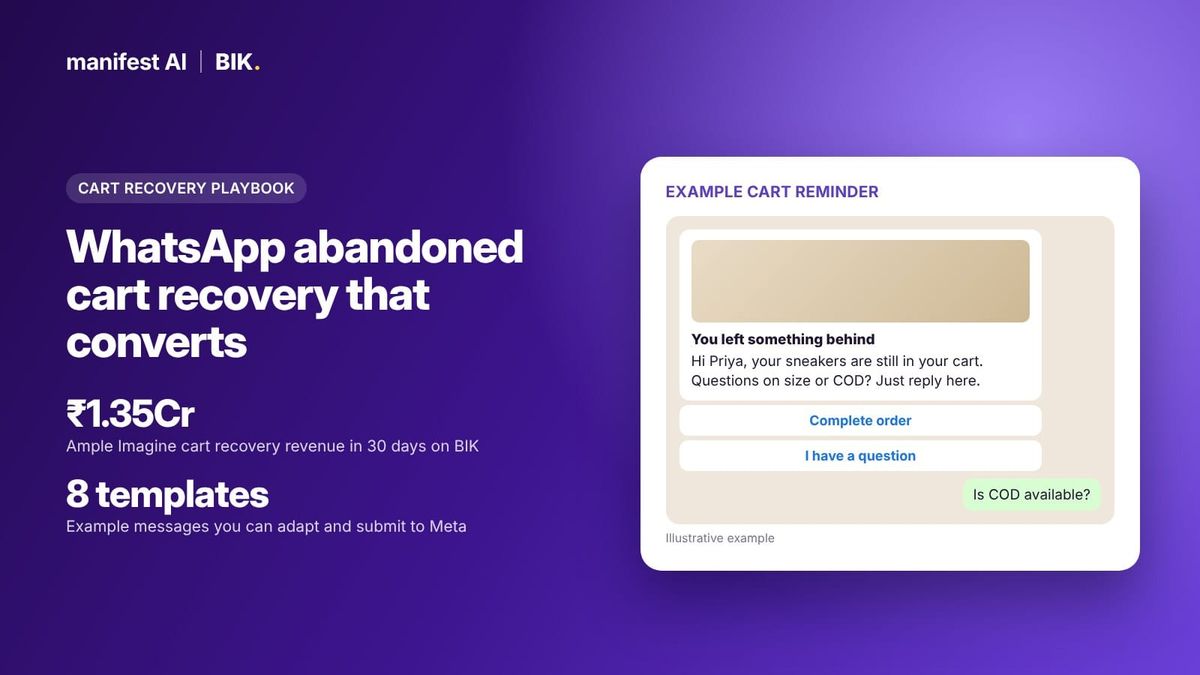
Short answer: WhatsApp abandoned cart recovery is an automated sequence that messages shoppers who left items in their cart or checkout, usually starting 15 to 60 minutes after they leave, then following up at around 12 and 36 hours with a reason to return. The best setups branch by cart contents, cancel the moment an order is placed, fall back to email or SMS when WhatsApp fails, and hand high-intent shoppers to a human or an AI voice call. BIK runs all of this on one profile, with Meta's WhatsApp rates passed through at cost.

Most Shopify stores already send an abandoned checkout email, but email is easy to ignore and Shopify's recovery email needs an email address. WhatsApp fills that gap if the flow is built properly. This guide covers the flow structure, timing, eight ready-to-adapt message templates, the fallback logic, what to measure and how the main tools compare in October 2026.
What is WhatsApp abandoned cart recovery?
It is a triggered journey: a shopper leaves without paying, and your platform sends a WhatsApp template linking back to their cart, then follow-ups, then stops.
Two events are often lumped together:
- Abandoned cart (add to cart, no checkout): the shopper added a product but never reached checkout. You can only message them if you already know who they are, for example a returning customer or a visitor identified by a checkout app.
- Abandoned checkout: the shopper started checkout and entered contact details. Shopify's help centre says a checkout counts as abandoned if it stays incomplete for more than ten minutes. This is the higher-intent group and the core of most recovery flows.
Meta classifies cart reminders as marketing templates, even when the customer asked for them, so marketing rates and Meta's per-user marketing limits apply.
Why WhatsApp works for cart recovery
People read WhatsApp. In BIK case studies, Duroflex reports an 81% open rate on invoices sent by WhatsApp, and Ample Imagine reports that roughly 80% of 6.6K delivered shipping updates were opened. Those are transactional messages, so treat them as evidence of attention, not a recovery benchmark.
A WhatsApp reminder is also a conversation. The shopper can reply "can I pay cash on delivery?" and get an answer in the same thread.
The abandoned cart timing sequence
A pattern that suits most catalogues: one fast reminder, one value message, one urgency message, then a human or a call.
| Step | Timing after abandonment | Channel | Goal |
|---|---|---|---|
| 1. Reminder | 15 to 60 minutes | Bring back shoppers who were interrupted. No discount yet. | |
| 2. Help or AI call | From 5 minutes (high-value carts) | AI voice call or WhatsApp reply | Handle objections: size, delivery date, COD, returns. |
| 3. Value message | About 12 hours | Social proof, bestsellers, reviews, or a small incentive. | |
| 4. Urgency message | About 24 to 36 hours | Limited stock or expiring offer, if true. | |
| 5. Fallback | Whenever WhatsApp fails | Email, SMS or RCS | Keep the sequence alive when a message is not delivered. |
| 6. Human handoff | After the last message | WhatsApp live agent | Personal follow-up for carts worth the time. |
A real example: Ample Imagine, an Apple reseller on Shopify, runs its cart recovery on BIK. According to its case study, the flow waits 30 minutes, removes anyone who ordered in that window, branches into six product categories (Mac, iPad, iPhone, Apple Watch, Music, TV and Home), then sends a reminder with an accessory coupon, a follow-up at 12 hours, an urgency push at 36 hours, and finally routes to a live WhatsApp agent. Over 30 days it reports 10.05K abandoned cart triggers and ₹1.35Cr in order revenue, the largest figure across its BIK flows. You can read the full breakdown in how Ample Imagine matches its cart recovery messages to what's in the cart.
Three rules for timing
- Always set a cancel trigger. If the shopper orders, the journey must stop.
- Cap frequency. Three abandonments in a day should not mean nine messages.
- Respect quiet hours. Pause marketing sends overnight.
Selling on WhatsApp? Manifest AI and BIK turn WhatsApp conversations into orders, with AI agents that answer questions, recommend products and recover carts.
8 abandoned cart WhatsApp message templates
These are example templates written for this guide, not copy from any brand. Replace the variables in double braces with your platform's fields. Keep each under about 450 characters, use one clear button, and submit them under the Marketing category so Meta approves them without reclassification.
Example 1: Simple reminder (first message)
Hi {{1}}, you left {{2}} in your cart. We have saved it for you. Tap below to pick up where you left off.
Button: Complete my order
Example 2: Reminder with a question
Hi {{1}}, still thinking about {{2}}? If something stopped you, like size, delivery time or payment, just reply here and we will help.
Buttons: Complete order | I have a question
Example 3: Product image with social proof
[Image header: product photo] {{2}} is one of our most-reviewed products this month. Your cart is ready whenever you are.
Button: View my cart
Example 4: Small incentive (second or third message)
Hi {{1}}, here is {{3}} off your cart with code {{4}}, valid for the next 24 hours. Your items: {{2}}.
Button: Apply code and checkout
Example 5: Free shipping nudge
Good news, {{1}}: your cart qualifies for free shipping today. {{2}} is waiting for you.
Button: Checkout now
Example 6: Low stock urgency (only if true)
Heads up, {{1}}: only a few units of {{2}} are left in your size. We cannot hold your cart much longer.
Button: Complete my order
Example 7: COD reassurance (India)
Hi {{1}}, prefer to pay on delivery? Cash on delivery is available for your pin code. Or pay online now and save {{3}}.
Buttons: Pay online | Order with COD
Example 8: Carousel of the cart plus related picks
Card 1: your cart item with "Checkout" button. Cards 2 to 4: complementary products, each with "Add to cart". Body: Your cart is still here, {{1}}. Customers who bought {{2}} also liked these.
Do not open with a discount; shoppers learn to abandon carts to get one. And an "I have a question" button turns a reminder into a sales conversation that an AI agent or a person can close.
How to set up Shopify abandoned cart recovery on WhatsApp
The steps are similar on most platforms. Here is how it works in BIK, based on BIK's help documentation.
- Connect Shopify and WhatsApp. Connect your store, then your WhatsApp Business API number (new number or migration from another provider).
- Pick the trigger. BIK's "Abandoned a cart" event fires when a customer starts checkout and adds contact information but does not complete the purchase. "Add to cart" and "Product viewed" events are also available once store channel settings are enabled.
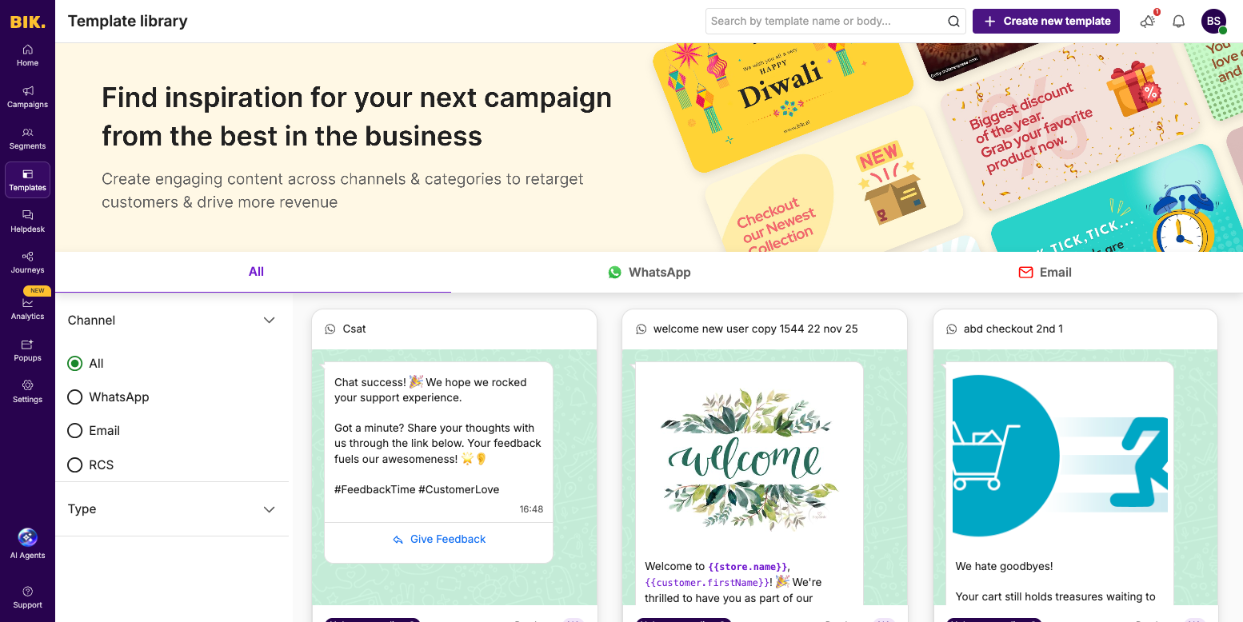
- Start from the library. BIK's flow library includes an abandoned cart flow, an abandoned cart flow with discount and an omnichannel abandoned cart journey.
- Use quick checkout links if you have a checkout partner. BIK fetches checkout URLs automatically for Shopflo, Zecpe, GoSwift, Razorpay Magic Checkout, Xpresslane and GoKwik, so the button opens the right checkout.
- Add delays, filters and branches. Branch on cart value, collection or customer type. Add a cancel trigger on "Ordered".
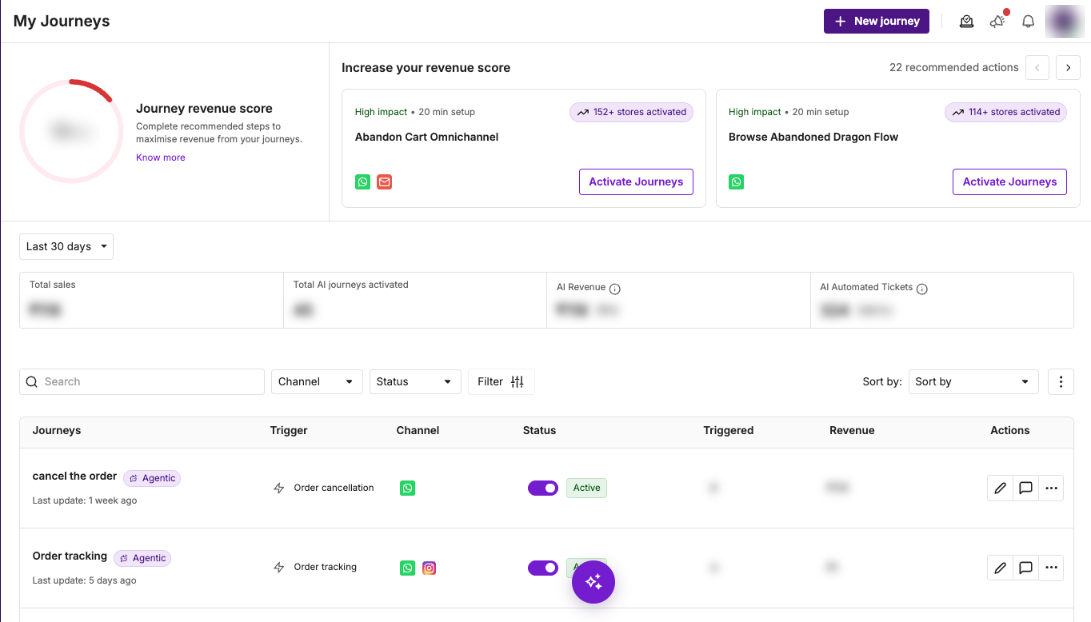
- Add a fallback channel for undelivered messages, and an agent handoff at the end.
Omnichannel fallback: what happens when WhatsApp fails
Not every WhatsApp message is delivered. The common reasons are a number not on WhatsApp, a paused template, or Meta's per-user marketing limits. Meta's developer documentation says WhatsApp may cap how many marketing templates a user receives from businesses, based on their engagement, and returns error 131049 when a message is blocked. Meta advises waiting at least 24 hours before retrying.
A good recovery setup handles each case:
- Not on WhatsApp or undelivered: send the same reminder by SMS, RCS or email. BIK's drip campaigns can automatically retry on email or SMS when a WhatsApp message does not reach the user.
- Per-user limit hit: BIK's Smart Retry retries failed campaign messages with timed attempts inside a retry window, instead of hammering the user.
- Template paused or restricted: BIK's Fallback AI generates a Meta-compliant fallback template so the send does not fail outright.
Sleepyhead's contest flow, built on BIK, is a useful pattern here: when a WhatsApp message failed, the flow switched to SMS so no participant dropped out. See Sleepyhead's multi-round contest.
Voice Agent: calling shoppers who abandon checkout
For high-value carts, a call can beat any message, but calling every abandoned checkout with a human team is too expensive. BIK's Voice Agent places an automated AI call to shoppers who abandon checkout.
According to BIK's help documentation, the AI Voice Agent block sits inside an abandoned cart journey after a delay of at least 5 minutes. During the call the agent introduces the reason for the call, answers questions using order and customer context, can offer a discount and update the delivery address if you enable those options, and asks for the order. Each call exits through an outcome, such as COD order placed, payment link requested, no answer, or no order, so you can continue the journey. A shopper who asks for a payment link can get it on WhatsApp straight after the call. Unanswered calls are retried up to two times.
Use voice selectively, for example on carts above a value threshold.
Checkout inside WhatsApp
Every redirect to a website loses some shoppers. BIK's End-to-End Checkout on WhatsApp lets customers browse products, build a cart and pay without leaving the chat. BIK's help docs describe the flow: the shopper sends the cart, chooses checkout on chat or by link, confirms an address suggested from Shopify or enters a new one, picks COD or prepaid, sees a bill with discount, taxes and shipping, then confirms the COD order or pays via a link. Prepaid orders need Razorpay connected to BIK.
This helps most with repeat buyers and shoppers from Click-to-WhatsApp ads.
See what your brand could automate. Our team builds the agents for you, and most brands are live in about 2 weeks.
Metrics to track for WhatsApp cart recovery
| Metric | What it tells you | What to do if it is weak |
|---|---|---|
| Triggers | How many abandonments entered the flow | Check event setup and phone capture at checkout |
| Delivery rate | Share of sends that reached WhatsApp | Add fallback channels, check per-user limits and quality rating |
| Click-through rate | Whether the offer and button worked | Test images, button text and cart preview |
| Reply rate | How many shoppers had questions | Make sure replies are answered fast, by AI or agents |
| Recovered orders and revenue | The outcome | Compare against a holdout group to see true lift |
| Cost per recovered order | Message, call and discount cost per order | Cut steps that add cost without orders |
Some shoppers would have returned anyway. The cleanest test is a holdout: message nobody in a small random share of abandoners for two weeks and compare conversion.
WhatsApp abandoned cart tools compared
| Tool | Cart recovery approach | Pricing notes (as listed in October 2026) |
|---|---|---|
| BIK | Journeys with branching, cancel triggers, omnichannel fallback (email, SMS, RCS), AI Voice Agent, checkout inside WhatsApp, AI replies to campaign responses | From $250 per month on contacts; WhatsApp at Meta's rate card with no markup |
| Zoko | Abandoned checkout recovery included as an essential Shopify flow; third-party checkout recovery is a premium flow at $5.99 per month per flow | Starter $49.99, Plus $79.99, Elite $139.99, Max $499.99 per month; Starter adds $0.015 per conversation |
| WATI | Growth plan includes Shopify abandoned cart and order templates | Shopify integration add-on $4.99 per month; messages billed on WATI's rate card |
| AiSensy | Lists Shopify abandoned cart and order status; chatbot builder add-on includes Shopify integration | India marketing ₹1.09 per message; chatbot builder ₹2,500 per month |
| Interakt | Shopify-focused WhatsApp platform popular with Indian D2C brands | Starter ₹3,499 per quarter; reported 12% to 25% markup over Meta base rates on self-serve plans |
Each tool can send a cart reminder. The differences are in branching, fallback, AI replies, calling and checkout without a redirect. For a wider comparison, see the best WhatsApp marketing tools for Shopify brands.
How BIK handles abandoned cart recovery
- One profile across channels: WhatsApp, email, SMS, RCS, Instagram and web push share one customer profile, so the fallback message knows what the WhatsApp message already said.
- Ready flows plus a growth manager: new brands get a growth manager who sets up 30+ flows, including cart recovery.
- Campaign Sales Agent: an AI agent replies to shoppers who respond to campaigns, using campaign context to answer questions and handle objections.
- Deliverability tools: Smart Retry, Fallback AI, WhatsApp Warm-up, frequency caps and quiet hours.
- Transparent costs: plans from $250 per month on unique contacts, plus Meta's WhatsApp rates at cost with no markup, charged to a prepaid wallet. See WhatsApp BSP markup explained.
When BIK is not the right fit
If you only want a basic WhatsApp inbox with a single cart reminder and no wider retention programme, a basic tool such as WATI with its Shopify add-on or Zoko's Starter plan covers that. BIK's standard plans are built for established brands doing about ₹1 crore or more a month, where branching, fallback and no markup on Meta rates pay back; smaller brands can start on BIK's startup plan. If your store sells mostly to US customers, WhatsApp marketing templates are not currently delivered to US numbers according to Meta's developer documentation, so email and SMS should lead your recovery and WhatsApp plays a smaller role. And if your marketing team already runs everything in a CDP such as MoEngage, you may prefer to keep journeys there and use BIK only for WhatsApp, as Popclub does.
80%+ of tickets automated, or your money back. That's the Manifest AI guarantee, written into your contract.
FAQ
What is the best time to send an abandoned cart WhatsApp message?
Send the first reminder between 15 and 60 minutes after abandonment, when intent is still high. Ample Imagine waits 30 minutes so shoppers who come back on their own are not messaged. Follow up at around 12 hours and 24 to 36 hours, then stop.
Are abandoned cart WhatsApp messages marketing or utility?
Marketing. Meta's template guidelines list cart reminders under marketing, even when the customer requested them. That means marketing rates apply and per-user marketing limits can block some sends.
Do I need customer opt-in to send cart reminders on WhatsApp?
Yes. Meta requires opt-in before you send business-initiated messages, and the opt-in must name your business and say the customer will get WhatsApp messages. Collect it at checkout or in a popup with a clear checkbox.
Can I recover carts from shoppers who never entered a phone number?
Only if you can identify them. Checkout and identification apps such as Shopflo or Nitro Commerce can tag visitors, and BIK can use those tags to trigger WhatsApp journeys. LEGO India uses this approach for browse retargeting.
How much does a WhatsApp cart reminder cost?
You pay Meta's marketing rate for the recipient's country, plus any markup your provider adds. In India Meta's base marketing rate is about ₹0.8631 per message in October 2026; BIK passes that through at cost.