.png)
WhatsApp Business API Updates 2026: Every Change Brands Need to Know
A dated changelog of WhatsApp Business API changes from 2025 to October 2026: per-message pricing, portfolio messaging limits, the Calling API, Marketing Messages API, the AI chatbot policy, usernames and service message charges, each with its source.
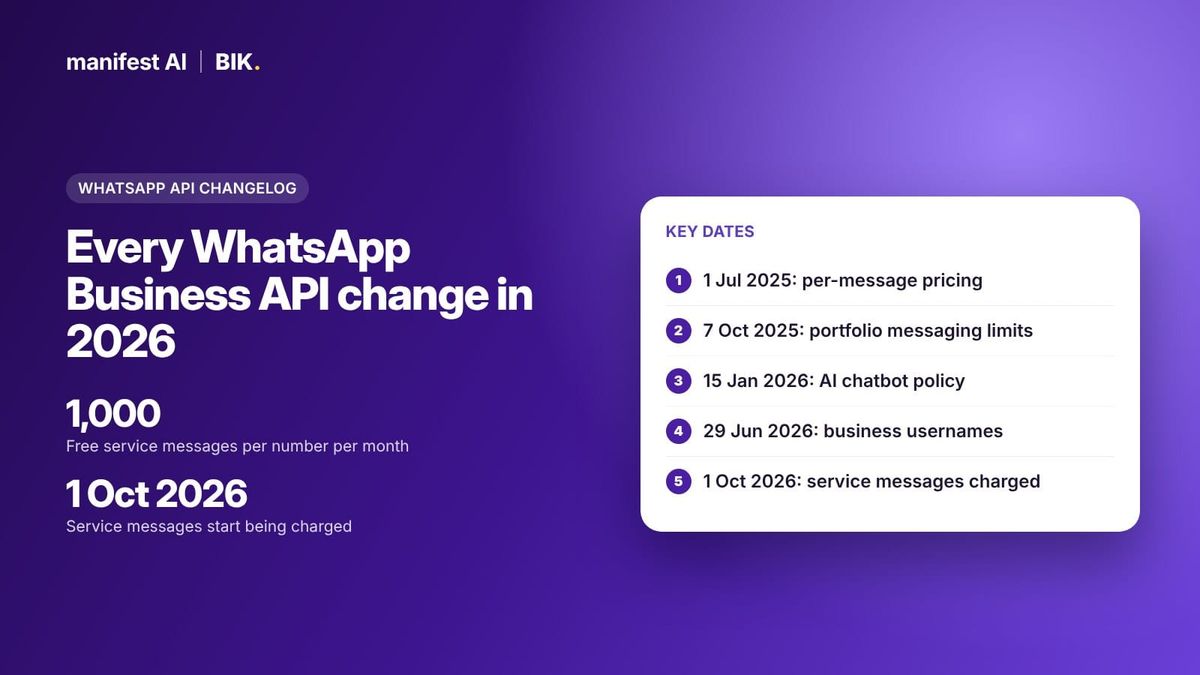
Short answer: The biggest WhatsApp Business API changes for brands since 2025 are: per-message pricing (1 July 2025), messaging limits moving to the business portfolio (7 October 2025), the Calling API (July 2025), Marketing Messages API for WhatsApp reaching general availability (November 2025), the ban on general-purpose AI chatbots (15 January 2026), usernames and business-scoped user IDs (2026), and charges for service messages after 1,000 free per number each month (1 October 2026). BIK passes every Meta rate through at cost, with no markup; its BSP (API-only) offering is $10 per number per month with no platform fee, and its marketing platform is a separate subscription from $250 per month.
Last updated 10 October 2026.
Meta ships changes to the WhatsApp Business Platform almost every week, and most of them only matter to developers. This changelog keeps the ones that change what an ecommerce brand pays, who it can reach, or what it can build. Each entry has a date and a link to the source, which is Meta's own documentation wherever Meta publishes the detail. We update this page as new changes go live.
WhatsApp Business API changes at a glance
| Date | Change | Who it affects |
|---|---|---|
| 11 Feb 2025 | Coexistence: onboard a WhatsApp Business app number to the API | Small brands moving from the app |
| 1 Apr 2025 | Marketing templates to US numbers paused | Brands with US customers |
| 1 Apr 2025 | Marketing Messages Lite API opens to all businesses (open beta) | High-volume marketers |
| 9 Apr 2025 | Utility templates Meta considers marketing are approved as marketing by default | Everyone sending utility templates |
| 1 Jul 2025 | Per-message pricing replaces conversation pricing | Everyone |
| 15 Jul 2025 | WhatsApp Business Calling API available | Support and sales teams |
| 6 Oct 2025 | Groups API launched | Community-led brands |
| 7 Oct 2025 | Messaging limits move to business portfolio level | Everyone sending templates |
| 19 Nov 2025 | MM Lite renamed Marketing Messages API for WhatsApp, now generally available | High-volume marketers |
| 1 Jan 2026 | India marketing rate rises; India billing moves to INR | Brands messaging India |
| 15 Jan 2026 | General-purpose AI chatbots barred from the platform | AI assistant providers (not brands' own AI agents) |
| 16 Feb 2026 | AI provider pricing for non-template messages begins (Italy first) | AI assistant providers |
| April 2026 | Business-scoped user IDs start appearing in webhooks | Anyone with an API integration |
| 6 Apr 2026 | Option to switch off marketing on the Cloud API (error 131063) | Marketing Messages API users |
| 15 May 2026 | Max price per marketing message enters limited beta | Marketing Messages API users |
| 29 Jun 2026 | Businesses can reserve and adopt usernames | All brands |
| 1 Jul 2026 | UK, Italy and Spain marketing rates rise; Brazil billing in BRL | Brands messaging those markets |
| 1 Oct 2026 | Service messages charged after 1,000 free per number per month | Everyone who handles support on WhatsApp |
| 15 Oct 2026 | Embedded Signup v2 deprecated | Solution providers (and brands still onboarding through v2) |
Pricing changes
1 July 2025: per-message pricing
Meta stopped charging per 24-hour conversation and started charging per delivered template message, priced by category (marketing, utility, authentication) and the recipient's country code. Failed messages are not charged. Utility and authentication templates got monthly volume tiers, aggregated across all accounts in a business portfolio; marketing has none. Meta changes rates only on 1 January, 1 April, 1 July and 1 October, with at least one month's notice for rate card updates. Our guide to BSP markups explains what providers add on top.
1 January 2026: India rate rise and INR billing
Meta raised the India marketing rate and moved India billing to Indian rupees, with accounts billed in other currencies to be migrated by 31 December 2026. As of October 2026, Meta's India base rates are ₹0.8631 per marketing message and ₹0.115 per utility or authentication message. The same update lowered utility and authentication rates for North America.
1 April and 1 July 2026: more rate changes and local currencies
On 1 April 2026, the Saudi Arabia marketing rate rose and eight new billing currencies were added, including AED, SAR and SGD. On 1 July 2026, marketing rates rose in Italy, Spain and the UK, and Brazil billing moved to BRL, with migration due by 30 June 2027.
1 October 2026: service messages are no longer free
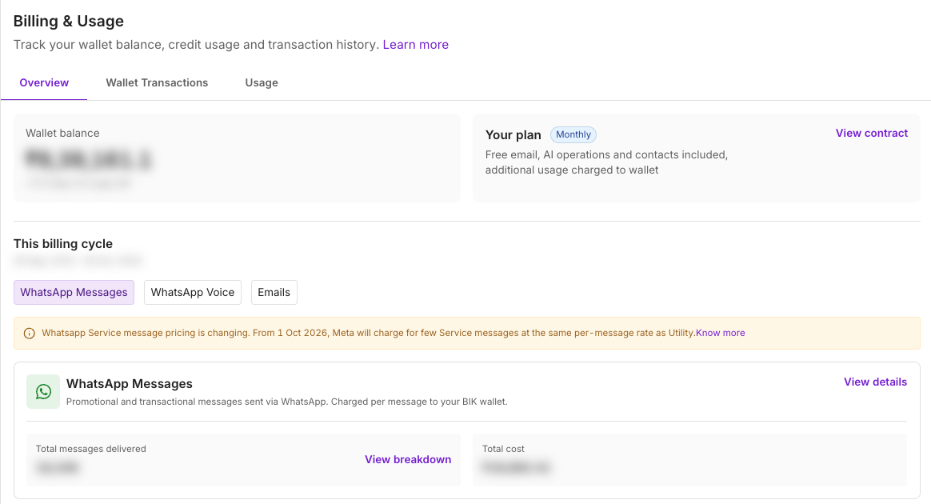
This is the change most brands will feel. Free-form replies inside the 24-hour customer service window are now charged at the recipient country's utility rate after the first 1,000 free service messages per business phone number per month. The allowance resets monthly and does not roll over. Industry summaries also report that utility templates sent inside an open window, which were free before, are now charged from the first message. YCloud's summary noted that service delivery could stop for accounts without a payment method by 30 September 2026. Conversations that start from Click-to-WhatsApp ads or Facebook Page buttons stay free during the free entry point window. Our service message pricing explainer works through the cost.
Messaging limits and template rules
9 April 2025: utility templates default to marketing when Meta disagrees
If Meta decides a template submitted as utility is really marketing, it is now approved as marketing by default. Since 16 April 2025, businesses already warned for misuse get no advance notice before a recategorization. Repeated misuse can lead to utility rate limits and portfolio-wide restrictions. See our template categories guide.
7 October 2025: messaging limits move to the business portfolio
Limits on how many unique people you can message outside a customer service window in 24 hours are now set per business portfolio and shared by all its numbers. New portfolios start at 250; the next step is 2,000, then automatic scaling to 10,000, 100,000 and unlimited. Increases apply within 6 hours instead of 24. The Flagged status is gone, and a quality drop no longer lowers your limit. The old per-number webhook fields were removed in February 2026. Full detail is in our messaging limits and quality rating guide.
8 December 2025: portfolio pacing for large campaigns
Meta added business portfolio pacing to batch template delivery for large campaigns. Expect very large sends to be paced by Meta rather than delivered in one burst.
Marketing Messages API for WhatsApp
Meta's separate API for marketing templates went through several stages:
- 1 April 2025: Marketing Messages Lite API enters open beta, with self-signup for all partners and businesses.
- 1 July 2025: per-message pricing applies to it, the same as the Cloud API.
- 19 November 2025: renamed Marketing Messages API for WhatsApp and made generally available.
- 6 April 2026: businesses can switch off marketing on the Cloud API so all marketing goes through the new API. Marketing templates sent the old way then fail with error 131063.
- 15 May 2026: a max price per message enters limited beta. When set, Meta charges that price or less per delivery.
Meta describes the API as using automatic delivery optimization to reach people most likely to find a message relevant, plus benchmarks, conversion metrics, richer media such as GIFs, and a time-to-live setting so stale offers are not delivered late. It only supports marketing templates; order updates and OTPs stay on the Cloud API.
1 April 2025: marketing to US numbers paused
Meta stopped delivering marketing templates to WhatsApp users with US phone numbers on 1 April 2025. Meta's per-user limits documentation still says WhatsApp "does not currently deliver" them, and no restart date has been announced as of October 2026. Utility and authentication templates to US numbers are unaffected. Separately, Meta caps how many marketing messages each user receives from all businesses, based on engagement; blocked sends fail with error 131049. Our guide to failed WhatsApp marketing messages covers the fixes.
AI chatbot policy and AI provider pricing
15 January 2026: general-purpose AI assistants barred
In October 2025, Meta added an "AI providers" section to the WhatsApp Business Solution terms, effective 15 January 2026. Providers of general-purpose AI assistants, where the AI is the primary product rather than incidental to a business's service, can no longer use the Business Platform to distribute them. Meta told TechCrunch the change does not affect businesses that use AI to serve their own customers. For a brand, that means an AI agent answering order questions, recommending products or recovering carts is still allowed.
16 February to 13 May 2026: AI provider pricing
Meta introduced per-message charges for non-template messages sent by AI providers: Italy from 16 February 2026, then Brazil and a list of European markets from 11 March 2026. From 13 May 2026, Meta stopped these charges in the EU and EEA, while Brazil's continue. Meta states the policy does not change pricing for other businesses.
Calling API
The WhatsApp Business Calling API became available on 15 July 2025. Customers can call a business, and businesses can call customers who have granted call permission. User-initiated calls are free. Business-initiated calls are billed in six-second pulses by destination country, with monthly volume tiers; the current rate cards took effect on 1 April 2026. Business-initiated calling is not available for business numbers in the US, Canada, Egypt, Vietnam and Nigeria, and permission requests are capped per customer (in production, one per day and two per week). Calling restrictions based on user feedback took effect on 27 January 2026.
Usernames and business-scoped user IDs
WhatsApp is rolling out optional usernames, so users can hide their phone number. To prepare, Meta introduced business-scoped user IDs (BSUIDs), a stable ID for each user per business portfolio. BSUIDs began appearing in webhooks in early April 2026. Businesses could reserve and adopt their own usernames from 29 June 2026, and Meta's APIs added support for sending to BSUIDs in July 2026. If a user adopts a username, their phone number can be missing from webhooks unless you messaged or called each other in the last 30 days or they are in your contact book. Meta recommends sending marketing to phone numbers so you keep receiving numbers in webhooks. Ask your provider whether it stores BSUIDs.
Coexistence, Groups and onboarding
- Coexistence (11 February 2025, expanded 23 October 2025): businesses can bring an existing WhatsApp Business app number onto the API and keep using the app for one-to-one chats, with up to six months of history synced. India numbers were supported from 5 May 2025, and the October expansion added the EU, EEA, UK, Japan, South Korea, Australia and others. Throughput on coexistence numbers is fixed at 20 messages per second, and some app features, such as broadcast lists, are disabled.
- Groups API (6 October 2025): businesses can create and manage WhatsApp groups programmatically.
- Multi-solution conversations (15 July 2025, open beta): one number can work with more than one partner.
- Embedded Signup v2 deprecated (15 October 2026): providers must move to v4, which since 8 October 2025 supports onboarding to several products at once, including the Marketing Messages API.
What brands should do now
- Re-budget support. Service replies beyond 1,000 per number per month now cost the utility rate. Automate repetitive questions and make sure a payment method is on file.
- Audit template categories. Move any promotional "utility" template to marketing before Meta does it for you.
- Plan limit growth before peak season. Limits are shared across your portfolio and grow one level at a time.
- Check your provider's markup. Every Meta rate change is multiplied by any percentage markup your provider adds.
- Prepare for usernames. Make sure your provider handles BSUIDs.
How BIK keeps brands current
BIK is a Meta Business Solution Provider and a retention, conversational commerce and helpdesk platform for ecommerce brands. It sells these as two separate offerings. How they line up with the changes above:
- Pricing at cost. Meta's rate card with no markup for marketing, utility, authentication and service messages in every country. BIK's BSP (API-only) offering costs $10 per WhatsApp number per month with a $0 platform fee. On the platform, messages are charged per message to a prepaid BIK wallet.
- Marketing Messages Lite API support. BIK's channel settings show Marketing Messages Lite API support on the connected number.
- WhatsApp Calling. Calling is built into the BIK helpdesk with calling journeys, and BIK's Voice Agent calls customers who abandon checkout.
- Delivery protection. Smart Retry, Fallback AI for paused templates, WhatsApp Warm-up for portfolio limits, frequency caps and Do Not Disturb.
- AI agents for your own customers. BIK's Campaign Sales Agent replies to customers who respond to campaigns, which is the kind of business AI use Meta's policy allows.
The calling, delivery protection and AI agent features above are part of the BIK platform, a separate subscription not included in the BSP's $10. Platform plans start at $250 per month, priced on unique contacts (100,000 contacts is $300 per month) with AI credits included. Migration is included, and every client gets a dedicated WhatsApp group with the BIK team.
When another option fits better
- You are an AI assistant company. Meta's AI provider terms apply to you, not to brand tools, so speak to Meta or a developer-focused provider directly.
- You want only an API. BIK's BSP (API-only) offering, or a developer-first provider such as 360dialog or Gupshup, suits teams that build everything in-house.
- Your market is the US. With marketing templates paused there, WhatsApp is mainly a support and order-update channel.
FAQ
What are the latest WhatsApp Business API updates in 2026?
The main 2026 changes are charges for service messages after 1,000 free per number per month (1 October), usernames and business-scoped user IDs, the ban on general-purpose AI chatbots (15 January), max price bidding for the Marketing Messages API, and quarterly rate changes in India, Saudi Arabia, the UK, Italy and Spain.
Are WhatsApp service messages still free in 2026?
Partly. Since 1 October 2026, each business phone number gets 1,000 free service messages a month, then pays the recipient country's utility rate. Conversations from Click-to-WhatsApp ads remain free during the free entry point window.
Can brands still use AI chatbots on WhatsApp after January 2026?
Yes. Meta's rule targets providers whose main product is a general-purpose AI assistant. Meta has said businesses using AI to serve their own customers are not affected.
Is the Marketing Messages Lite API the same as the Marketing Messages API for WhatsApp?
Yes. Meta renamed Marketing Messages Lite API to Marketing Messages API for WhatsApp on 19 November 2025, when it became generally available. It handles marketing templates only.
Do WhatsApp usernames mean I lose customers' phone numbers?
Not for existing customers you message regularly. Phone numbers are omitted from webhooks only for users with a username who have not messaged or called you, or been messaged by you, in the last 30 days and are not in your contact book.
When does Meta change WhatsApp prices?
Only on 1 January, 1 April, 1 July or 1 October, with at least one month's notice for rate card changes and longer for changes to the pricing model.