.png)
WhatsApp vs SMS vs Email for Ecommerce Retention (2026 Benchmarks)
Sourced 2025-2026 benchmarks for WhatsApp, SMS and email: read rates, click rates, conversion, revenue and cost per message in India and the US, plus when to use each channel and how to orchestrate them with fallback.
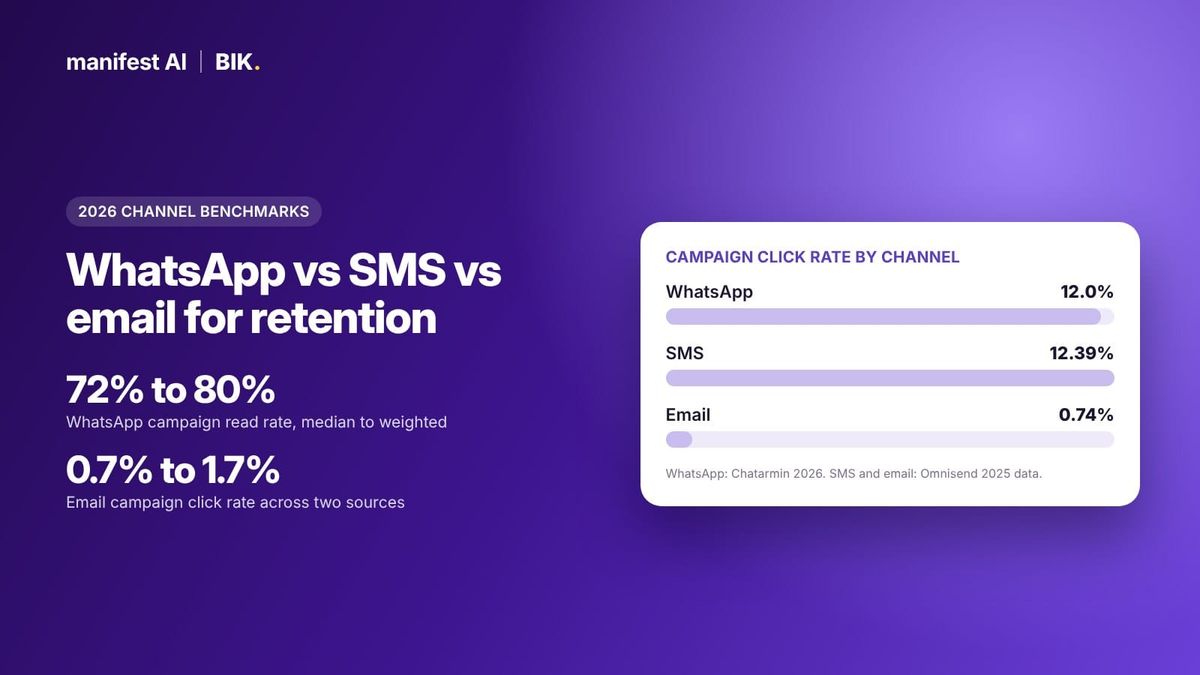
Short answer: WhatsApp gets read and clicked far more than email, and roughly matches SMS on clicks while allowing images, buttons, catalogues and two-way chat. Email is still the cheapest per send and converts well in automated flows. SMS is the reliable fallback. Sourced 2025-2026 benchmarks put WhatsApp campaign read rates at about 72% to 80%, SMS campaign click rates at about 9% to 14.5%, and email campaign click rates at about 0.7% to 1.7%. The best retention setup uses all three from one customer profile with automatic fallback, which is how BIK works.
Most "WhatsApp vs SMS vs email" articles quote a 98% open rate for WhatsApp and SMS without saying where it comes from. This guide uses only benchmarks with a named source and a stated method, gives a range where sources disagree, and prices each channel per message in October 2026. Treat every benchmark as directional: each comes from a vendor's own customer base, and your list, offer and timing will move the numbers more than the channel does.
WhatsApp vs SMS vs email: 2026 benchmarks
| Metric | SMS | ||
|---|---|---|---|
| Open or read rate, campaigns | 79.6% weighted, 72.05% median per brand (Chatarmin) | No reliable measure; commonly cited around 90% to 98% without a documented method | 31% "good" benchmark (Klaviyo); inflated by mail privacy features that open messages automatically |
| Click rate, campaigns | 12.0% of delivered messages, all clicks counted (Chatarmin) | 12.39% (Omnisend); 8.9% to 14.5% for ecommerce (Klaviyo, as cited by ClickMinded) | 0.74% (Omnisend); 1.69% "good" benchmark (Klaviyo) |
| Click rate, automated flows | Not published separately | 20.34% (Omnisend); near 10% (Klaviyo) | 4.66% (Omnisend); 5.58% "good" benchmark (Klaviyo) |
| Conversion rate | Not published as a rate | 0.12% campaigns, 0.78% automations (Omnisend) | 0.08% campaigns, 1.49% automations (Omnisend) |
| Revenue per message | €1.03 per campaign message (Chatarmin) | $0.15 campaigns, $0.75 automations (Omnisend) | $3.41 per automated email (Omnisend) |
| Opt-out rate, campaigns | 0.34% (Chatarmin) | 0.6% to 1.4% for ecommerce (Klaviyo, as cited by ClickMinded) | Varies by list |
How to read this table:
- WhatsApp: Chatarmin's 2026 benchmark covers 11.8 million delivered messages from March to May 2026 for read and click rates, and 49.3 million campaign messages from June 2025 to June 2026 for revenue. The sample is Chatarmin's own customers, not ecommerce as a whole, and its click rate counts every click per delivered message, not unique clickers. Chatarmin itself says the median per brand (72.05%) is the more realistic target than the weighted 79.6%.
- SMS and email: Omnisend's figures come from 2025 data across 27,000+ brands, with 246 million+ SMS campaign sends. Klaviyo's email benchmarks are "good" benchmarks rather than averages, based on more than 183,000 customers. The two disagree on email campaign clicks (0.74% vs 1.69%), so treat the real figure as a range.
- Single-brand data: PopClub's WhatsApp points-expiry reminders on BIK reached a 54% read rate (27.8K reads from 51.3K sent). That is lower than Chatarmin's average and a useful reminder that one programme can sit well below a benchmark.
One more caution on WhatsApp open rates. Pages claiming 95% to 98% usually do not say whether they divide by messages sent or delivered, or how read receipts are handled. Use clicks, orders and opt-outs to compare channels, not opens.
Cost per message: WhatsApp vs SMS vs email (October 2026)
| Channel | India | United States | Notes |
|---|---|---|---|
| WhatsApp marketing | ₹0.8631 | About $0.025 | Meta base rate per delivered message; providers may add a markup |
| WhatsApp utility (order updates) | ₹0.115 | $0.0034 | Meta base rate; service replies cost the same after 1,000 free per number per month |
| SMS | ₹0.16 to ₹0.25 plus GST (MSG91, by volume); $0.0832 via Twilio | $0.0083 plus a carrier fee of $0.0025 to $0.005 per segment (Twilio) | Charged per segment; long messages use several segments |
| $0.10 per 1,000 emails on Amazon SES infrastructure; most ESPs price by contacts instead | Cheapest per send by far; platform fee dominates | ||
WhatsApp figures are Meta's base rates per third-party summaries of Meta's rate card and Meta's pricing documentation, as of October 2026. SMS and email figures are list prices from the providers named, as listed in October 2026.
What this means in practice:
- In India, WhatsApp marketing costs several times more per message than SMS (₹0.8631 vs ₹0.16 to ₹0.25), but WhatsApp utility messages (₹0.115) are cheaper than SMS. Moving order updates from SMS to WhatsApp usually cuts cost and improves the experience.
- In the US, WhatsApp marketing (about $0.025) costs roughly twice a single-segment SMS (about $0.011 to $0.013 with carrier fees), while a WhatsApp utility message ($0.0034) costs less than one SMS segment. WhatsApp adoption in the US is lower than in India, so reach matters as much as price.
- Email is close to free per send, which is why it should carry newsletters, long content and lower-intent nudges.
Cost per message is only half the maths. Divide by clicks to get cost per click: at a 12% click rate, a ₹0.8631 WhatsApp marketing message costs about ₹7 per click; at a 1% click rate, even a near-free email needs a large list to produce the same number of visits. More detail: WhatsApp BSP markup explained and WhatsApp service message pricing from October 2026.
When to use WhatsApp, SMS or email for retention
| Use case | Best channel | Why |
|---|---|---|
| Abandoned cart, first reminder | High read and click rates; product image and a button back to cart | |
| Order confirmation, shipping, delivery | WhatsApp utility, email copy | Utility rate is low; email keeps a searchable record |
| COD confirmation (India) | Two-way reply with buttons; option to switch to prepaid | |
| OTP and critical alerts | SMS or WhatsApp authentication | SMS works without data or the app |
| Flash sale to whole list | Email first, WhatsApp to engaged segment | Email is cheapest at scale; save WhatsApp for likely buyers |
| Newsletter, story-led content | Long format and lowest cost | |
| Loyalty points and expiry reminders | Short, personal and time-bound | |
| Customers without WhatsApp or opted out | SMS or email | Fallback keeps the journey going |
Orchestration: one journey, three channels, automatic fallback
The question is rarely "which channel". It is which channel goes first for which customer, and what happens when a message does not land. A good retention setup does four things:
- Picks the first channel by customer. WhatsApp for customers who have opted in and engage there; email or SMS for the rest.
- Falls back when a message fails. WhatsApp messages can fail because the number is not on WhatsApp or because Meta caps how many marketing messages each user receives. The journey should switch to SMS, RCS or email instead of stopping.
- Caps frequency across channels. A customer who got a WhatsApp and an email today should not also get an SMS.
- Measures revenue per channel per journey, so you can move spend to what converts.
Example: an abandoned cart journey across three channels
Here is how the channel mix plays out in one journey for a brand selling in India. Timings are a starting point to test, not a benchmark.
- First reminder on WhatsApp. A marketing template with the product image and a button back to the cart. Cost: ₹0.8631 at Meta's base rate.
- If the WhatsApp message fails, because the number is not on WhatsApp or Meta's per-user marketing limit blocked it, send an SMS with a short link instead (₹0.16 to ₹0.25 on MSG91) or retry WhatsApp later inside a retry window.
- Next day, email. A richer email with the cart, reviews and similar products. Near-zero send cost, and email automations convert at 1.49% per Omnisend.
- Exit on purchase. The moment an order arrives, every pending step stops, on every channel.
- Cap the week. If the customer has already received your weekly limit across channels, the journey skips them.
The same logic applies to win-back and replenishment journeys. Lead with the channel the customer engages with most, fall back on failure, and never let two channels send the same message on the same day. Brands that run WhatsApp in one tool and email in another struggle with steps 4 and 5, because neither tool knows what the other sent.
How BIK runs WhatsApp, SMS and email from one profile
BIK is a retention, conversational commerce and helpdesk platform for ecommerce brands. WhatsApp, email, SMS, RCS, Instagram, web push and live chat share one customer profile, so segments, journeys and the helpdesk see the same history.
- Multi-channel fallback. BIK's drip campaigns retry on email or SMS when a WhatsApp message does not reach the customer, so the communication does not break. Journeys can be built across channels, such as the recommended Abandon Cart Omnichannel journey.
- Smart Retry. Failed WhatsApp campaign messages, including those hit by Meta's per-user marketing limits, are retried automatically with timing inside a retry window. Fallback AI generates a compliant backup template if the primary template is paused.
- Cross-channel frequency caps. Messaging Limits skip customers who already received a set number of messages in a time window across WhatsApp, email and SMS. Do Not Disturb pauses marketing during quiet hours, and Best Time to Send recommends a send window per segment.
- Analytics. Journey Score rates how journeys perform across WhatsApp, email, SMS and RCS.
- WhatsApp at cost. BIK plans start at $250 per month on unique contacts, with 100,000 contacts at $300 per month, and WhatsApp messages are charged per message to a prepaid wallet at Meta's rate card with no markup.
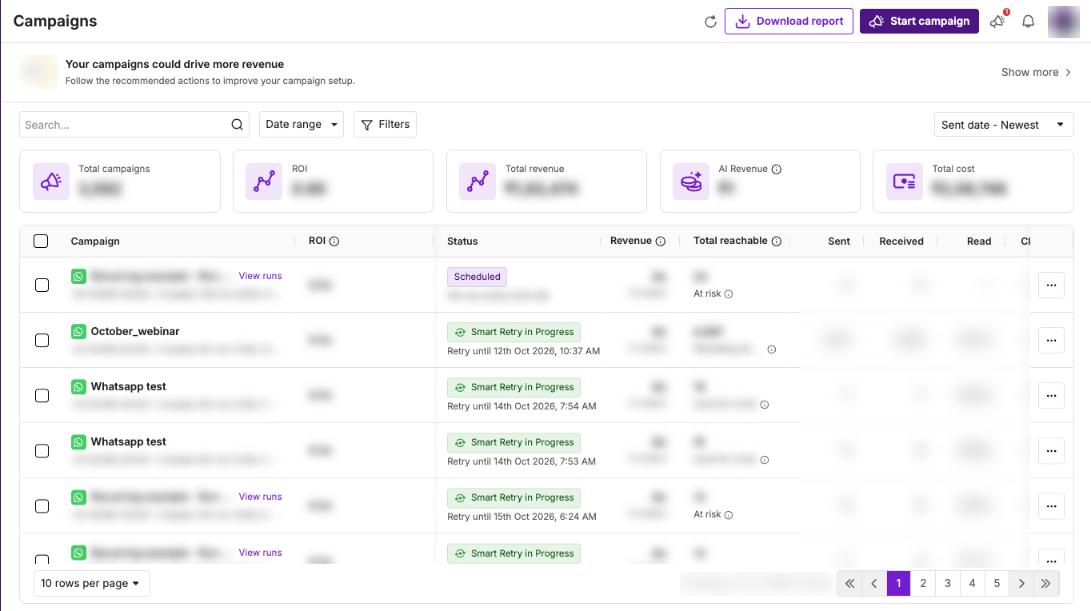
In practice: Sleepyhead ran a multi-round contest that never lost a participant to a failed WhatsApp message, and PopClub moved its points-expiry reminders from email to WhatsApp after email reminders were not getting through. If you currently run email on Klaviyo, see BIK vs Klaviyo for WhatsApp and email.
When BIK is not the right fit
- Your customers do not use WhatsApp. In markets where WhatsApp adoption is low, an email and SMS platform may be all you need.
- You only send a monthly newsletter and run no retention programme. A basic email tool covers that. Smaller brands that want WhatsApp, SMS and email journeys can start on BIK's startup plan.
- You are deeply invested in one email platform's advanced features and only want to add WhatsApp. A WhatsApp-only tool alongside it can work, at the cost of two customer profiles.
FAQ
Is WhatsApp marketing better than SMS?
For rich, two-way messages, usually yes: WhatsApp supports images, buttons, catalogues and replies, and Chatarmin's 2026 data shows a 12% campaign click rate, similar to the 9% to 14.5% SMS range from Omnisend and Klaviyo. SMS still wins as a fallback for customers without WhatsApp and for critical alerts, and in India it is cheaper per marketing message.
What is the open rate of WhatsApp marketing?
The best-documented 2026 figure is a 79.6% weighted read rate, with a 72.05% median per brand, from Chatarmin's analysis of 11.8 million delivered messages. Single programmes vary: PopClub's reminders on BIK saw 54%. Claims of 98% rarely state a method.
Is WhatsApp better than email marketing for ecommerce?
WhatsApp gets far more clicks per message: about 12% versus 0.74% to 1.69% for email campaigns in the sources above. Email is much cheaper per send and converts well in automated flows (1.49% per Omnisend), so most brands should run both.
What is the ROI of WhatsApp marketing?
Chatarmin reports €1.03 of attributed revenue per WhatsApp campaign message across its customers. Against Meta's marketing rate of about ₹0.8631 in India or about $0.025 in the US, that suggests a strong return, but attribution windows differ by platform, so measure your own revenue per message.
How much does WhatsApp cost compared with SMS?
In India, a WhatsApp marketing message costs ₹0.8631 at Meta's base rate versus ₹0.16 to ₹0.25 for SMS on MSG91, while WhatsApp utility messages cost ₹0.115. In the US, WhatsApp marketing is about $0.025 against roughly $0.011 to $0.013 for an SMS segment on Twilio.
Can one platform send WhatsApp, SMS and email?
Yes. BIK sends WhatsApp, SMS, email, RCS and more from one customer profile, with fallback from WhatsApp to SMS or email and frequency caps across channels.
Sources
- Chatarmin: WhatsApp Benchmark Report 2026
- Omnisend: SMS marketing benchmarks
- Klaviyo: Email marketing benchmarks by industry
- Klaviyo: SMS benchmarks by industry
- ClickMinded: SMS marketing benchmarks
- Meta for Developers: WhatsApp Business Platform pricing
- InstantDM: WhatsApp pricing in India, October 2026
- Twilio: SMS pricing, United States
- Twilio: SMS pricing, India
- MSG91: SMS pricing
- Amazon SES pricing
Related reading: BIK vs Klaviyo for WhatsApp and email, Best WhatsApp automation tools for ecommerce, How to sell on WhatsApp and Best WhatsApp marketing software for D2C brands in India.